
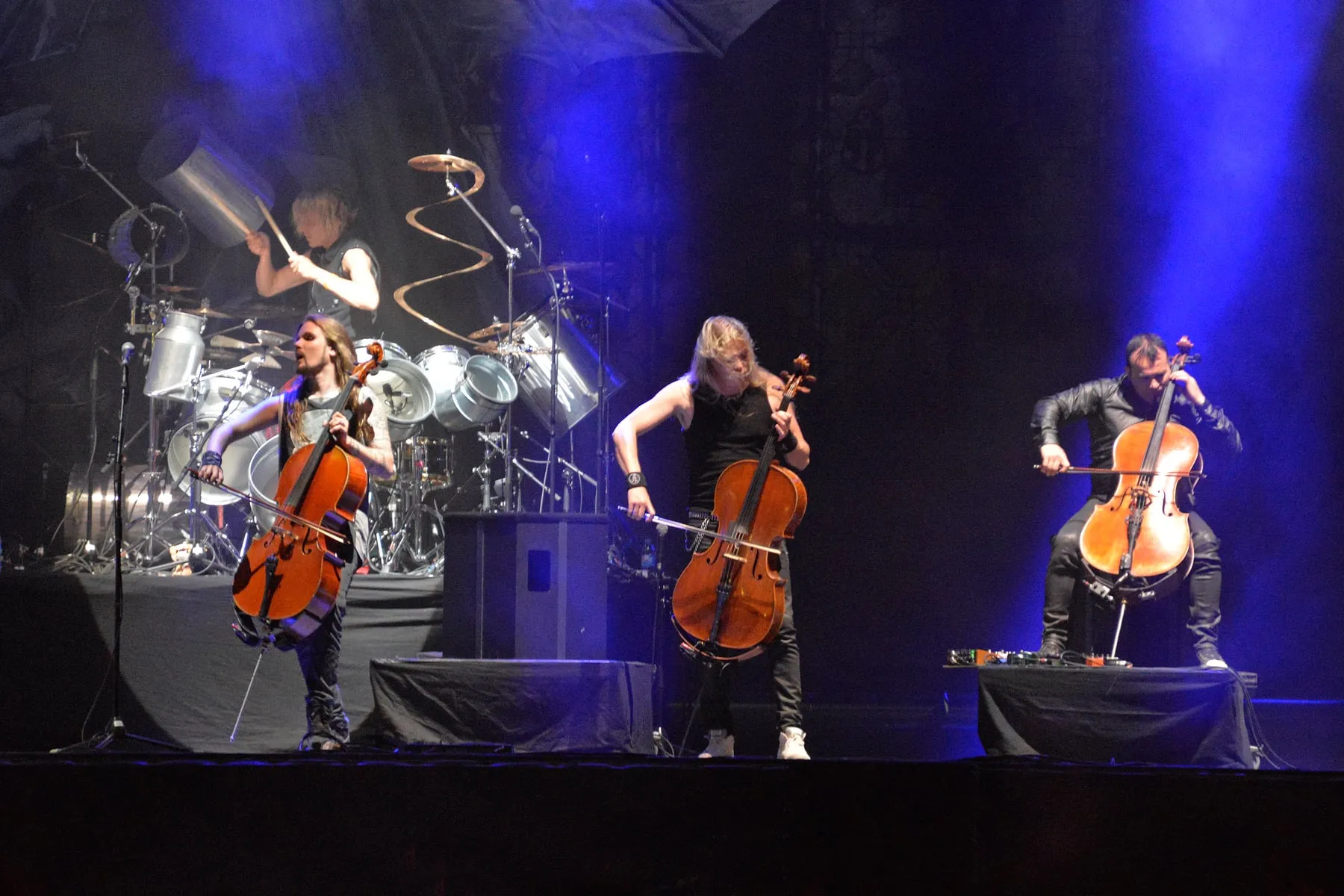
Photo by Selbymay , licensed under CC BY-SA 4.0 · Wikimedia Commons
Rank #434
Apocalyptica
From Wikipedia
Apocalyptica is a Finnish symphonic metal band from Helsinki, formed in 1993. The band is currently composed of three classically trained cellists Eicca Toppinen, Paavo Lötjönen, and Perttu Kivilaakso. Originally a classical-style Metallica tribute band, the band eventually adopted a neoclassical metal style without the use of conventional guitars and bass. They have sold over four million albums to date.
Members
- Antero Manninen
- Eicca Toppinen
- Franky Perez
- Max Lilja
- Mikko Sirén
- Paavo Lötjönen
- Perttu Kivilaakso
Discography & Previews
Browse through and click an album to open and play 30-second previews streamed from Apple Music.


Cult
2000 · 14 tracks
- 1 Path Vol. 2 (feat. Sandra Nasic) ↗ 3:24
- 2 Struggle ↗ 3:28
- 3 Romance ↗ 3:27
- 4 Pray! ↗ 4:25
- 5 In Memoriam ↗ 4:42
- 6 Hyperventilation ↗ 4:25
- 7 Beyond Time ↗ 3:58
- 8 Hope ↗ 3:25
- 9 Kaamos ↗ 4:44
- 10 Coma ↗ 6:45
- 11 Hall of the Mountain King ↗ 3:29
- 12 Until It Sleeps ↗ 3:14
- 13 Fight Fire White Fire ↗ 3:27
- 14 Path ↗ 3:06

Reflections
2003 · 18 tracks
- 1 Prologue (Apprehension) [feat. Dave Lombardo] ↗ 3:12
- 2 No Education (feat. Dave Lombardo) ↗ 3:18
- 3 Faraway ↗ 5:13
- 4 Somewhere Around Nothing (feat. Dave Lombardo) ↗ 4:10
- 5 Drive ↗ 3:22
- 6 Cohkka ↗ 4:29
- 7 Conclusion ↗ 4:07
- 8 Resurrection (feat. Dave Lombardo) ↗ 3:35
- 9 Heat ↗ 3:22
- 10 Cortége (feat. Dave Lombardo) ↗ 4:29
- 11 Pandemonium ↗ 2:06
- 12 Toreador II ↗ 3:57
- 13 Epilogue (Relief) ↗ 3:29
- 14 Seemann (feat. Nina Hagen) ↗ 4:43
- 15 Faraway Vol. 2 (feat. Linda & Dave Lombardo) ↗ 5:13
- 16 Delusion ↗ 4:11
- 17 Peridition ↗ 4:10
- 18 Leave Me Alone ↗ 4:10


Worlds Collide
2007 · 13 tracks
- 1 Worlds Collide ↗ 4:27
- 2 Grace (feat. Hotei) ↗ 4:10
- 3 I'm Not Jesus (feat. Corey Taylor) [International Version] ↗ 3:35
- 4 Ion ↗ 3:47
- 5 Helden (feat. Till Lindemann) ↗ 4:18
- 6 Stroke ↗ 4:33
- 7 Last Hope (feat. Dave Lombardo) ↗ 4:48
- 8 I Don't Care (feat. Adam Gontier) ↗ 3:57
- 9 Burn ↗ 4:18
- 10 S.O.S (Anything but Love) [feat. Cristina Scabbia] ↗ 4:20
- 11 Peace ↗ 5:49
- 12 I'm Not Jesus (feat. Corey Taylor) [Pain Remix] ↗ 3:44
- 13 I'm Not Jesus (feat. Corey Taylor) [Albert Vorne Mix] ↗ 8:03

7th Symphony
2010 · 15 tracks
- 1 At the Gates of Manala ↗ 7:03
- 2 End of Me (feat. Gavin Rossdale) ↗ 3:29
- 3 Not Strong Enough (feat. Brent Smith) ↗ 3:37
- 4 2010 (feat. Dave Lombardo) ↗ 4:31
- 5 Through Paris in a Sportscar ↗ 3:52
- 6 Beautiful ↗ 2:19
- 7 Broken Pieces (feat. Lacey) ↗ 3:54
- 8 On the Rooftop with Quasimodo ↗ 4:59
- 9 Bring Them to Light (feat. Joseph Duplantier) ↗ 4:45
- 10 Sacra ↗ 4:22
- 11 Rage of Poseidon ↗ 8:41
- 12 The Shadow of Venus ↗ 6:06
- 13 Spiral Architect ↗ 3:17
- 14 Return Game ↗ 4:17
- 15 Not Strong Enough (feat. Doug Robb & Hoobastank) ↗ 3:35

Shadowmaker
2015 · 12 tracks
- 1 I - III - V Seed of Chaos ↗ 1:27
- 2 Cold Blood ↗ 3:28
- 3 Shadowmaker ↗ 7:35
- 4 Slow Burn ↗ 4:44
- 5 Reign of Fear ↗ 6:54
- 6 Hole in My Soul ↗ 4:06
- 7 House of Chains ↗ 3:29
- 8 Riot Lights ↗ 6:40
- 9 Come Back Down ↗ 4:25
- 10 Sea Song (You Waded out) ↗ 4:54
- 11 Till Death Do Us Part ↗ 7:51
- 12 Dead Man's Eyes ↗ 9:43


Plays Metallica, Vol. 2
2024 · 10 tracks
- 1 Ride the Lightning ↗ 6:47
- 2 St. Anger ↗ 4:18
- 3 The Unforgiven II ↗ 4:05
- 4 Blackened (feat. Dave Lombardo) ↗ 5:59
- 5 The Call of Ktulu ↗ 7:27
- 6 The Four Horsemen (feat. Robert Trujillo) ↗ 4:46
- 7 Holier than Thou ↗ 3:43
- 8 To Live Is to Die ↗ 3:01
- 9 One (feat. James Hetfield & Robert Trujillo) ↗ 9:35
- 10 One (feat. Robert Trujillo) [Instrumental] ↗ 9:35
-
 Plays Metallica by Four CellosApocalyptica19968 tracks
 -
 CultApocalyptica200014 tracks
 -
 ReflectionsApocalyptica200318 tracks
 -
 ApocalypticaApocalyptica200511 tracks
 -
 Worlds CollideApocalyptica200713 tracks
 -
 7th SymphonyApocalyptica201015 tracks
 -
 ShadowmakerApocalyptica201512 tracks
 -
 Cell-0Apocalyptica20209 tracks
 -
 Plays Metallica, Vol. 2Apocalyptica202410 tracks
Deep Dive
Overview
Apocalyptica is a Finnish symphonic metal band that emerged from Helsinki in 1993 and has become one of the most distinctive acts in modern heavy music. The band stands apart in the rock and metal landscape by foregoing conventional guitars and bass entirely, instead building their sound around three classically trained cellists performing original compositions and arrangements rooted in neoclassical metal aesthetics. Since their formation, Apocalyptica has sold over four million albums worldwide, establishing themselves as a significant presence in the symphonic metal genre and proving that orchestral instrumentation could anchor heavy, dynamic rock music.
Formation Story
Apocalyptica was founded in 1993 in Helsinki, Finland, initially as a classical-style Metallica tribute band. The core of the group formed around three cellists—Eicca Toppinen, Paavo Lötjönen, and Perttu Kivilaakso—who were classically trained musicians drawn to the idea of reimagining heavy metal through a string ensemble lens. Rather than simply covering Metallica, the band’s founding vision was to strip away the electric guitars and drums and translate the intensity and structure of metal into an arrangement language centered on the cello. This unconventional starting point proved to be their most enduring strength, as what began as a tribute project became the foundation for an entirely original musical identity.
Breakthrough Moment
Apocalyptica’s debut album, Plays Metallica by Four Cellos (1996), introduced their concept to a wider audience and established the template that would define their early career. The album’s success demonstrated that there was genuine commercial and artistic appetite for metal music played on string instruments, breaking down assumptions about what rock and metal music could sound like. This record, built entirely around cello arrangements of Metallica compositions, put Apocalyptica on the map and set them on a path toward developing their own original material while maintaining the orchestral approach that made them unique.
Peak Era
Apocalyptica’s most creatively expansive period extended through the 2000s, marked by the release of Inquisition Symphony (1998), Cult (2000), Reflections (2003), and their self-titled Apocalyptica (2005). During these years, the band moved decisively toward original compositions while continuing to refine their neoclassical metal sound. The release of Seemann \ Reflections Revised (2004) showed the band’s willingness to revisit and reimagine their own material. By the time they released their self-titled 2005 album, Apocalyptica had fully matured as compositional voices, with Toppinen, Lötjönen, and Kivilaakso writing and arranging pieces that showcased both technical virtuosity and emotional depth. The band continued this creative momentum into the 2010s with albums like 7th Symphony (2010) and Shadowmaker (2015), maintaining their position as leaders in the symphonic metal space.
Musical Style
Apocalyptica’s sound is defined by the absence of conventional rock instruments—no electric guitars, no bass guitar, no drums. Instead, three cellists provide the melodic, harmonic, and rhythmic foundation of every arrangement. The cello, an instrument traditionally associated with classical music, becomes the engine of heavy, fast-paced metal compositions. This instrumentation forces a compositional approach rooted in classical technique and string writing while maintaining the intensity, tempo variations, and dramatic arcs of metal music. The band’s style draws from neoclassical metal, with its emphasis on rapid arpeggios, complex arrangements, and instrumental prowess, yet filtered entirely through the tonal and technical vocabulary of string music. Melodies that might be played on a guitar riff become intricate cello passages; rhythm sections that would typically rely on drums and bass are suggested through pizzicato playing, bow articulation, and interweaving cell parts. The result is symphonic in texture yet decidedly metal in energy and structural logic.
Major Albums
Plays Metallica by Four Cellos (1996)
Apocalyptica’s debut cemented the viability of translating heavy metal through string arrangements, demonstrating that their concept could resonate with a substantial audience and establishing themselves as more than a novelty act.
Inquisition Symphony (1998)
The band’s second album moved toward original compositions while maintaining their signature all-cello approach, signaling their ambition to establish themselves as songwriters rather than merely tribute interpreters.
Cult (2000)
This album further solidified Apocalyptica’s position in symphonic metal, showcasing increased compositional confidence and a more fully realized vision of what cello-driven metal could achieve.
Apocalyptica (2005)
The band’s self-titled offering represented a creative peak, with Toppinen, Lötjönen, and Kivilaakso collaborating on original material that balanced technical virtuosity with melodic accessibility, proving their maturity as composers.
7th Symphony (2010)
This album continued the band’s trajectory of original work, maintaining their symphonic metal credentials while exploring new compositional directions within their signature cello-based framework.
Cell-0 (2020)
Apocalyptica’s most recent studio work demonstrates the band’s ability to evolve their sound while remaining rooted in their core identity as cellists pushing the boundaries of metal instrumentation.
Signature Songs
- “Master of Puppets” — A standout from their Metallica tribute debut, demonstrating how effectively metal’s most iconic riff translates to cello performance.
- “Broken Pieces” — A showcase for the band’s original composition skills and their ability to create emotionally resonant heavy music without conventional rock instrumentation.
- “Bittersweet” — Highlights the band’s exploration of melody-forward writing within the symphonic metal framework.
- “Pathetic” — Demonstrates the dynamic range possible within their all-cello arrangement approach, moving between intimate passages and intense crescendos.
Influence on Rock
Apocalyptica’s most significant contribution to rock and metal music has been the expansion of what instrumentation and compositional approaches qualify as legitimate within the genre. By proving that heavy, complex metal music could be performed entirely on orchestral instruments—specifically the cello—the band challenged fundamental assumptions about rock’s sonic palette. Their success opened pathways for other unconventional instrumental projects and influenced a broader acceptance of symphonic and orchestral approaches within metal. The band demonstrated that technical virtuosity drawn from classical training could serve metal’s aesthetic and energy without compromise, influencing the development of symphonic metal as a distinct subgenre and proving that innovation in rock could come through instrumentation and arrangement as much as through songwriting or production.
Legacy
Apocalyptica’s legacy rests on their sustained commitment to an original concept that has remained commercially and artistically viable for over three decades. The band’s sale of over four million albums positions them among the more successful metal acts of the modern era, despite their fundamental departure from rock’s conventional instrumental setup. Their 2024 release, Plays Metallica, Vol. 2, demonstrates their willingness to return to their roots while continuing to issue original material, showing that both their early tribute concept and their original compositions retain cultural relevance. The band has established themselves as proof that genre boundaries in rock are permeable and that technical mastery combined with a clear artistic vision can sustain a career even when that vision initially appears unlikely or commercially risky.
Fun Facts
- All three core members of Apocalyptica—Eicca Toppinen, Paavo Lötjönen, and Perttu Kivilaakso—are classically trained cellists, giving the band a foundation in formal orchestral technique that distinguishes them from most rock musicians.
- The band’s debut album Plays Metallica by Four Cellos was recorded with four cellists, whereas the group later stabilized around the three-cellist lineup that has defined their sound.
- Apocalyptica’s discography spans 28 years from their 1996 debut to 2024, demonstrating remarkable longevity in a music industry often defined by shorter-lived trends.
- The band has maintained relative stability in their core lineup, with the same three cellists—Toppinen, Lötjönen, and Kivilaakso—anchoring the project since its inception.