
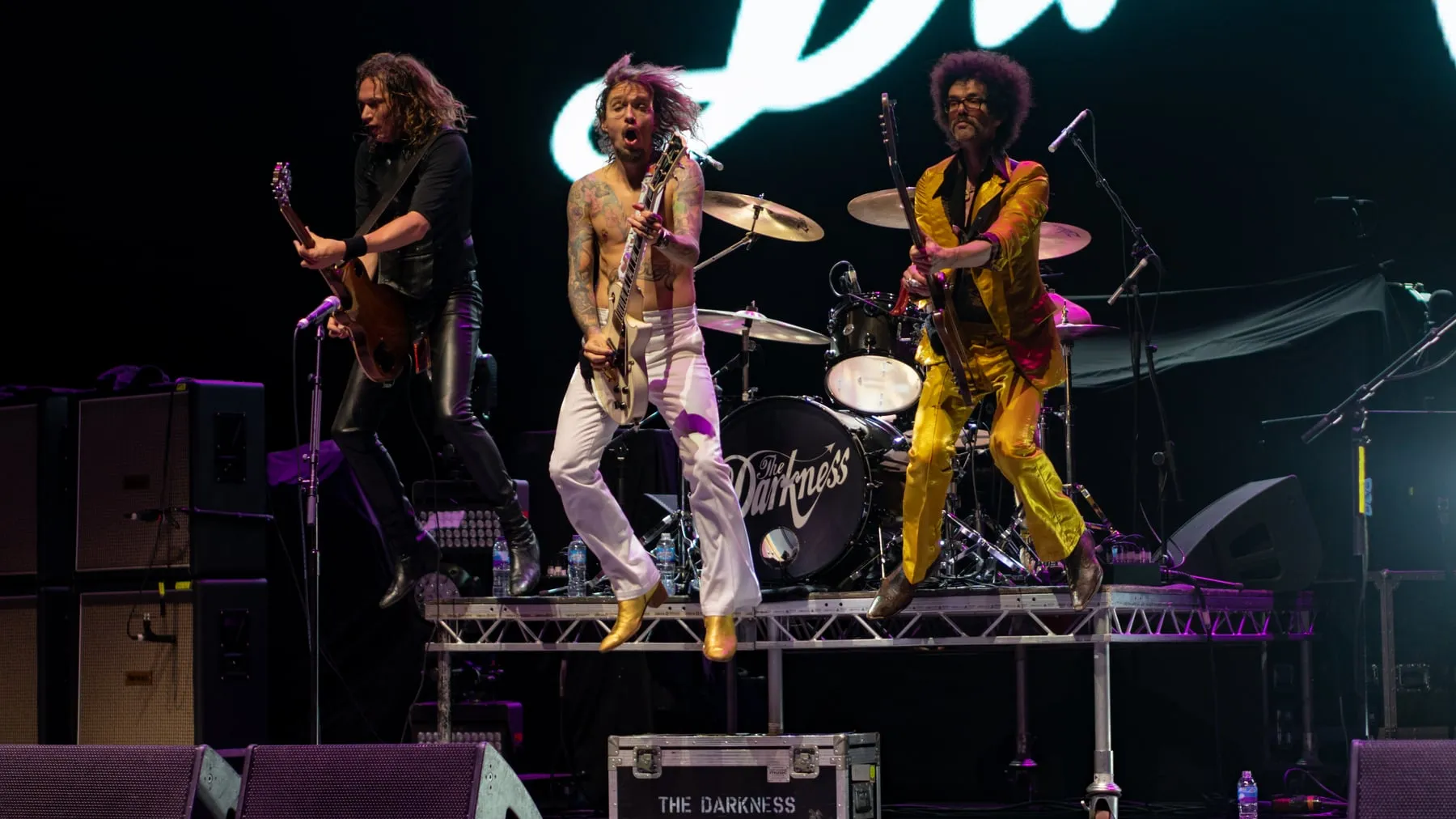
Photo by Raph_PH , licensed under CC BY 2.0 · Wikimedia Commons
Rank #433
The Darkness
From Wikipedia
The Darkness are a British hard rock band formed in Lowestoft in 2000. The band consists of the Hawkins brothers Justin Hawkins & Dan Hawkins (guitar), Frankie Poullain (bass) and Rufus Tiger Taylor (drums).
Members
- Dan Hawkins (2000–present)
- Ed Graham · drum kit (2000–2014)
- Frankie Poullain · bass guitar (2000–present)
- Justin Hawkins (2000–present)
- Rufus Tiger Taylor · drum kit (2015–present)
- Emily Dolan Davies · drum kit (?–2015)
Discography & Previews
Browse through and click an album to open and play 30-second previews streamed from Apple Music.
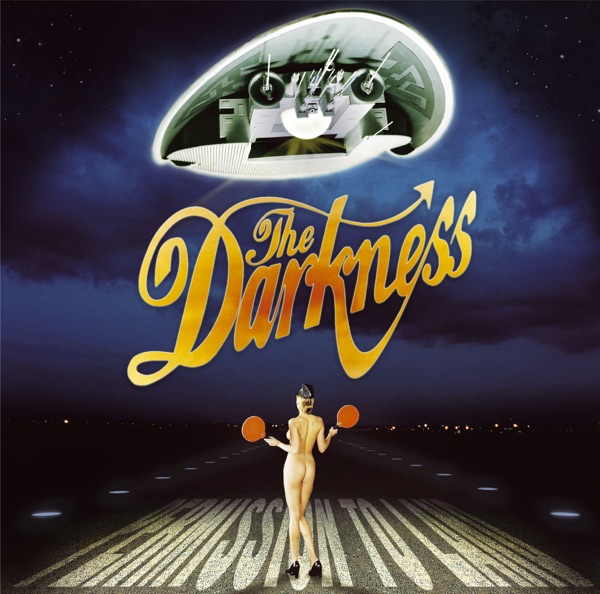
Permission to Land
2003 · 11 tracks
- 1 Black Shuck ↗ 3:20
- 2 Get Your Hands Off My Woman ↗ 2:46
- 3 Growing On Me ↗ 3:31
- 4 I Believe in a Thing Called Love ↗ 3:36
- 5 Love Is Only a Feeling ↗ 4:20
- 6 Givin' Up ↗ 3:35
- 7 Stuck in a Rut ↗ 3:18
- 8 Friday Night ↗ 2:56
- 9 Love On the Rocks With No Ice ↗ 5:57
- 10 Holding My Own ↗ 4:57
- 11 Makin' Out ↗ 3:41

Hot Cakes
2012 · 15 tracks
- 1 Every Inch of You ↗ 3:05
- 2 Nothin's Gonna Stop Us ↗ 2:45
- 3 With a Woman ↗ 3:41
- 4 Keep Me Hangin' On ↗ 3:01
- 5 Living Each Day Blind ↗ 5:07
- 6 Everybody Have a Good Time ↗ 4:48
- 7 She Just a Girl, Eddie ↗ 3:47
- 8 Forbidden Love ↗ 3:50
- 9 Concrete ↗ 3:52
- 10 Street Spirit (Fade Out) ↗ 3:07
- 11 Love Is Not the Answer ↗ 3:42
- 12 I Can't Believe It's Not Love (Acoustic Demo) ↗ 3:44
- 13 Love Is Not the Answer (Acoustic Demo) ↗ 3:46
- 14 Pat Pong Ladies ↗ 3:57
- 15 Cannonball (Long Version) ↗ 4:20


Pinewood Smile
2017 · 10 tracks

Easter Is Cancelled
2019 · 10 tracks


Dreams on Toast
2025 · 10 tracks
-
 Permission to LandThe Darkness200311 tracks
 -
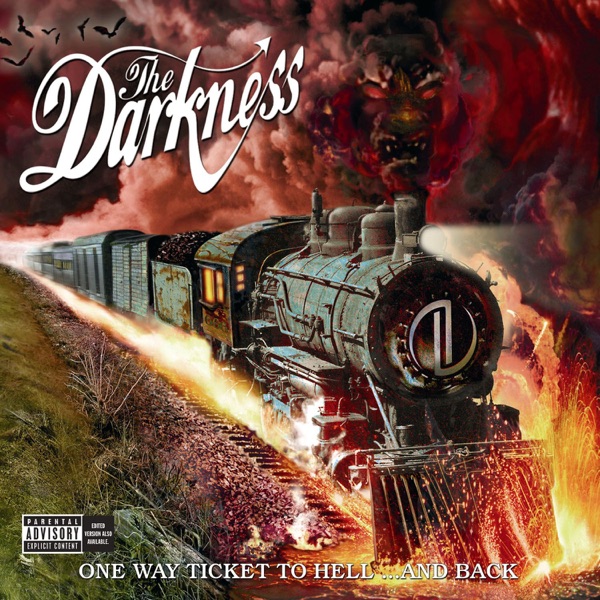
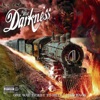 One Way Ticket to Hell …and BackThe Darkness200510 tracks
 -
 Hot CakesThe Darkness201215 tracks
 -
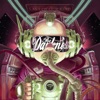 Last of Our KindThe Darkness201510 tracks
 -
 Pinewood SmileThe Darkness201710 tracks
 -
 Easter Is CancelledThe Darkness201910 tracks
 -
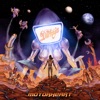 MotorheartThe Darkness20219 tracks
 -
 Dreams on ToastThe Darkness202510 tracks
Deep Dive
Overview
The Darkness are a British hard rock band formed in Lowestoft in 2000. Anchored by brothers Justin and Dan Hawkins on vocals and guitar respectively, alongside bassist Frankie Poullain and drummer Rufus Tiger Taylor, the band occupies a distinct space in early-2000s rock by reviving glam rock’s theatrical excess and sonic bombast within a contemporary hard rock framework. Their arrival marked a deliberate departure from the grunge legacy and nu-metal dominance of the preceding decade, instead mining the guitar-driven swagger and melodic clarity of 1970s rock heroes.
Formation Story
The Darkness coalesced in Lowestoft, a coastal town in Suffolk, England, where brothers Justin and Dan Hawkins had grown up surrounded by classic rock and glam influences. The formation of the band in 2000 brought together Justin Hawkins’ distinctive falsetto vocals and theatrical stage presence, Dan Hawkins’ guitar work, Frankie Poullain on bass, and Ed Graham on drums, establishing the core unit that would carry the band through its initial run. The band emerged from a music scene largely overshadowed by post-Britpop guitar rock and the emerging metal-rap fusion of the late 1990s, yet their members shared a conviction that hard rock, stripped of irony and played with unabashed commitment to melodic hooks and guitar-driven spectacle, retained untapped commercial potential.
Breakthrough Moment
The Darkness achieved significant breakthrough with the release of their debut album Permission to Land in 2003. The record’s blend of hard rock crunch, glam-inflected production, and anthemic chorus writing resonated with audiences fatigued by the sonic austerity of post-grunge rock, propelling the band into the mainstream rock conversation. Permission to Land established their signature sound and introduced their live reputation for high-energy, visually arresting performances that channeled the exuberance of 1970s arena rock into a 2000s context.
Peak Era
The band’s peak period extended from 2003 through the mid-2010s, marked by a succession of studio albums that refined their hard rock-glam fusion. Following Permission to Land, they released One Way Ticket to Hell …and Back in 2005, consolidating their audience and demonstrating their ability to sustain commercial momentum. The 2012 album Hot Cakes represented a continued commitment to the band’s core sonic DNA, while Last of Our Kind in 2015 saw the introduction of Rufus Tiger Taylor on drums, replacing Ed Graham and marking a significant lineup change. This era established The Darkness as consistent touring draw and recording presence, maintaining visibility even as rock radio’s cultural centrality diminished in the streaming era.
Musical Style
The Darkness function as a direct conduit from 1970s glam rock and hard rock into the 21st century. Justin Hawkins’ vocal approach—embracing his considerable range and unafraid of high registers and theatrical delivery—recalls the melodic fearlessness of glam-era frontmen, while the band’s rhythm section provides the bottom-end weight of hard rock. Dan Hawkins’ guitar work emphasizes hook-laden riffs, soaring lead passages, and production clarity over the distortion-heavy murk that dominated much alternative metal; the interplay between vocal melody and guitar melody defines their compositions. The band’s songwriting privileges accessible, sing-along choruses and narrative specificity over the abstract imagery common in their alternative rock contemporaries. Their sound evolved gradually across their catalog, incorporating production refinements and varying degrees of experimentation, but the foundational commitment to melodic clarity, rock musicianship, and theatrical presentation remained consistent from album to album.
Major Albums
Permission to Land (2003)
The debut that established The Darkness as serious chart contenders, featuring the melodic hard rock and glam-influenced production that became their signature. The album proved that audiences remained receptive to guitar-driven rock built on hooks and craft rather than irony or deconstructionism.
One Way Ticket to Hell …and Back (2005)
The follow-up demonstrated the band could sustain quality and momentum, offering further refinement of their glam-rock-meets-hard-rock aesthetic and confirming their status as more than a one-album phenomenon.
Hot Cakes (2012)
A return to studio recording after a period of relative quiet, Hot Cakes reinforced the band’s commitment to their core sound and proved their appeal remained intact despite shifts in mainstream rock consumption.
Last of Our Kind (2015)
Marked by the arrival of Rufus Tiger Taylor on drums, this album represented both continuity and renewal, maintaining the band’s established musical direction while introducing fresh energy through its new drummer.
Motorheart (2021)
A recent entry in their catalog demonstrating the band’s ongoing creative engagement, released well into the streaming era and illustrating their sustained output beyond their initial commercial peak.
Signature Songs
- “Permission to Land” — The title track and mission statement that defined the band’s unapologetic embrace of glam-rock maximalism within hard rock.
- “Growing on Me” — A standout from the debut album showcasing the band’s ability to craft hook-laden anthems with theatrical flair.
- “Black Shiver” — A signature vocal showcase for Justin Hawkins’ range and the band’s commitment to melodic invention.
Influence on Rock
The Darkness arrived at a moment when hard rock and heavy metal were in flux, with grunge’s legacy fading and alternative metal fragmented into numerous subgenres. By reviving glam rock’s theatrical tradition and coupling it with contemporary hard rock production values, they opened a lane for subsequent bands willing to embrace melodic excess and rock musicianship without irony. Their success in the early-to-mid 2000s demonstrated that audiences in the digital age retained appetite for hook-driven, guitar-based rock that prioritized sing-along clarity. While they did not single-handedly reverse rock’s declining mainstream radio presence, they contributed to a broader reassertion of guitar rock’s melodic and theatrical potential during a period when such assertions were culturally necessary.
Legacy
The Darkness have maintained an active touring and recording presence across two decades, proving the durability of their core appeal despite radical shifts in music consumption and radio’s declining cultural centrality. Their continued studio output into the 2020s—including Dreams on Toast in 2025—demonstrates an artist unconcerned with chasing trends, instead remaining committed to the hard rock-glam fusion that defines them. The band’s sustained live reputation and devoted fanbase across Europe and beyond attest to the authentic musicianship and theatrical energy embedded in their performances. While they occupy a different tier of historical significance than the genre’s canonical figures, their role in early-2000s rock revival and their longevity in an era hostile to traditional rock values secures their position in the decade’s musical narrative.
Fun Facts
- Justin and Dan Hawkins are brothers, with both central to the band’s songwriting and sound from formation in 2000 onward.
- The band experienced a significant lineup change in 2015 when Rufus Tiger Taylor replaced longtime drummer Ed Graham, though the core songwriting partnership of the Hawkins brothers remained intact.
- The Darkness emerged from Lowestoft, a provincial English coastal town, rather than a major music industry center, underscoring their development outside the traditional London-Manchester axis of British rock.