
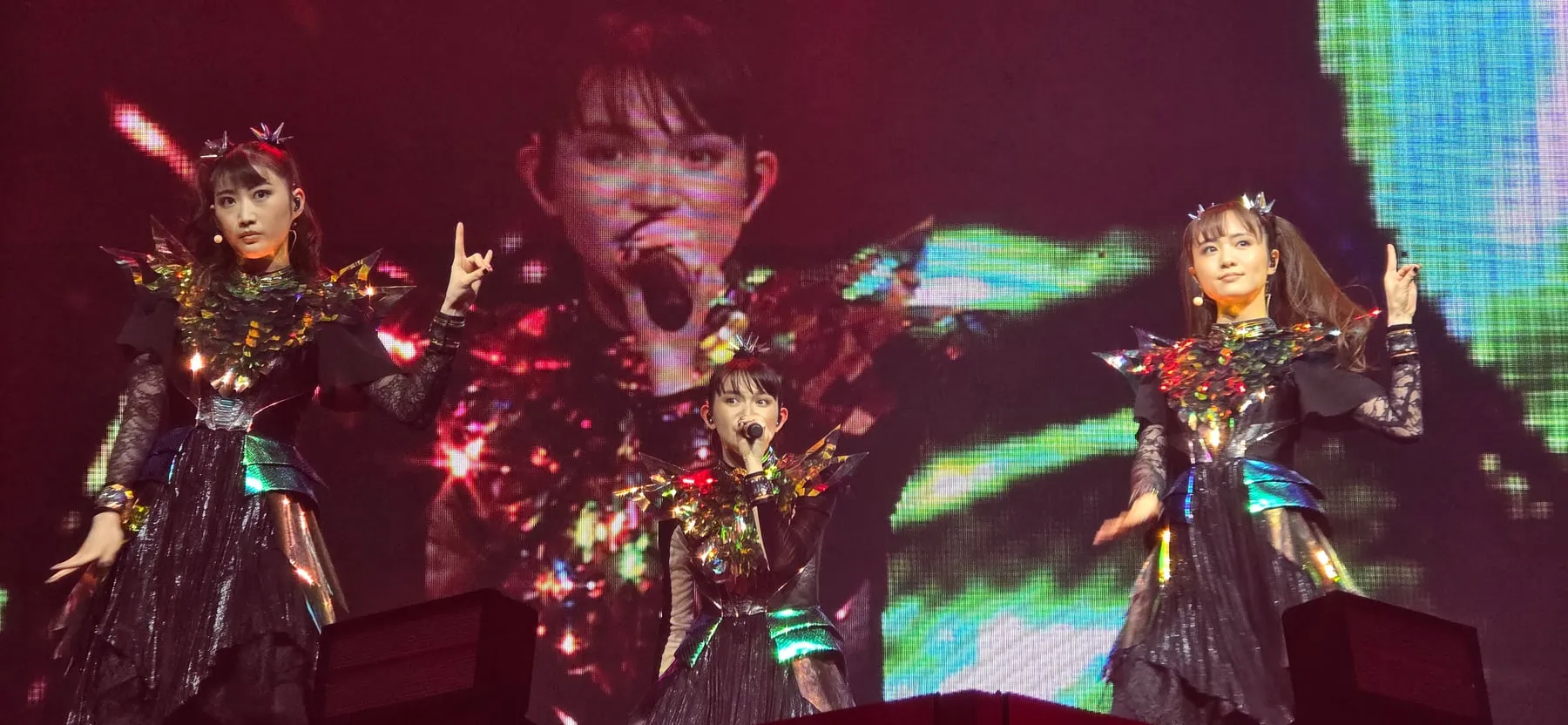
Photo by DragonFury , licensed under CC BY-SA 4.0 · Wikimedia Commons
Rank #343
Babymetal
From Wikipedia
Babymetal , stylized in all caps, is a Japanese kawaii metal band formed in Tokyo in 2010. It consists of Suzuka Nakamoto as "Su-metal", Moa Kikuchi as "Moametal", and Momoko Okazaki as "Momometal". The band is produced by Kobametal from the talent agency Amuse Inc. Their vocals are backed by instrumentation performed by a group of session musicians known as the "Kami Band".
Members
- Momoko Okazaki (2023–present)
- Moa Kikuchi
- Suzuka Nakamoto
- Yui Mizuno (?–2018)
Discography & Previews
Browse through and click an album to open and play 30-second previews streamed from Apple Music.

BABYMETAL
2014 · 15 tracks
- 1 BABYMETAL DEATH ↗ 5:46
- 2 Megitsune ↗ 4:08
- 3 Gimme Chocolate!! ↗ 3:51
- 4 Iine! ↗ 4:08
- 5 Akatsuki ↗ 5:26
- 6 Doki Doki ☆ Morning ↗ 3:46
- 7 Onedari Daisakusen ↗ 3:16
- 8 Song 4 ↗ 4:02
- 9 Uki Uki ★ Midnight ↗ 3:18
- 10 Catch Me If You Can ↗ 3:54
- 11 Rondo of Nightmare ↗ 3:34
- 12 Headbangeeeeerrrrr!!!!! ↗ 4:00
- 13 Ijime, Dame, Zettai ↗ 6:05
- 14 Road of Resistance ↗ 5:18
- 15 Gimme Chocolate!! (Live at O2 Academy Brixton, London) ↗ 5:05

METAL RESISTANCE
2016 · 12 tracks
METAL GALAXY
2019 · 14 tracks
- 1 FUTURE METAL ↗ 2:06
- 2 DA DA DANCE (feat. Tak Matsumoto) ↗ 3:51
- 3 Elevator Girl (English Version) ↗ 2:45
- 4 Shanti Shanti Shanti ↗ 3:11
- 5 Oh! MAJINAI (feat. Joakim Brodén) ↗ 3:13
- 6 Brand New Day (feat. Scott Lepage & Tim Henson) ↗ 4:08
- 7 Night Night Burn! ↗ 3:41
- 8 IN THE NAME OF ↗ 4:31
- 9 Distortion (feat. Alissa White-Gluz) ↗ 3:04
- 10 PA PA YA!! (feat. F.HERO) ↗ 3:55
- 11 Kagerou ↗ 3:31
- 12 Starlight ↗ 3:37
- 13 Shine ↗ 5:53
- 14 Arkadia ↗ 5:19

-
 BABYMETALBabymetal201415 tracks
 -
 METAL RESISTANCEBabymetal201612 tracks
 -
 METAL GALAXYBabymetal201914 tracks
 -
 THE OTHER ONEBabymetal202310 tracks
 -
 METAL FORTHBabymetal202510 tracks
Deep Dive
Overview
Babymetal is a Japanese kawaii metal band formed in Tokyo in 2010 that redefined the intersection of pop music, idol culture, and heavy metal. The project pairs high-energy vocals and stage choreography rooted in J-pop tradition with aggressive death metal and speed metal instrumentation, creating a sound that has few direct precedents in rock or metal history. Fronted by vocalists Suzuka Nakamoto (“Su-metal”), Moa Kikuchi (“Moametal”), and currently Momoko Okazaki (“Momometal”), the band is produced by Kobametal and arranged by a rotating ensemble of session musicians known as the Kami Band. Babymetal’s emergence from the Japanese entertainment industry into a global metal audience represents a significant cultural and commercial anomaly in the genre’s otherwise Western-dominated landscape.
Formation Story
Babymetal originated in 2010 in Tokyo as a project of Kobametal, a producer at the talent agency Amuse Inc. Rather than assembling a traditional metal band around guitarist and drummer, Kobametal began with young vocalists trained in J-pop and idol performance traditions, then grafted onto their delivery the sonic architecture of death metal. The original core lineup consisted of Suzuka Nakamoto and Moa Kikuchi, both schooled in the precision choreography and audience interaction protocols of Japanese pop music. The band’s visual aesthetic and performance structure drew more from that idol sphere than from metal convention, positioning teenage female singers at the center of a stage with a hidden backing ensemble. This fusion of pop idol culture and extreme metal—the term “kawaii metal” emerged to describe the resulting hybrid—was entirely novel within the metal world’s existing taxonomy.
Breakthrough Moment
Babymetal released their self-titled debut album BABYMETAL in 2014, which became the global watershed moment for the project. The album’s combination of crisp production, melodic vocal hooks, and crushing riffage attracted listeners outside traditional metal circles while maintaining the technical credibility required to be taken seriously within metal communities. The record achieved international streaming penetration and led to festival bookings and tour dates across North America and Europe, territories where Japanese metal acts had little prior presence. By the mid-2010s, Babymetal had built a devoted fanbase that treated the project with the fervor typically reserved for legacy metal bands, despite their recent formation and unconventional origin.
Peak Era
Babymetal’s most creatively expansive and commercially significant period ran from 2014 through 2019, bracketed by their debut and their third album METAL GALAXY. METAL RESISTANCE (2016) deepened and refined the formula, demonstrating that the 2014 album was not a novelty but a sustainable artistic direction. The band’s live shows during this period became increasingly elaborate, with choreography as essential to the presentation as the music itself. This era established Babymetal as a touring force, selling out venues in major cities worldwide and headlining metal festivals alongside established acts. The 2016–2019 window saw the project reach the apex of its cultural impact, generating media coverage far beyond metal journalism and attracting listeners curious about the experimental genre fusion on its own terms.
Musical Style
Babymetal’s sound melds the high-pitched, harmonically intricate vocal delivery of J-pop with the distorted guitars, blast-beat drums, and tremolo-picked riffs characteristic of death metal and speed metal. The production emphasizes clarity and separation between elements: the vocalists occupy the center, their melodies often in major keys, while the rhythm section drives underneath with minor-key chord progressions and dissonant textures. The instrumental backing, provided by the Kami Band, operates with the precision of a session ensemble rather than a traditional band’s organic chemistry, allowing for rapid stylistic shifts within single songs. Lyrically and thematically, Babymetal maintains the uplifting, community-focused messaging of J-pop while adopting some of metal’s darker visual and sonic language—a balance that would seem untenable until heard. The vocal technique relies on clarity and projection rather than the growling or screaming associated with extreme metal, preserving pop accessibility while the instruments provide metallic heaviness.
Major Albums
BABYMETAL (2014)
The debut established the kawaii metal template: pop-trained vocalists over death metal instrumentation, with melodies that could lodge in listeners’ heads despite the sonic aggression surrounding them. This album proved the hybrid was not a one-off novelty and attracted both metalheads and J-pop listeners.
METAL RESISTANCE (2016)
The follow-up refined the formula and expanded Babymetal’s sonic palette, deepening the integration of pop structure and metal dynamics. The album solidified the project’s touring foundation and cemented the project’s place in international metal consciousness.
METAL GALAXY (2019)
The third album marked the peak of Babymetal’s exploration of the kawaii metal template, combining the lessons of the first two records with enhanced production and guest contributors that signaled the project’s integration into the broader metal world.
THE OTHER ONE (2023)
Released after a lineup transition that brought Momoko Okazaki into the vocal rotation, this album demonstrated Babymetal’s capacity to evolve while maintaining the core aesthetic and musical values established over the previous decade.
Signature Songs
- Gimme Chocolate!! — The breakthrough international hit that fused J-pop earworm hooks with extreme metal instrumentation and became Babymetal’s most recognizable track globally.
- Karate — A song that balanced aggressive musicianship with soaring melodic hooks, showcasing the band’s ability to compose within pop structures while preserving metal credibility.
- Megitsune — An early composition that demonstrated the project’s connection to Japanese cultural imagery and Shinto-influenced thematic material.
- The One — A song that highlighted the vocal capabilities of the core lineup and the precision of the backing ensemble.
Influence on Rock
Babymetal’s emergence changed the conversation around what metal could be and where metal musicians could come from. They demonstrated that extreme music did not require a Western origin story or a traditionally male-coded performance mode. Their success created space in global metal discourse for Japanese artists and challenged the genre’s assumptions about vocal delivery, visual presentation, and the relationship between pop and metal. The project influenced subsequent Japanese metal and rock acts by demonstrating that fusion of traditional genres could achieve international commercial success without diluting musical aggression. More broadly, Babymetal’s integration into major metal festival lineups and their peer treatment by established metal acts signaled a shift in the genre’s cultural permeability.
Legacy
Babymetal remains active as of 2025, with the release of METAL FORTH continuing the project into its second and a half decade. The band’s ability to maintain relevance across different lineup configurations and production cycles has confirmed that the kawaii metal formula possesses sufficient artistic depth to sustain long-term interest. Babymetal’s stream counts and touring revenue place them among the highest-grossing Japanese rock acts globally, a position achieved without traditional rock-radio promotion or the institutional support structures that typically boost Western metal bands. The project’s longevity has retrospectively validated what seemed initially implausible: that a producer-driven fusion of idol culture and death metal could generate authentic fan engagement and creative sustainability.
Fun Facts
- Babymetal’s backing ensemble, the Kami Band, has remained anonymous performers, with audience members discussing lineup changes and session musician rotations online based on instrumental style variations rather than visual identification.
- The group has performed at major European metal festivals alongside bands with several decades of history, a trajectory that would be unthinkable for most acts formed in the early 2010s.
- Babymetal’s lyrics frequently reference Japanese Shinto mythology and cultural imagery, grounding the kawaii metal fusion in Japanese cultural specificity rather than generic pop-metal pastiche.
- The project emerged from Amuse Inc., a major Japanese talent agency with deep roots in the country’s entertainment industry, positioning Babymetal as an institutional experiment rather than a grassroots band formation.