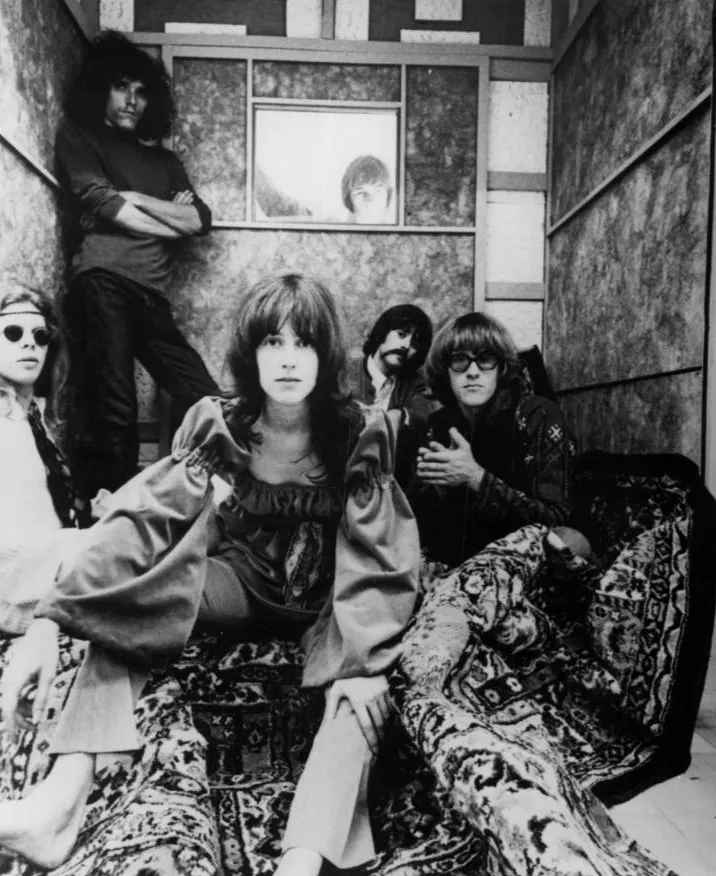
Photo by RCA Records/photographer: Herb Greene , licensed under Public domain · Wikimedia Commons
Rank #63
Jefferson Airplane
From Wikipedia
Jefferson Airplane was an American rock band formed in San Francisco in 1965. One of the pioneering bands of psychedelic rock, the group defined the San Francisco Sound and was the first from the Bay Area to achieve international commercial success. They appeared at the Monterey Pop Festival (1967), the first Isle of Wight Festival (1968) as headliners, Woodstock (1969), and Altamont Free Concert (1969). Their 1967 breakout album Surrealistic Pillow was one of the most significant recordings of the Summer of Love. Two songs from that album, "Somebody to Love" and "White Rabbit", are among Rolling Stone's "500 Greatest Songs of All Time".
Members
- Jack Casady (1965–1972)
- Jorma Kaukonen (1965–1972)
- Marty Balin (1965–1971)
- Paul Kantner (1965–1972)
- Signe Toly Anderson (1965–1966)
- Grace Slick (1966–1972)
- Spencer Dryden (1966–1970)
- Joey Covington (1970–1972)
- Papa John Creach (1970–1972)
- Bob Harvey
- John Barbata
Discography & Previews
Browse through and click an album to open and play 30-second previews streamed from Apple Music.

Jefferson Airplane Takes Off
1966 · 19 tracks
- 1 Blues from an Airplane ↗ 2:10
- 2 Let Me In ↗ 2:56
- 3 Bringing Me Down ↗ 2:22
- 4 It's No Secret ↗ 2:38
- 5 Tobacco Road ↗ 3:28
- 6 Come Up the Years ↗ 2:31
- 7 Run Around ↗ 2:37
- 8 Let's Get Together ↗ 3:34
- 9 Don't Slip Away ↗ 2:32
- 10 Chauffeur Blues ↗ 2:26
- 11 And I Like It ↗ 3:16
- 12 Runnin' 'Round This World ↗ 2:23
- 13 High Flying Bird ↗ 2:33
- 14 It's Alright ↗ 2:15
- 15 Go To Her (Version One) ↗ 4:06
- 16 Let Me In (Original Uncensored/Deleted Version) ↗ 3:28
- 17 Run Around (Original Uncensored Version) ↗ 2:32
- 18 Chauffeur Blues (Alternate Version) ↗ 2:47
- 19 And I Like It (Alternate Version) ↗ 10:36
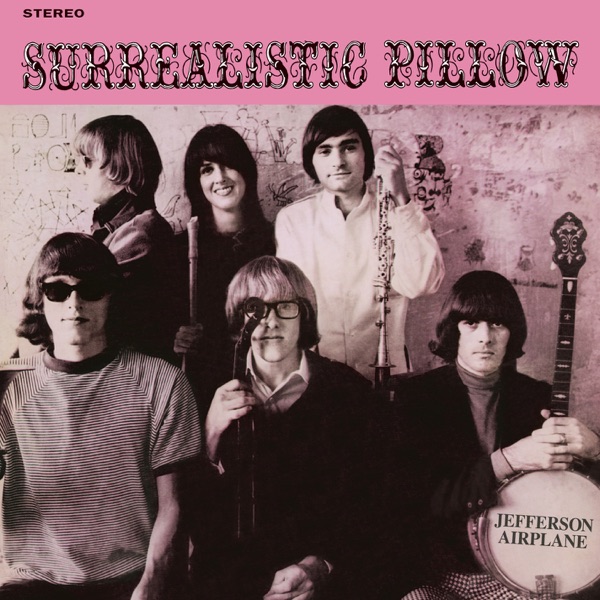
Surrealistic Pillow
1967 · 17 tracks
- 1 She Has Funny Cars ↗ 3:08
- 2 Somebody to Love ↗ 2:55
- 3 My Best Friend ↗ 3:00
- 4 Today ↗ 2:58
- 5 Comin' Back to Me ↗ 5:15
- 6 3/5 Of a Mile In 10 Seconds ↗ 3:40
- 7 D. C. B. A. 25 ↗ 2:36
- 8 How Do You Feel ↗ 3:29
- 9 Embryonic Journey ↗ 1:52
- 10 White Rabbit ↗ 2:31
- 11 Plastic Fantastic Lover ↗ 2:33
- 12 In the Morning ↗ 6:20
- 13 J. P. P. Mc Step B. Blues ↗ 2:36
- 14 Go to Her ↗ 4:02
- 15 Come Back Baby ↗ 2:56
- 16 Somebody to Love (Mono Single Version) ↗ 2:59
- 17 White Rabbit/D.C.B.A.-25 (Hidden Instrumental Track) ↗ 5:21

Crown of Creation
1968 · 15 tracks
- 1 Lather ↗ 2:57
- 2 In Time ↗ 4:12
- 3 Triad ↗ 4:54
- 4 Star Track ↗ 3:09
- 5 Share a Little Joke ↗ 3:07
- 6 Chushingura ↗ 1:18
- 7 If You Feel ↗ 3:22
- 8 Crown of Creation ↗ 2:54
- 9 Ice Cream Phoenix ↗ 3:00
- 10 Greasy Heart ↗ 3:26
- 11 The House at Pooneil Corners ↗ 5:50
- 12 Ribumbabap Rubadubaoumoum ↗ 1:30
- 13 Would You Like a Snack ↗ 2:38
- 14 Share A Little Joke (Mono Single Version) ↗ 3:06
- 15 The Saga Of Sydney Spacepig ↗ 10:30
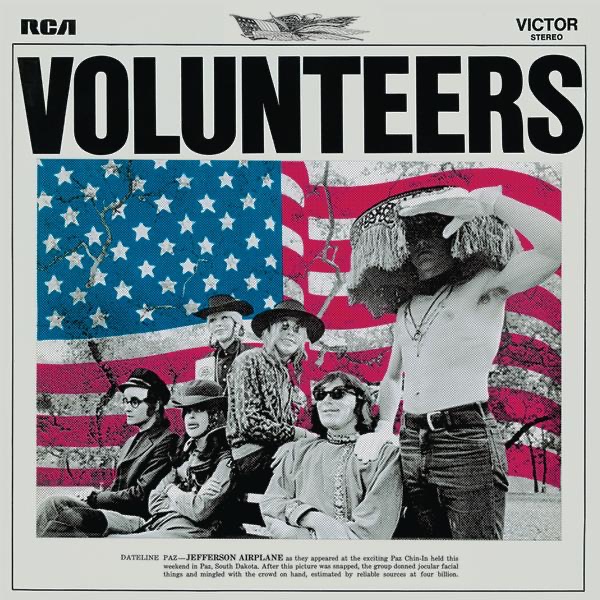
Volunteers
1969 · 15 tracks
- 1 We Can Be Together ↗ 5:48
- 2 Good Shepherd ↗ 4:23
- 3 The Farm ↗ 3:12
- 4 Hey Frederick ↗ 8:33
- 5 Turn My Life Down ↗ 2:58
- 6 Wooden Ships ↗ 6:26
- 7 Eskimo Blue Day ↗ 6:37
- 8 A Song for All Seasons ↗ 3:31
- 9 Meadowlands ↗ 1:06
- 10 Volunteers ↗ 2:03
- 11 Good Shepherd (Live) [Bonus Track] ↗ 7:25
- 12 Somebody to Love (Live) [Bonus Track] ↗ 4:11
- 13 Plastic Fantastic Lover (Live) [Bonus Track] ↗ 3:22
- 14 Wooden Ships (Live) [Bonus Track] ↗ 7:00
- 15 Volunteers (Live) [Bonus Track] ↗ 3:27

Bark
1971 · 13 tracks
- 1 When the Earth Moves Again ↗ 3:55
- 2 Feel So Good ↗ 4:37
- 3 Crazy Miranda ↗ 3:24
- 4 Pretty as You Feel ↗ 4:30
- 5 Wild Turkey ↗ 4:45
- 6 Law Man ↗ 2:42
- 7 Rock and Roll Island ↗ 3:45
- 8 Third Week in the Chelsea ↗ 4:35
- 9 Never Argue with a German If You're Tired or European Song ↗ 4:32
- 10 Thunk ↗ 2:59
- 11 War Movie ↗ 4:43
- 12 Pretty as You Feel (Single Edit) ↗ 3:09
- 13 Feel So Good (Extended Version) ↗ 9:25


Jefferson Airplane
1989 · 13 tracks
-
 Jefferson Airplane Takes OffJefferson Airplane196619 tracks
 -
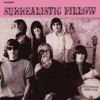 Surrealistic PillowJefferson Airplane196717 tracks
 -
 Crown of CreationJefferson Airplane196815 tracks
 -
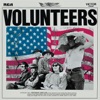 VolunteersJefferson Airplane196915 tracks
 -
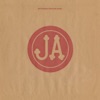 BarkJefferson Airplane197113 tracks
 -
 Long John SilverJefferson Airplane19729 tracks
 -
 Jefferson AirplaneJefferson Airplane198913 tracks
Deep Dive
Overview
Jefferson Airplane was an American rock band formed in San Francisco in 1965 that became one of the most significant voices of psychedelic rock. Emerging from the Bay Area at the height of the counterculture movement, they defined the San Francisco Sound and were the first band from that region to achieve substantial international commercial success. Their combination of blues-rock instrumentation, experimental production, and politically conscious songwriting made them emblematic of the era’s musical and social upheaval.
Formation Story
Jefferson Airplane coalesced in San Francisco in 1965, drawing from the city’s emerging folk and electric blues scenes. The original lineup featured Marty Balin on vocals, Paul Kantner on rhythm guitar, Jorma Kaukonen on lead guitar, Jack Casady on bass, and Signe Toly Anderson as the first vocalist, with drummer Spencer Dryden joining in 1966. San Francisco’s geographic isolation from the commercial music industry and its thriving underground club scene allowed the band to develop a distinctive sound rooted in both acoustic folk traditions and amplified rock experimentation. The addition of Grace Slick in 1966 marked a turning point; her powerful, wide-ranging contralto voice and theatrical presence transformed the group’s dynamic and would become central to their identity.
Breakthrough Moment
Jefferson Airplane’s breakthrough came with Surrealistic Pillow in 1967, an album that captured the essence of the Summer of Love and became one of the decade’s most significant recordings. Two tracks from that album, “Somebody to Love” and “White Rabbit,” transcended their moment to become enduring classics, later recognized among Rolling Stone’s “500 Greatest Songs of All Time.” The album’s commercial and critical success propelled the band to national prominence and established them as the leading musical voice of San Francisco’s psychedelic movement. Their appearance at the Monterey Pop Festival in 1967 further cemented their status as pioneers of the new sound.
Peak Era
Jefferson Airplane’s peak period spanned from 1967 through the early 1970s, during which they released a succession of albums that balanced commercial appeal with artistic ambition. After Bathing at Baxter’s arrived in 1967, followed by Crown of Creation in 1968, Volunteers in 1969, and Bark in 1971. These years saw the band at festival appearances that defined the era: the first Isle of Wight Festival in 1968 as headliners, the legendary Woodstock Festival in 1969, and the ill-fated Altamont Free Concert later that same year. By the early 1970s, internal tensions and evolving musical directions began to fragment the group, leading to their initial dissolution in 1972 after releasing Long John Silver.
Musical Style
Jefferson Airplane’s sound fused blues-rock foundations with psychedelic arrangements, modal folk influences, and increasingly ambitious studio production. Jorma Kaukonen’s lead guitar work ranged from traditional blues phrasing to textural, effects-laden soundscapes, while Jack Casady’s bass playing provided melodic counterpoint rather than simple rhythmic anchor. The rhythm section, anchored by drummer Spencer Dryden until 1970 and then Joey Covington, drove the band’s grooves with a blend of hard-rock propulsion and jazz-influenced flexibility. Grace Slick’s vocals—capable of both delicate phrasing and raw power—contrasted with Marty Balin’s gentler tenor, and the interplay between the two singers became a signature element. Paul Kantner’s songwriting and guitar contributions reflected the band’s growing political consciousness. The addition of Papa John Creach on violin in 1970 further expanded their palette, introducing orchestral textures to their rock foundation.
Major Albums
Surrealistic Pillow (1967)
The album that defined the Summer of Love, featuring the enduring hits “Somebody to Love” and “White Rabbit.” Its combination of psychedelic experimentation and pop sensibility made it the group’s commercial and artistic peak.
After Bathing at Baxter’s (1967)
A second album released in the same year as Surrealistic Pillow, demonstrating the band’s prolific output and willingness to explore extended instrumental passages and complex arrangements.
Volunteers (1969)
The band’s most politically explicit album, recorded during the height of anti-war sentiment and released at a moment of cultural turbulence following the Woodstock Festival.
Bark (1971)
Their final album before initial dissolution, showing a band in transition and grappling with personnel changes, including the additions and departures that would reshape their lineup.
Signature Songs
- “Somebody to Love” — A four-on-the-floor rock anthem that became one of the era’s definitive songs and remains a staple of classic rock radio.
- “White Rabbit” — A surreal, descending bassline-driven track that evoked psychedelic imagery and became as iconic as any song from the 1960s.
- “Volunteers” — The title track of their political album, embodying the band’s engagement with contemporary activism.
- “Crown of Creation” — A showcase for the band’s more sophisticated arrangements and multi-part vocal harmonies.
Influence on Rock
Jefferson Airplane proved that rock music emerging from a regional scene outside the established industry centers could achieve international success and critical respect. They demonstrated that psychedelic rock could be both commercially viable and artistically serious, influencing countless bands that followed in the late 1960s and 1970s. Their integration of folk, blues, and rock traditions within a psychedelic framework became a template for bands across the era. The group’s willingness to engage with political and social themes in their lyrics helped establish rock music as a vehicle for commentary on events of the moment, a role the medium would increasingly adopt.
Legacy
Jefferson Airplane disbanded in 1972, though the era that produced them—and the music itself—never fully faded. The original members reunited under the name Jefferson Airplane in 1989, releasing an album of the same name, a signal of the band’s enduring cultural importance. Their recordings from the 1960s remain central to any understanding of the Summer of Love, psychedelic rock, and the San Francisco Sound. The band’s pioneering status as the first Bay Area group to achieve global commercial success established a template that countless San Francisco acts would follow. Surrealistic Pillow in particular remains a touchstone album of the 1960s, and the two most famous songs from it retain their power to define an era.
Fun Facts
- Signe Toly Anderson, the band’s original female vocalist, departed after the first album and was replaced by Grace Slick, whose arrival transformed the band’s vocal identity.
- The band’s lineup proved unusually fluid, with Papa John Creach joining as violinist in 1970 and multiple drummer changes between Spencer Dryden’s departure and Joey Covington’s arrival.
- Jefferson Airplane’s appearances at the Monterey Pop Festival, Woodstock, and Altamont Free Concert meant they performed at three of the era’s most historically significant rock events in rapid succession.
- The band released two albums in 1967 alone—After Bathing at Baxter’s and Surrealistic Pillow—demonstrating an extraordinary level of creative output during their breakthrough year.