
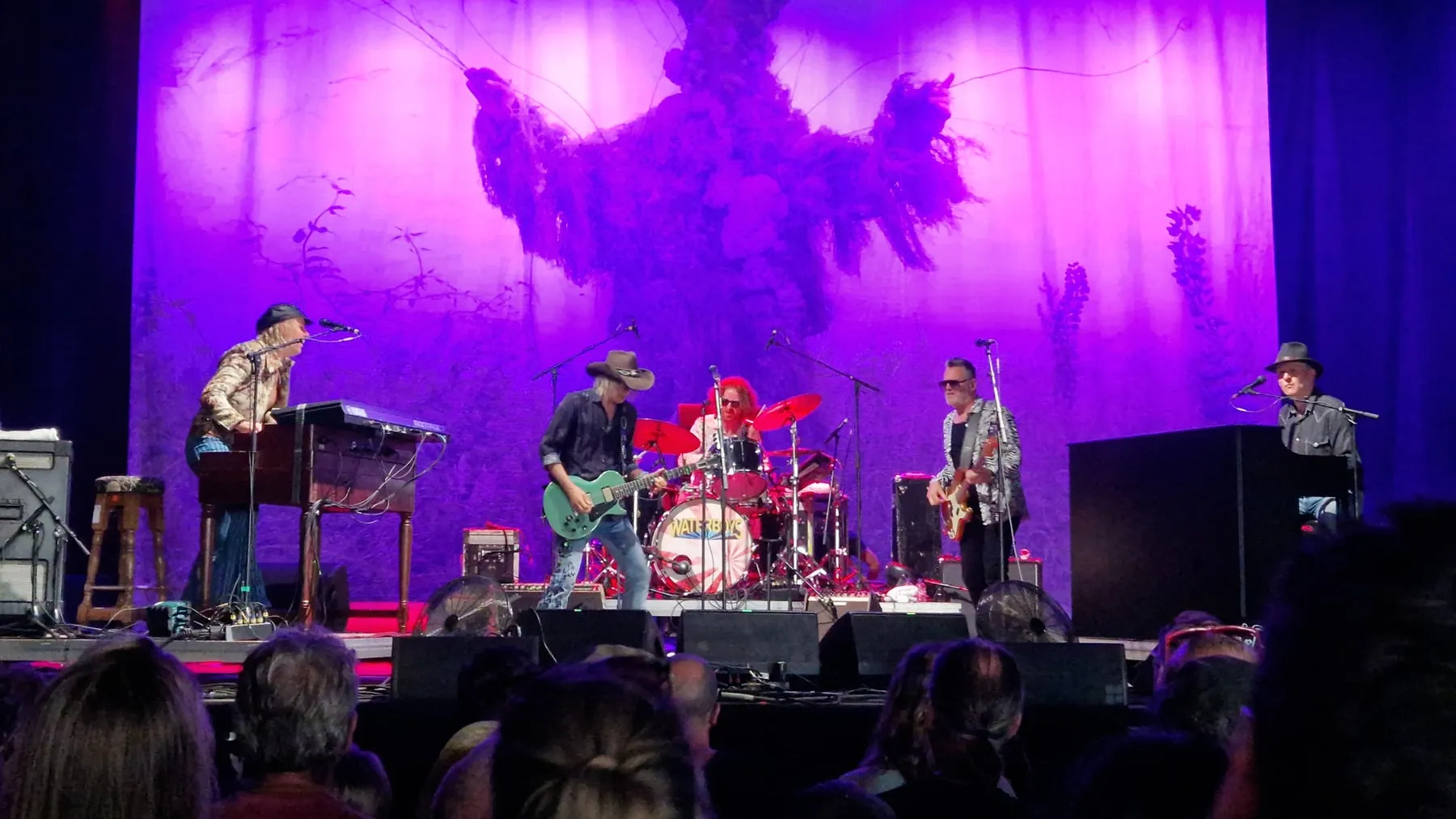
Photo by Haggis MacHaggis , licensed under CC0 · Wikimedia Commons
Rank #225
The Waterboys
Mike Scott's pan-Celtic 'big music' band of folk-rock grandeur.
From Wikipedia
The Waterboys are a rock band formed in 1983 in London by Scottish musician and songwriter Mike Scott. The band's membership, past and present, has been composed mainly of musicians from Britain and Ireland, with Scott being the only constant member. Over a four-decade career, the band has drawn on multiple styles of music including punk rock, rock and roll, folk music, Celtic soul, noise rock, country music, rhythm & blues and chamber music.
Deep Dive
Overview
The Waterboys are a rock band formed in 1983 in London by Scottish musician and songwriter Mike Scott, whose restless artistic vision has driven the ensemble through four decades of stylistic evolution. The band stands as a unique fixture in post-punk and alternative rock history, neither purely rooted in folk nor fully committed to electric rock convention, but instead synthesizing punk energy, Celtic traditional music, rhythm and blues, chamber instrumentation, and noise rock into what Scott termed “big music”—a grandiose, transcendent sound that prizes emotional and spiritual intensity over commercial formula. With Scott as the sole constant member throughout the band’s existence, The Waterboys have functioned as a vehicle for one songwriter’s wandering artistic sensibility, marked by radical reinvention and a refusal to calcify around early success.
Formation Story
Mike Scott initiated The Waterboys in London in 1983, during a period when British post-punk was fragmenting into new wave, synth-pop, and the emerging alternative underground. The band’s early lineup drew from the broader British and Irish musician pool, establishing a pattern that would define the group: fluid membership serving a single vision. Scott’s Scottish roots and his outsider status in the London scene—neither fully plugged into punk revival nor synth-pop machinery—allowed him to chart an idiosyncratic course. From the outset, The Waterboys existed as a collision between contemporary rock urgency and a deeper pull toward folk and traditional Celtic sources, a tension that would only deepen over successive records.
Breakthrough Moment
The Waterboys achieved their widest recognition with Fisherman’s Blues (1988), a watershed album that crowned five years of sustained artistic development and touring. Following the foundation laid by This Is the Sea (1985)—which introduced Scott’s maximalist approach and marked a shift toward more ambitious arrangements—Fisherman’s Blues crystallized the band’s sonic identity by embracing Irish and Scottish folk melodies and instrumentation while maintaining the propulsive energy of contemporary rock. The album’s success, particularly in the UK and Ireland, established The Waterboys as more than a cult act and validated Scott’s refusal to trade artistic conviction for radio friendliness. The band’s ability to package folk and traditional material in contemporary rock garb gave them access to audiences across folk, rock, and alternative markets simultaneously, a rare achievement in the mid-1980s landscape.
Peak Era
The years spanning 1985 through 1990—from This Is the Sea through Room to Roam—represent The Waterboys’ most creatively potent and commercially successful stretch. During this period, the band refined their signature sound: layered, orchestral arrangements built around Scott’s passionate vocals and guitar work, seasoned with traditional folk instrumentation including uilleann pipes, bodhráns, and fiddle. Room to Roam (1990) extended the folk-rock template further, deepening the Irish and Scottish traditional elements that had emerged on Fisherman’s Blues and solidifying the band’s reputation as serious interpreters of Celtic music who refused to abandon rock’s vitality. Throughout this era, The Waterboys moved steadily away from the angular post-punk posture of their debut albums toward a more openly emotional and mythic presentation, one that positioned rock music as a vessel for spiritual and cultural yearning.
Musical Style
The Waterboys’ sound defies easy categorization because it deliberately spans multiple traditions and idioms. Early records incorporated post-punk’s rhythmic drive and guitar textures, but by This Is the Sea, Scott was introducing orchestral arrangements, chamber strings, and horn sections that borrowed equally from 1960s soul production and European art-rock precedent. The arrival of traditional folk instrumentation—particularly uilleann pipes and bodhrán—on Fisherman’s Blues marked a deliberate turn toward Irish and Scottish musical DNA, yet Scott never abandoned rock’s electric guitar, drums, and forward momentum. His vocals occupy a singular register within rock: passionate and often unpolished, capable of both gentle introspection and near-operatic grandeur. The band’s approach to melody is distinctly melodic and often hymn-like, drawing unconsciously from Celtic folk song structure while the production and arrangement vocabulary remained contemporary. This collision between old and new, traditional and modern, gives The Waterboys their most distinctive characteristic: a sense that folk spirituality and rock’s electric power are not opposed forces but necessary complements.
Major Albums
This Is the Sea (1985)
Scott’s breakthrough statement of artistic ambition, introducing the full orchestral scope and emotional intensity that would define the band’s mature sound, moving decisively beyond the post-punk formalism of the debut records.
Fisherman’s Blues (1988)
The album that crystallized The Waterboys’ folk-rock identity and achieved both critical and commercial success by seamlessly integrating Irish traditional music with contemporary rock production and energy.
Room to Roam (1990)
The definitive flowering of the band’s pan-Celtic vision, deepening the traditional instrumentation and songwriting approaches introduced on Fisherman’s Blues while maintaining the scale and ambition Scott demanded.
A Rock in the Weary Land (2000)
A substantial return following a decade-long recording gap, reasserting The Waterboys’ commitment to “big music” and demonstrating Scott’s sustained creative vitality across the turn of the millennium.
An Appointment With Mr. Yeats (2011)
An ambitious thematic album that engaged Irish literary and cultural sources, continuing the band’s deep dialogue with Celtic tradition and spiritual questioning.
Signature Songs
- The Whole of the Moon — Scott’s archetypal statement of spiritual yearning and romantic excess, capturing the band’s gift for transforming personal emotion into universal myth.
- Fisherman’s Blues — The title track of their breakthrough album, a folk-rooted melody married to rock arrangement, epitomizing their ability to honor tradition while remaining contemporary.
- We Will Not Be Lovers — A showcase for Scott’s emotional vocal intensity and the band’s gift for orchestral arrangement, demonstrating their chamber-music sophistication.
- The Pan Within — A representative mid-period work revealing the band’s ability to fuse Celtic instrumentation with rock energy and philosophical depth.
- Don’t Bang the Drum — An uplifting folk-rock anthem that exemplifies The Waterboys’ capacity to make traditional material feel urgent and alive.
Influence on Rock
The Waterboys’ primary influence has been to legitimize the integration of Celtic folk sources within contemporary rock music at a level of artistic seriousness rarely attempted in the 1980s and 1990s. By refusing to relegate folk elements to novelty or decoration and instead building entire albums around folk melody, traditional instrumentation, and Celtic spiritual themes, Scott demonstrated that rock music could authentically house multiple musical traditions simultaneously. Their success opened pathways for other British and Irish acts to explore folk and traditional sources without fear of commercial irrelevance. The band’s emphasis on emotional sincerity and spiritual questioning—rather than irony or detachment—also positioned them as precursors to later alternative-rock movements that valued authenticity and emotional transparency. Their influence extends across indie rock, folk-rock revival acts, and beyond, establishing a template for how contemporary songwriters might draw from deeper cultural wells without sacrificing either artistic integrity or popular connection.
Legacy
The Waterboys have maintained continuous artistic activity across four decades, releasing new studio albums regularly into the 2020s, with All Souls Hill appearing in 2022 and both Life, Death and Dennis Hopper and The Waterboys Present: Rips From The Cutting Room Floor announced for 2025. This sustained output—averaging a new full-length roughly every two to three years since returning to regular recording after 2000—testifies to Scott’s undiminished creative drive and the band’s sustained cultural relevance within folk-rock and alternative circles. The Waterboys remain fixtures on the live touring circuit, particularly in the UK and Ireland, where their catalog has achieved canonical status. Their streaming presence remains substantial, with Fisherman’s Blues and This Is the Sea continuing to find new listeners across digital platforms. The band’s refusal to either dissolve or fossilize around past glories—a common trap for 1980s alternative acts—has allowed them to remain visible in contemporary music discourse while building a body of work that now spans nearly forty-five years of continuous artistic documentation.
Fun Facts
- Mike Scott remains the only constant member across The Waterboys’ entire existence, making him the singular continuity point through the band’s numerous lineup changes and stylistic evolutions across four decades.
- The band’s integration of uilleann pipes and other traditional Irish instrumentation on Fisherman’s Blues arrived at a moment when Celtic music was being revived globally, positioning them at the intersection of traditional music revival and contemporary alternative rock.
- The Pagan Place Sessions, released in 2002, documented material from the band’s 1984 album A Pagan Place, showing Scott’s willingness to revisit and recontextualize earlier work decades after its original recording.
- The Waterboys have released material across a twenty-year span from 2000 onward at a consistent rate, making them one of the few 1980s alternative acts to maintain regular studio output into the 2020s.