
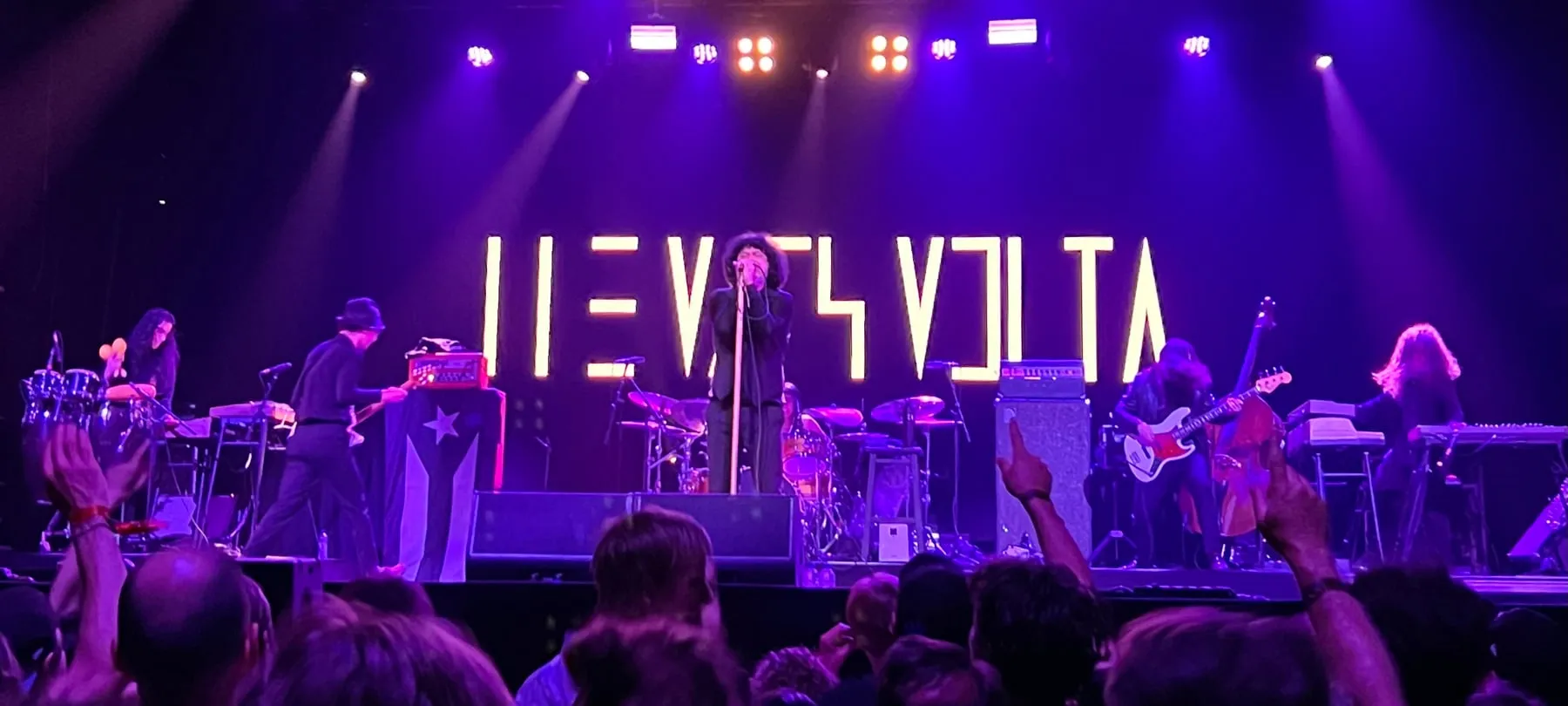
Photo by Will Bonniker , licensed under CC BY-SA 4.0 · Wikimedia Commons
Rank #147
The Mars Volta
Post-At-the-Drive-In Latin prog explosion of fierce ambition.
From Wikipedia
The Mars Volta is an American progressive rock band formed in 2001. The band's only constant members are Omar Rodríguez-López and Cedric Bixler-Zavala, whose partnership forms the core of the band. The band's current line-up also includes founding member Eva Gardner (bass), Omar's brother Marcel Rodríguez-López, Leo Genovese and Linda-Philomène Tsoungui (drums).
Members
- Cedric Bixler-Zavala
- Juan Alderete
- Omar Rodríguez-López
Studio Albums
- 2003 De‐Loused in the Comatorium
- 2005 Frances the Mute
- 2006 Amputechture
- 2008 The Bedlam in Goliath
- 2009 Octahedron
- 2012 Noctourniquet
- 2022 The Mars Volta
- 2023 Que dios te maldiga mi corazón
- 2025 Lucro sucio; los ojos del vacio
Source: MusicBrainz
Deep Dive
Overview
The Mars Volta emerged in 2001 as an American progressive rock band from El Paso, Texas, defined by instrumental virtuosity, rhythmic complexity, and the artistic partnership between guitarist Omar Rodríguez-López and vocalist Cedric Bixler-Zavala. The band absorbed the post-hardcore intensity of their predecessors—Bixler-Zavala and Rodríguez-López both came from At the Drive-In—and transformed it through extended compositions built on Latin percussion, unconventional song structures, and elaborate production. Operating across three decades, The Mars Volta established themselves as one of the most ambitious and uncompromising acts in 21st-century rock.
Formation Story
The Mars Volta coalesced in 2001 following the 2001 breakup of At the Drive-In, with Cedric Bixler-Zavala and Omar Rodríguez-López steering the project. Their El Paso origins grounded the band’s sound in a border aesthetic that would influence their later incorporation of Latin rhythmic elements and instrumentation. The founding lineup included Eva Gardner on bass and Juan Alderete, establishing the instrumental depth that would become their trademark. From the outset, the partnership between Rodríguez-López’s guitar orchestrations and Bixler-Zavala’s distinctive, often-distorted vocal delivery formed the creative nucleus around which the band’s sound would crystallize.
Breakthrough Moment
The Mars Volta’s debut album, De-Loused in the Comatorium, arrived in 2003 and announced a fully formed artistic vision. The record sprawled across lengthy instrumental passages, polyrhythmic drum patterns, and layered arrangements that rewarded close listening and repeated exposure. Its ambition and technical execution immediately attracted progressive rock enthusiasts and younger listeners drawn to post-hardcore’s emotional intensity. The album’s success established The Mars Volta as something more than a side project for At the Drive-In members—they were a primary vehicle for increasingly complex compositional ideas.
Peak Era
The band’s most fertile period spanned 2005 to 2008, encompassing three consecutive studio albums. Frances the Mute (2005) deepened the orchestral scope of their predecessor, while Amputechture (2006) further refined their approach to interweaving Latin percussion, jazz harmonies, and post-punk vocal presentation. The Bedlam in Goliath (2008) represented the apex of their ambition during this stretch, showcasing compositions of epic proportions and studio production that placed the band at the forefront of progressive rock’s 21st-century revival. Each album expanded their audience while maintaining an uncompromising artistic stance.
Musical Style
The Mars Volta’s sound fused post-hardcore’s urgent energy with progressive rock’s structural complexity and an unmistakable Latin influence stemming from their El Paso location and deliberate incorporation of bongos, congas, and other percussion instruments. Omar Rodríguez-López’s guitar work moved between searing leads, atmospheric textures, and rhythmic precision, often layered across multiple instruments and overdubs. Cedric Bixler-Zavala’s vocals operated as another instrument unto themselves, ranging from controlled melodic phrasing to cathartic screams and falsetto flourishes, sometimes within the same composition. The rhythm section prioritized polyrhythmic complexity over straightforward timekeeping, with Juan Alderete’s bass weaving countermelodies beneath fractured time signatures and elaborate drum patterns. Their arrangements typically eschewed radio-friendly song structures in favor of extended instrumental passages, narrative arcs, and production techniques derived from experimental and jazz traditions.
Major Albums
De-Loused in the Comatorium (2003)
The debut distilled Post-At-the-Drive-In ambition into intricately layered compositions that balanced emotional catharsis with instrumental excess, establishing their core template and attracting both rock and experimental music audiences.
Frances the Mute (2005)
Expanding on their debut’s blueprint, this album introduced even more orchestral arrangements and instrumental complexity while deepening the band’s commitment to non-linear song structures and studio-based production sophistication.
Amputechture (2006)
The band continued refining their post-hardcore-meets-prog vocabulary, with tighter songwriting that did not sacrifice ambition for accessibility, making this album a creative high point during their most prolific era.
The Bedlam in Goliath (2008)
Their most sonically ambitious statement to date, this album showcased the full potential of their compositional and production vision, with sprawling arrangements and emotional intensity reaching operatic proportions across multiple movements.
Octahedron (2009)
A more restrained entry that suggested the band exploring introspection and dynamics, moving away from the bombastic production of earlier work while maintaining harmonic sophistication.
Noctourniquet (2012)
Released after a three-year gap, this album marked a shift toward a more streamlined aesthetic while retaining the band’s commitment to unusual structures and polyrhythmic interplay.
Signature Songs
- Inertiatic ESP — An extended instrumental introduction to the debut that showcases Rodríguez-López’s guitar architecture and the band’s rhythmic precision.
- Roulette Dares — The vocal centerpiece of De-Loused in the Comatorium, featuring Bixler-Zavala’s most cathartic performance over intricate musical arrangements.
- The Widow — A composition that balances immediate melodic appeal with structural innovation across its extended runtime.
- Cotopaxi — A showcase for polyrhythmic drumming and Latin percussion elements central to the band’s identity.
- Asymmetry — Demonstrates the band’s ability to build emotional intensity through repeated harmonic cycles and dynamic layering.
Influence on Rock
The Mars Volta emerged at a moment when progressive rock was resurfacing in underground circles, and they became one of the genre’s most visible modern representatives. Their synthesis of post-hardcore energy with jazz harmonies, Latin rhythms, and uncompromising structural complexity influenced a generation of bands working at the intersection of accessible rock and experimental composition. Though never achieving mainstream commercial dominance, their albums consistently found audiences within rock communities and among listeners seeking demanding, non-formulaic music. Their dedication to ensemble playing and compositional ambition helped establish a template for 21st-century progressive rock that prioritized instrumental virtuosity and artistic autonomy over commercial palatability.
Legacy
The Mars Volta’s longevity—spanning from 2001 through 2025—reflects the sustained viability of uncompromising artistic vision in contemporary rock. Their discography documents two decades of stylistic evolution, from the maximalist arrangements of their early work through occasional recalibration toward restraint and back again. After a decade-long gap following Noctourniquet (2012), the band returned in 2022 with a self-titled album, followed quickly by Que dios te maldiga mi corazón (2023) and Lucro sucio; los ojos del vacio (2025), signaling renewed creative energy in their later career. The band’s status as a reference point for progressive rock’s contemporary practice—cited by musicians and critics examining the genre’s post-2000 development—ensures that their catalog remains essential listening for anyone tracking rock music’s more ambitious and structurally complex directions.
Fun Facts
- Omar Rodríguez-López and Cedric Bixler-Zavala, the band’s constant creative core, previously performed together in At the Drive-In before launching The Mars Volta as their primary project.
- Eva Gardner served as the founding bassist and remained with the band through multiple lineup changes, making her one of the few members beside Rodríguez-López and Bixler-Zavala to span much of the band’s active period.
- The band’s song titles and album artwork frequently reference literary, scientific, and philosophical concepts, reflecting an intellectual approach to rock composition that extends beyond typical genre conventions.
- The Mars Volta’s return to recording in 2022 came after a ten-year silence, suggesting cyclical creative patterns that parallel broader shifts in the rock music landscape.
Discography & Previews
Click any album to expand its track list. Each track plays a 30-second preview streamed from Apple Music. Tap the link icon next to a track to open it in Apple Music for full playback.


- 1 The Whip Hand ↗ 4:47
- 2 Aegis ↗ 5:11
- 3 Dyslexicon ↗ 4:22
- 4 Empty Vessels Make the Loudest Sound ↗ 6:43
- 5 The Malkin Jewel ↗ 4:42
- 6 Lapochka ↗ 4:15
- 7 In Absentia ↗ 7:26
- 8 Imago ↗ 3:56
- 9 Molochwalker ↗ 3:31
- 10 Trinkets Pale of Moon ↗ 4:25
- 11 Vedamalady ↗ 3:52
- 12 Noctourniquet ↗ 5:38
- 13 Zed and Two Naughts ↗ 5:36

- 1 Blacklight Shine ↗ 2:56
- 2 Graveyard Love ↗ 3:14
- 3 Shore Story ↗ 3:15
- 4 Blank Condolences ↗ 3:27
- 5 Vigil ↗ 3:14
- 6 Que Dios Te Maldiga Mi Corazon ↗ 1:41
- 7 Cerulea ↗ 3:45
- 8 Flash Burns From Flashbacks ↗ 2:39
- 9 Palm Full Of Crux ↗ 3:37
- 10 No Case Gain ↗ 2:41
- 11 Tourmaline ↗ 3:35
- 12 Equus 3 ↗ 4:10
- 13 Collapsible Shoulders ↗ 2:25
- 14 The Requisition ↗ 4:13

- 1 Blacklight Shine (acoustic) ↗ 2:59
- 2 Graveyard Love (acoustic) ↗ 3:43
- 3 Shore Story (acoustic) ↗ 3:22
- 4 Blank Condolences (acoustic) ↗ 3:28
- 5 Vigil (acoustic) ↗ 3:36
- 6 Que Dios Te Maldiga Mi Corazon (acoustic) ↗ 1:52
- 7 Cerulea (acoustic) ↗ 3:54
- 8 Flash Burns From Flashbacks (acoustic) ↗ 3:28
- 9 Palm Full Of Crux (acoustic) ↗ 3:42
- 10 NoCaseGain (acoustic) ↗ 2:50
- 11 Tourmaline (acoustic) ↗ 3:29
- 12 Equus 3 (acoustic) ↗ 3:52
- 13 Collapsible Shoulders (acoustic) ↗ 2:39
- 14 The Requisition (acoustic) ↗ 4:34

- 1 Fin ↗ 1:15
- 2 Reina tormenta ↗ 1:10
- 3 Enlazan las tinieblas ↗ 3:12
- 4 Mictlán ↗ 2:34
- 5 The Iron Rose ↗ 3:48
- 6 Cue the sun ↗ 2:17
- 7 Alba del orate ↗ 3:12
- 8 Voice in my knives ↗ 2:42
- 9 Poseedora de mi sombra ↗ 2:47
- 10 Celaje ↗ 3:48
- 11 Vociferó ↗ 2:29
- 12 Mito de los trece cielos ↗ 1:05
- 13 Un disparo al vacío ↗ 3:31
- 14 Detrás de la puerta dorada ↗ 0:29
- 15 Maullidos ↗ 2:56
- 16 Morgana ↗ 3:06
- 17 Cue the sun (reprise) ↗ 3:30
- 18 Lucro sucio ↗ 5:45