
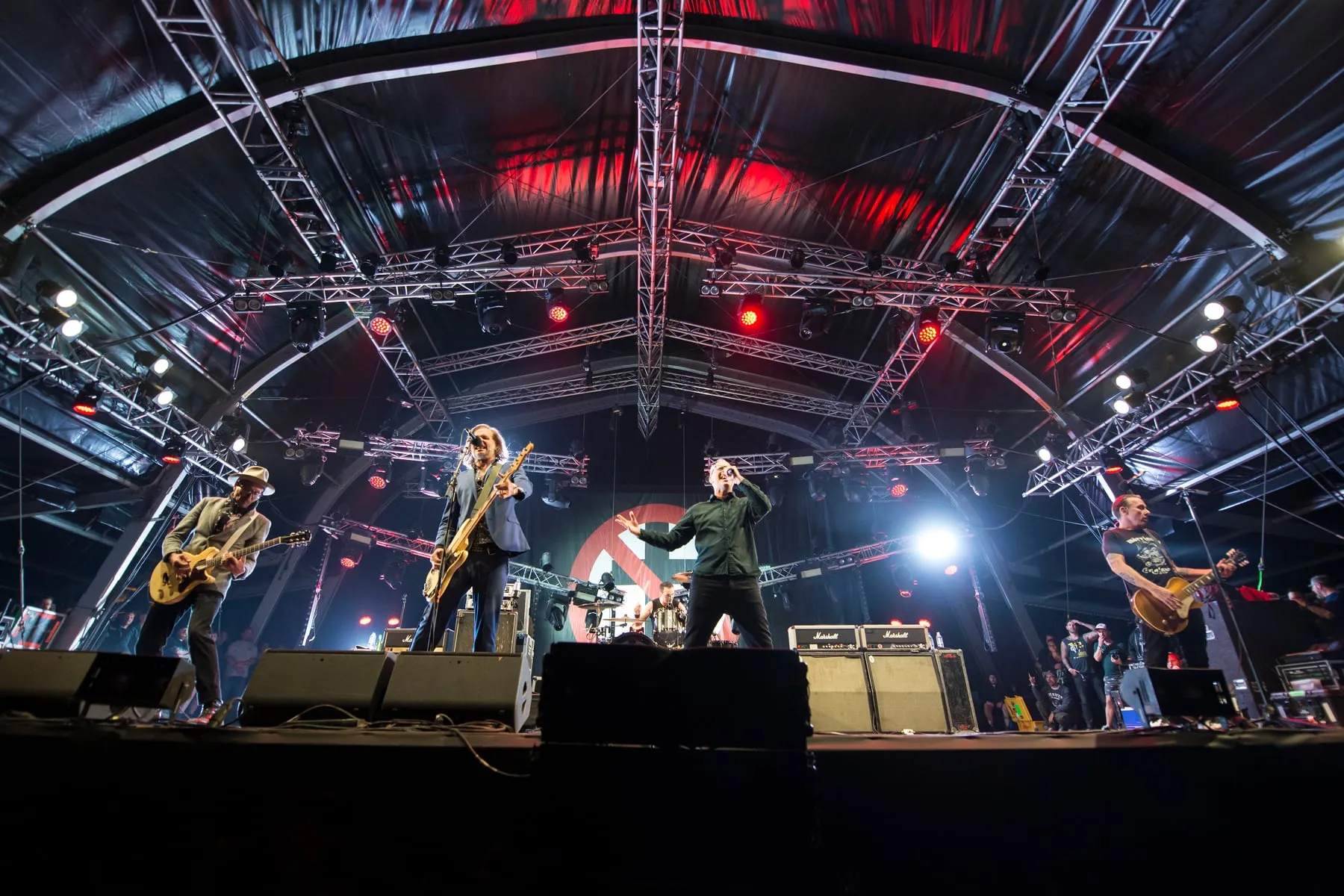
Photo by Selbymay , licensed under CC BY-SA 4.0 · Wikimedia Commons
Rank #148
Bad Religion
L.A. melodic-punk academy who proved punk could be erudite.
From Wikipedia
Bad Religion is an American punk rock band, formed in Los Angeles, California, in 1980. The band's lyrics cover topics related to religion, politics, society, the media and science. Musically, they are noted for their melodic sensibilities and extensive use of three-part vocal harmonies. The band has experienced multiple lineup changes, with singer Greg Graffin being the band's only constant member, though fellow founding members Jay Bentley and Brett Gurewitz have also been with the band for most of their history while guitarist Brian Baker has been a member of the group since 1994. Guitarist Mike Dimkich and drummer Jamie Miller have been members of the band since 2013 and 2015 respectively. To date, Bad Religion has released seventeen studio albums, two live albums, three compilation albums, three EPs, and two live DVDs. They are considered to be one of the best-selling punk rock acts of all time, having sold over five million albums worldwide.
Deep Dive
Overview
Bad Religion is an American punk rock band formed in Los Angeles, California, in 1980, and stands as one of the best-selling punk rock acts of all time, having sold over five million albums worldwide. What distinguishes them from their contemporaries is their fusion of punk rock’s raw energy with melodic sensibilities and intellectual rigor—a band that proved punk could engage with philosophy, science, and political thought without sacrificing urgency or accessibility. The group’s signature sound relies on three-part vocal harmonies layered atop driving punk arrangements, creating a tension between pop accessibility and ideological substance that has defined their thirty-year-plus catalog.
Formation Story
Bad Religion emerged from the San Fernando Valley in Los Angeles in 1980, during the city’s early hardcore punk scene. The founding lineup featured vocalist Greg Graffin, bassist Jay Bentley, and guitarist Brett Gurewitz—a trio whose complementary songwriting and harmonic instincts would set them apart within a genre often hostile to melody. Los Angeles at the time was a fertile breeding ground for punk innovation, with bands pushing the form in various directions; Bad Religion’s particular genius lay in preserving punk’s confrontational ethos while incorporating chord progressions and vocal arrangements that recalled power pop and even doo-wop traditions. The early years saw the band develop their approach through relentless gigging and recording within the underground punk network, establishing themselves as serious songwriters rather than mere rabble-rousers.
Breakthrough Moment
The band’s initial recordings—How Could Hell Be Any Worse? (1982) and Into the Unknown (1983)—established their template but remained primarily known within punk circles. However, the release of Suffer in 1988 marked a turning point, presenting Bad Religion’s vision in its most refined form to that date: urgent, hook-laden punk songs addressing existential and social themes with uncommon philosophical depth. This album and its immediate successor, No Control (1989), solidified their status beyond the underground. Against the Grain (1990) continued the trajectory, but it was the release of Generator in 1992 that positioned Bad Religion as architects of a new punk mainstream—one where lyrical intelligence and political substance were not obstacles to popularity but ingredients in it. The addition of guitarist Brian Baker in 1994 further strengthened their sound and marked the beginning of their most commercially productive era.
Peak Era
Bad Religion’s creative and commercial zenith extended from the mid-1990s through the early 2000s. Albums including Stranger Than Fiction (1994), The Gray Race (1996), No Substance (1998), The New America (2000), and The Process of Belief (2002) established them as reliable sellers and critical favorites, each advancing or refining their core formula. This period saw the band leverage major-label backing—they signed to Atlantic Records while maintaining association with Epitaph Records—to reach audiences far beyond punk’s traditional confines. The songwriting became increasingly sophisticated in its thematic concerns, addressing everything from media manipulation to scientific progress to religious skepticism, yet the melodies remained instantly accessible. Their live performances from this era demonstrated the power of three-part harmonies executed with precision and passion, with Greg Graffin’s distinctive vocals anchoring intricate arrangements built by Bentley, Gurewitz, and Baker.
Musical Style
Bad Religion’s sound is defined by the interplay between aggressive punk rock instrumentation—distorted guitars, driving bass, and propulsive drums—and carefully constructed vocal harmonies that emerge from the din with crystalline clarity. Where most punk bands viewed harmony as antithetical to punk’s rebellious character, Bad Religion treated three-part harmonies as a natural extension of punk’s emotional directness, using them to amplify both the catchiness and the emotional weight of their songs. Lyrically, they distinguish themselves by refusing the genre’s typical recourse to abstractions or rage-driven nihilism; instead, their songs grapple with specific ideas—critiques of organized religion, explorations of scientific rationalism, examinations of media complicity—delivered with intellectual rigor but never at the expense of visceral impact. Musically, this means verse-chorus structures that feel both inevitable and surprising, guitar riffs that burn bright without sacrificing clarity, and a production approach that values definition over murkiness, allowing every instrument and voice to be heard.
Major Albums
Suffer (1988)
A watershed moment that synthesized their early rawness with increasingly sophisticated songwriting, Suffer established the template for all that followed: catchy, intelligent punk rock powered by multi-part harmonies and lyrics engaged with real ideas.
Generator (1992)
A masterpiece of melodic punk that deepened both the musical and lyrical ambitions; this album proved Bad Religion could sustain an entire record of both hook-laden songs and substantive thematic concerns without compromise.
Stranger Than Fiction (1994)
Released after Brian Baker’s arrival, this album solidified the classic-era lineup’s chemistry and showcased the band operating at peak commercial confidence while maintaining artistic integrity.
The Process of Belief (2002)
From their peak commercial period, this album demonstrates the band’s ability to craft radio-friendly punk songs without surrendering intellectual or musical substance, balancing accessibility with complexity.
The Empire Strikes First (2004)
A record that proved Bad Religion could remain vital and relevant well into their third decade, combining proven songwriting strategies with renewed energy and contemporary lyrical concerns.
Signature Songs
- “Suffer” — The title track and mission statement, combining urgent punk energy with harmonic sophistication and thematic depth about endurance.
- “21 Centuries” — A sweeping examination of human progress and religious belief, showcasing Bad Religion’s ability to address grand philosophical themes within a three-minute punk song.
- “Generator” — The propulsive title track that served as a flagship for the 1992 album, demonstrating the band’s knack for turning societal critique into an irresistible hook.
- “Struck a Nerve” — A lightning-quick burst of controlled fury that displays the band’s technical precision and emotional immediacy.
Influence on Rock
Bad Religion fundamentally altered the trajectory of punk rock by demonstrating that the genre could accommodate intellectual content and melodic sophistication without losing its essential energy or transgressive edge. They proved that punk audiences would embrace bands that took ideas seriously, and that major labels would invest in punk acts with substantive rather than purely rebellious credentials. Their influence cascaded through 1990s and 2000s alternative and punk rock, inspiring bands to treat the form as a vehicle for genuine lyrical and musical complexity. In doing so, they helped elevate punk rock’s status from primarily subcultural artifact to viable mainstream format—not by diluting punk’s values but by expanding what punk could contain. The band’s emphasis on three-part harmonies influenced countless melodic punk and pop-punk acts, while their intellectual approach to songwriting opened pathways for bands seeking to engage with philosophy, science, and politics without irony or condescension.
Legacy
Bad Religion remains among the most consistently touring and recording punk acts, with studio albums continuing into the 2010s and beyond—True North (2013) and Age of Unreason (2019) demonstrate their ongoing creative engagement. Their continued existence with Greg Graffin as the sole original constant member (joined by longtime members Jay Bentley and Brett Gurewitz, plus newer additions Brian Baker, Mike Dimkich, and Jamie Miller) speaks to the durability of the band’s core identity. They are universally recognized as one of the best-selling punk rock acts of all time, having moved more than five million albums globally and maintained a substantial streaming and touring presence across multiple generations of listeners. Bad Religion’s legacy is that of a band that expanded punk rock’s thematic and musical vocabulary without ever compromising its essential rebellious spirit—proof that intellectual engagement and visceral impact are not opposites but partners in the service of vital rock music.
Fun Facts
- Greg Graffin, the band’s sole constant member since formation, earned a master’s degree in geology and frequently addresses scientific topics in the band’s lyrics.
- The band’s association with Epitaph Records, founded by fellow punk musician Brett Gurewitz, helped establish the label as a premier outlet for melodic and socially conscious punk rock.
- Bad Religion has performed continuously through multiple decades despite significant lineup changes, with Brian Baker (who joined in 1994) becoming one of the longest-serving members outside the founding core.