
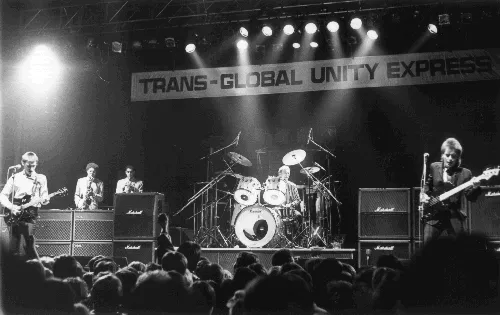
Photo by Neil Twink Tinning, , licensed under CC BY 2.5 · Wikimedia Commons
Rank #214
The Jam
Paul Weller's mod-punk band who topped UK charts in three short years.
From Wikipedia
The Jam were an English rock band formed in 1972 in Woking, Surrey, consisting of Paul Weller, Bruce Foxton and Rick Buckler. They released 18 consecutive top 40 singles in the United Kingdom, from their debut in 1977 to their break-up in December 1982, including four number one hits. As of 2007, "That's Entertainment" and "Just Who Is the 5 O'Clock Hero?" remain the best-selling import singles of all time in the UK. They released one live album and six studio albums, the last of which, The Gift, reached number one on the UK Albums Chart. When the group disbanded in 1982, their first 15 singles were re-released and all placed within the top 100.
Members
- Bruce Foxton
- Paul Weller
- Rick Buckler
Studio Albums
- 1977 In the City
- 1977 This Is the Modern World
- 1978 All Mod Cons
- 1979 Setting Sons
- 1980 Sound Affects
- 1982 The Gift
- — Skirt!
Source: MusicBrainz
Deep Dive
Overview
The Jam were an English rock band that emerged from Woking, Surrey, in 1972 and became one of the most commercially dominant acts in United Kingdom popular music during their ten-year existence. Led by Paul Weller, alongside bassist Bruce Foxton and drummer Rick Buckler, the trio fused punk rock’s raw energy and urgency with mod revival aesthetics and power pop sensibilities, creating a distinctly British sound that proved irresistible to UK audiences. Between their debut single in 1977 and their dissolution in December 1982, they released 18 consecutive top-40 singles and four number-one hits, a commercial consistency that few British bands have matched.
Formation Story
The Jam coalesced in Woking in 1972, drawing from the post-war British mod subculture that had defined the 1960s. Paul Weller, Bruce Foxton, and Rick Buckler formed the core lineup that would remain stable throughout the band’s entire run. Woking, a commuter town southwest of London, provided the band with a working-class base removed from the capital’s established music scenes, yet close enough to participate in the emerging punk and new wave movements that were reshaping British rock in the mid-1970s. This provincial isolation gave The Jam a distinct identity—they were neither art-school experimentalists nor London scene-makers, but rather representatives of suburban youth culture seeking an authentic punk expression married to mod sensibilities.
Breakthrough Moment
The Jam’s commercial breakthrough arrived swiftly after their formation. In 1977, they released two studio albums—In the City and This Is the Modern World—establishing themselves as significant new voices within the British punk movement. The rapid succession of two albums in a single year demonstrated Weller’s prolific songwriting and the band’s ability to refine their sound at a remarkable pace. Their debut single achieved enough success to launch them into the UK top 40, and this early momentum never abated. By the end of 1977, The Jam had established themselves as working parts of the commercial rock landscape, with a growing fanbase that would sustain them through the next five years of relentless output and touring.
Peak Era
From 1978 to 1982, The Jam existed in a state of continuous commercial and creative activity that defined their peak era. All Mod Cons (1978) and Setting Sons (1979) solidified their position as chart mainstays, with Sound Affects (1980) extending their dominance into the new decade. During these years, the band released their final studio album, The Gift (1982), which reached number one on the UK Albums Chart and demonstrated that their appeal had not diminished despite the seismic shifts in popular music that occurred between punk’s emergence and the synthetic pop explosion of the early 1980s. The sheer volume of top-40 singles released during this five-year window—18 consecutive entries from their 1977 debut through their 1982 dissolution—represents a level of chart presence almost unprecedented in modern British rock music.
Musical Style
The Jam’s sound occupied a deliberate space between punk rock’s speed and aggression and power pop’s melodic craftsmanship, anchored throughout by the mod revival aesthetic of sharp tailoring, clean lines, and working-class pride. Paul Weller’s guitar work ranged from driving power chords to jangly, almost Beatle-esque melodies, while Bruce Foxton’s bass provided melodic counter-movement rather than simple rhythmic support. Rick Buckler’s drumming emphasized straightforward, propulsive rhythms that rarely employed the polyrhythmic complexity of progressive rock, instead serving the songs’ directness and emotional immediacy. Weller’s vocals were urgent and conversational, addressing contemporary British life and social observation rather than the fantasy and abstraction that dominated much 1970s rock. The band drew from the British new wave’s lean instrumentation and punk’s anti-establishment ethos, but retained a accessibility and tuneful quality that distinguished them from harder-edged contemporaries. By the early 1980s, as synth-pop and post-punk experimentation fractured rock music into competing factions, The Jam remained committed to electric guitar-based rock delivered with pop sensibility and working-class authenticity.
Major Albums
In the City (1977)
The Jam’s debut established their mod-punk fusion and announced Weller as a significant new songwriter, generating immediate UK chart success and securing their place within the broader new wave movement.
This Is the Modern World (1977)
Released in the same year as their debut, this second album proved the band’s rapid creative momentum and consolidated their fanbase, demonstrating that their initial success was no anomaly.
All Mod Cons (1978)
A landmark of the mod revival, this album refined The Jam’s sound and showcased Weller’s growing sophistication as a songwriter, establishing the template they would follow for the remainder of their career.
Setting Sons (1979)
Released at the height of punk’s commercial waning, Setting Sons proved The Jam’s ability to maintain chart success and critical relevance as musical tastes shifted, with Weller’s songwriting addressing social and personal themes.
Sound Affects (1980)
Entering the 1980s, this album demonstrated The Jam’s continued commercial dominance and their refusal to abandon guitar-driven rock in the face of synth-pop’s rising prominence.
The Gift (1982)
Their final album before dissolution, The Gift reached number one on the UK Albums Chart, proving that The Jam had lost none of their commercial appeal even after a decade of constant touring and recording.
Signature Songs
- “Down in the Tube Station at Midnight” — A vivid narrative of suburban violence and class tension that showcased Weller’s storytelling ability and the band’s capacity for guitar-driven drama.
- “That’s Entertainment” — Noted as one of the best-selling import singles of all time in the UK, this song exemplified The Jam’s ability to find melodic pop hooks within punk structures.
- “Just Who Is the 5 O’Clock Hero?” — The other best-selling import single of all time in the UK, demonstrating the band’s sustained commercial pull and the fervent loyalty of their fanbase.
- “In the City” — Their debut single, which announced their arrival and established the urgent, melodic approach that would define their decade.
- “Going Underground” — A track that captured their anti-establishment sentiment while maintaining pop accessibility.
Influence on Rock
The Jam proved that punk rock and commercial success were not mutually exclusive, nor were punk rock and pop melody incompatible. Their existence bridged the gap between punk’s ideological rejection of mainstream rock and the practical reality that audiences wanted hooks, choruses, and singalong moments. The mod revival they embodied later influenced British bands throughout the 1980s and beyond, while their insistence on guitar-driven rock in an age of synthesizers established a template for the alternative and indie rock movements that would emerge in the 1990s. Their chart success in the UK demonstrated the depth and loyalty of the British rock audience, a lesson that would inform subsequent generations of British rock bands who sought mainstream success without compromising musical integrity.
Legacy
The Jam disbanded in December 1982 at the height of their commercial powers, a decision that preserved their reputation and prevented the gradual decline that affects many long-running bands. In the years following their dissolution, their first 15 singles were re-released and all placed within the top 100, demonstrating the continued commercial viability of their catalog and the devotion of their fanbase. As of 2007, “That’s Entertainment” and “Just Who Is the 5 O’Clock Hero?” remained the best-selling import singles of all time in the UK, a distinction that speaks to their sustained presence in British popular culture. The band’s output—one live album and six studio albums released across their ten-year existence—remains in steady circulation and continues to define the sound of late-1970s and early-1980s British rock for successive generations of listeners.
Fun Facts
- The band maintained the same three-member lineup throughout their entire ten-year existence, from 1972 to their 1982 dissolution—a remarkable stability rare among rock bands.
- Their chart dominance was geographically specific: The Jam were primarily a UK phenomenon, achieving their massive success predominantly in British charts rather than achieving comparable worldwide recognition, a testament to their deep connection to British culture and audiences.
- The rapid release of two albums in 1977—In the City and This Is the Modern World—demonstrated Paul Weller’s prolific songwriting pace and the band’s commitment to constant creative productivity during their breakthrough year.
Discography & Previews
Click any album to expand its track list. Each track plays a 30-second preview streamed from Apple Music. Tap the link icon next to a track to open it in Apple Music for full playback.

- 1 Art School ↗ 2:01
- 2 I've Changed My Address ↗ 3:30
- 3 Slow Down ↗ 2:38
- 4 I Got By In Time ↗ 2:06
- 5 Away from the Numbers ↗ 4:02
- 6 Batman Theme ↗ 1:29
- 7 In the City ↗ 2:18
- 8 Sounds from the Street ↗ 3:13
- 9 Non-Stop Dancing ↗ 2:26
- 10 Time for Truth ↗ 3:09
- 11 Takin' My Love ↗ 2:14
- 12 Bricks and Mortar ↗ 2:37

- 1 The Modern World (Explicit Version) ↗ 2:31
- 2 London Traffic ↗ 1:49
- 3 Standards ↗ 2:29
- 4 Life from a Window ↗ 2:52
- 5 The Combine ↗ 2:20
- 6 Don't Tell Them You're Sane ↗ 3:40
- 7 In the Street Today ↗ 1:31
- 8 London Girl ↗ 2:40
- 9 I Need You (For Someone) ↗ 2:41
- 10 Here Comes the Weekend ↗ 3:30
- 11 Tonight At Noon ↗ 3:01
- 12 In the Midnight Hour ↗ 1:54

- 1 All Mod Cons (1997 Remaster) ↗ 1:19
- 2 To Be Someone (Didn't We Have A Nice Time) [1997 Remaster] ↗ 2:29
- 3 Mr. Clean (1997 Remaster) ↗ 3:28
- 4 David Watts (1997 Remaster) ↗ 2:55
- 5 English Rose (1997 Remaster) ↗ 2:49
- 6 In The Crowd (1997 Remaster) ↗ 5:39
- 7 Billy Hunt (1997 Remaster) ↗ 3:00
- 8 It's Too Bad (1997 Remaster) ↗ 2:36
- 9 Fly (1997 Remaster) ↗ 3:19
- 10 The Place I Love (1997 Remaster) ↗ 2:52
- 11 'A' Bomb In Wardour Street (1997 Remaster) ↗ 2:37
- 12 Down In The Tube Station At Midnight (1997 Remaster) ↗ 4:43


