
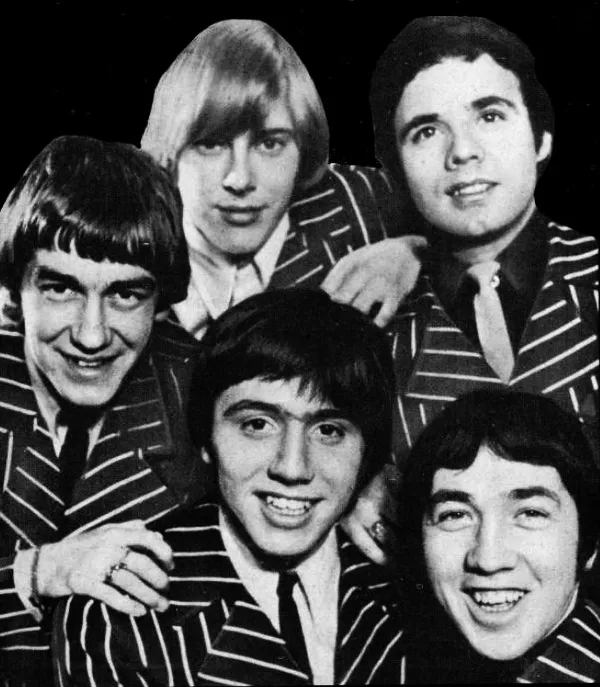
Photo by United Artists Records , licensed under Public domain · Wikimedia Commons
Rank #317
The Easybeats
Sydney British-Invasion-style band whose 'Friday on My Mind' is a global classic.
From Wikipedia
The Easybeats were an Australian rock band that formed in Sydney in late 1964. They are best known for their 1966 hit single "Friday on My Mind", which is regarded as the first Australian rock song to achieve international success; Rolling Stone described it as "the first international victory for Oz rock". One of the most popular and successful bands in the country, they were one of the few Australian bands of their time to foreground their original material; their first album Easy (1965) was one of the earliest Australian rock albums featuring all original songs.
Members
- Dick Diamonde
Deep Dive
Overview
The Easybeats were an Australian rock band that emerged from Sydney in the mid-1960s and became the country’s first internationally successful rock act. Formed in 1964, they bridged the gap between British Invasion aesthetics and homegrown Australian rock identity, releasing a string of albums that established original material as the backbone of their appeal. Their 1966 single “Friday on My Mind” stands as the landmark moment—the first Australian rock song to achieve genuine global chart success and a song that Rolling Stone would later identify as “the first international victory for Oz rock.”
Formation Story
The Easybeats came together in Sydney in late 1964, emerging from the same post-Beat Boom moment that produced countless garage and beat bands across the English-speaking world. What distinguished them from their contemporaries was an early commitment to original songwriting at a time when many local acts relied on covers. Recording for Parlophone and EMI, the band established themselves quickly in the Australian market and began thinking about how to translate their local success into something with wider reach.
Breakthrough Moment
The breakthrough came in 1966 with the single “Friday on My Mind,” released from the album of the same name in 1967. The song’s infectious energy, memorable melody, and relatable lyrical hook—a workplace narrative about anticipating the weekend—resonated far beyond Australia’s borders. It became the first rock recording by an Australian band to cross into the international mainstream, charting across Europe and North America and establishing The Easybeats as more than a local phenomenon. The success of “Friday on My Mind” opened doors for subsequent Australian rock acts and positioned the band as cultural ambassadors for their country’s emerging rock scene.
Peak Era
The band’s creative and commercial peak spanned the mid-to-late 1960s, roughly 1965 to 1968. Their early albums—Easy (1965), It’s 2 Easy (1966), and Volume 3 (1966)—established their template of upbeat, hook-driven rock songs built on tight arrangements and energetic performance. Following the international success of “Friday on My Mind,” the band released Vigil in 1968, attempting to consolidate their momentum and evolve their sound in the context of shifting rock trends. Though their initial burst of momentum eventually cooled, this five-year window represented a period when The Easybeats controlled much of Australian rock discourse and proved indigenous talent could compete on a world stage.
Musical Style
The Easybeats trafficked in beat music and garage rock with pronounced pop sensibilities, a style that owed much to the British Invasion while maintaining a distinctly Australian energy. Their sound was characterized by straightforward, driving rhythms, clear vocal melodies, and an emphasis on hooks and singalong choruses—the kind of music that prioritized immediate accessibility without sacrificing instrumental tightness. Song structures were economical and radio-friendly, yet the band demonstrated musicianship in their execution. As the decade progressed and psychedelic and experimental rock gained cultural ground, The Easybeats incorporated some of those textures into their work, though they never abandoned the pop-rock core that had defined them. The production across their EMI releases reflected professional studio standards, with emphasis on clarity and punch rather than avant-garde studio technique.
Major Albums
Easy (1965)
The band’s debut album was a significant marker in Australian rock history—one of the earliest rock albums from the country to feature all original material, a rarity at the time when covers still dominated local recording sessions. Its success established original songwriting as The Easybeats’ brand identity.
It’s 2 Easy (1966)
Released in the same year as Volume 3, this follow-up maintained the band’s hook-driven formula while consolidating their growing Australian fanbase and laying groundwork for their imminent international breakthrough.
Friday on My Mind (1967)
Titled after their breakout single, this album captured The Easybeats at the moment of their global emergence, featuring the title track alongside other upbeat rock compositions that explained their appeal to international audiences.
Vigil (1968)
By the band’s final studio album before a hiatus, Vigil represented an attempt to evolve their sound in response to the changing rock landscape of the late 1960s, incorporating more experimental production touches while retaining their essential melodic sensibility.
Signature Songs
- “Friday on My Mind” — The band’s signature achievement and the defining moment of Australian rock’s international arrival in 1966.
- “Sorry” — A track that showcased the band’s ability to balance pop appeal with rock instrumentation.
- “Who’ll Be the One (To Love You)” — Representative of their melodic strength and commercial accessibility.
Influence on Rock
The Easybeats’ most lasting contribution to rock history was proving that Australian rock could command international attention on its own terms. “Friday on My Mind” opened a cultural door; it demonstrated to record labels, radio programmers, and audiences worldwide that Australia could produce rock music worthy of global distribution. This success paved the way for subsequent Australian rock acts to gain international record contracts and airplay. Beyond their specific influence on later Australian bands, The Easybeats represented a particular strain of 1960s rock—unpretentious, hook-driven, and built on musicianship and songcraft rather than experimental boundary-pushing. Their example proved that rock music rooted in melody and energy could achieve commercial success without requiring either slavish adherence to American or British trends or complete stylistic independence.
Legacy
The Easybeats disbanded in 1969, their initial run completed before the 1970s rock landscape shifted further toward longer-form compositions, concept albums, and progressive structures. Yet their cultural footprint remained substantial. “Friday on My Mind” has endured as a standard in Australian popular culture and remains instantly recognizable internationally—a rarity for any 1960s rock single. The band’s commitment to original material early in their career established a template for how Australian rock bands could succeed. Though they never achieved the sustained superstardom of The Beatles or The Rolling Stones, their place in rock history is secure as pioneering figures in Australian rock and architects of a genuinely cross-cultural moment in 1960s popular music. Subsequent releases and compilations have kept their catalog available, and the band’s influence on later Australian rock sensibilities—particularly the emphasis on melodic songwriting and high-energy performance—can be traced through decades of the country’s rock output.
Fun Facts
- The Easybeats’ Easy (1965) was recognized as one of the earliest Australian rock albums to consist entirely of original compositions, a distinction that set them apart from peers still reliant on cover versions.
- “Friday on My Mind” achieved chart success across multiple continents, a feat virtually unheard of for Australian rock acts in 1966, establishing the template for international rock export from the country.
- The band recorded for EMI and its subsidiary Parlophone, major labels with worldwide distribution that proved essential to translating their Australian success into global reach.
- Dick Diamonde’s tenure as a consistent member throughout the band’s original run helped anchor their identity across five albums and multiple lineup configurations.