Photo by corevette , licensed under CC BY 2.0 · Wikimedia Commons
Rank #121
Russian Circles
Chicago instrumental trio fusing post-rock dynamics with metal weight.
From Wikipedia
Russian Circles is an American instrumental post-metal band based in Chicago, Illinois. The band was originally formed by childhood friends Mike Sullivan and Dave Turncrantz after their previous musical projects dissolved. After parting ways with their original bass player Colin DeKuiper in 2007, the trio was rounded out by Brian Cook. The band has gained widespread recognition based on a series of critically acclaimed albums and extensive international touring. Their name is taken from a drill exercise used in ice hockey, a sport Sullivan and Turncrantz grew up playing in their original hometown of St. Louis.
Studio Albums
- 2006 Enter
- 2008 Station
- 2009 Geneva
- 2011 Empros
- 2013 Memorial
- 2016 Guidance
- 2019 Blood Year
- 2022 Gnosis
Source: MusicBrainz
Deep Dive
Overview
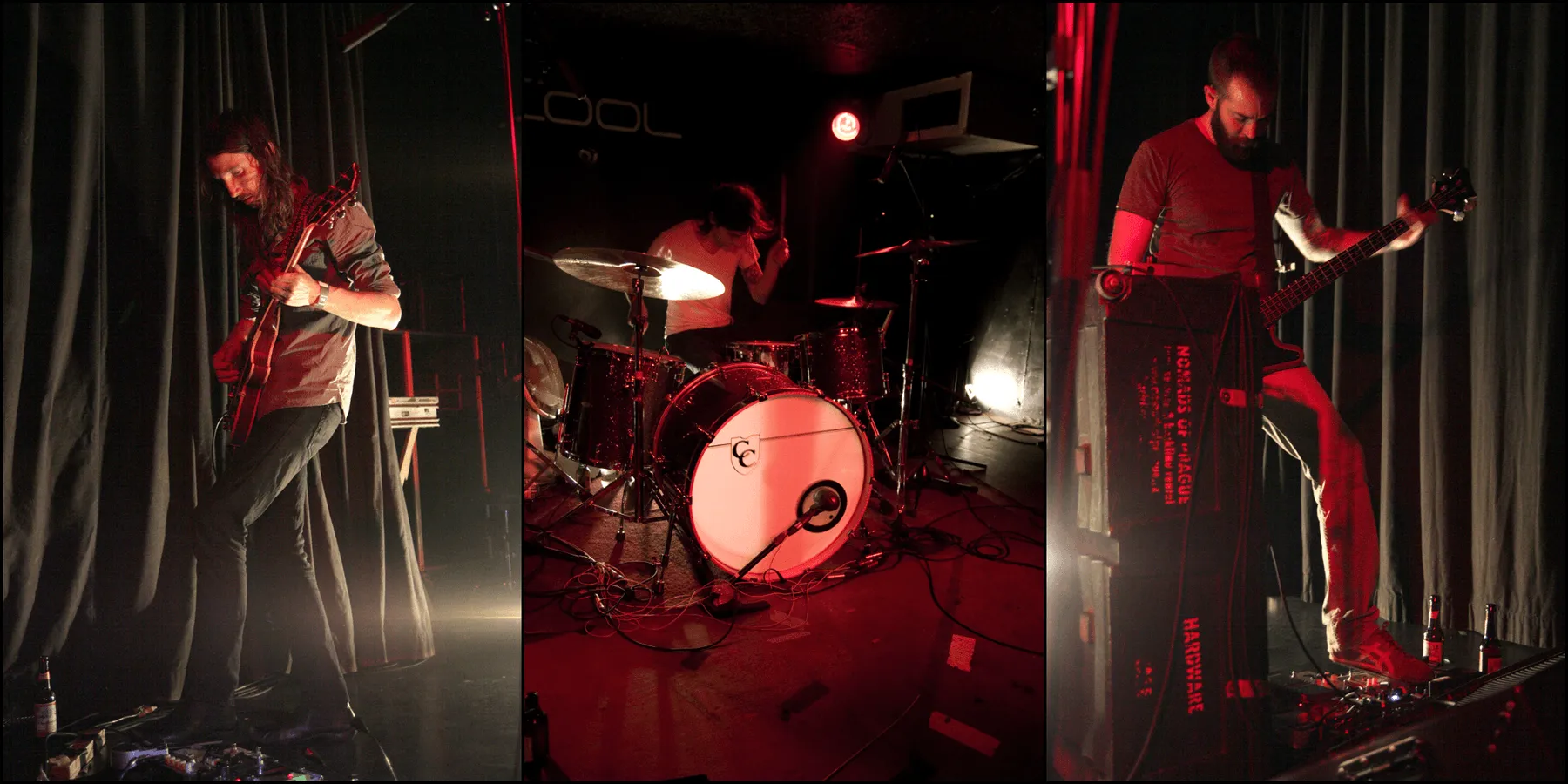
Russian Circles is an American instrumental post-metal band formed in Chicago in 2004. The trio—Mike Sullivan on guitar, Dave Turncrantz on drums, and Brian Cook on bass—has built a reputation as one of the defining acts in the intersection of post-rock and heavy metal. Without vocal melody to anchor their compositions, the band relies on instrumental dynamics, textural layering, and the physical weight of distorted guitars and thunderous rhythms to convey emotional and narrative arc. Their output across nearly two decades has established them as a cornerstone of the contemporary instrumental metal scene.
Formation Story
Mike Sullivan and Dave Turncrantz were childhood friends from St. Louis who grew up playing ice hockey; the band’s name itself references a drill exercise from that sport. Both musicians had been involved in previous projects that eventually dissolved, leaving them free to pursue a new collaboration. In 2004, they formed Russian Circles in Chicago and began developing an instrumental approach that would avoid traditional song structures built around lyrics or vocal hooks. The original lineup included Colin DeKuiper on bass, but after three years of initial formation and early recordings, DeKuiper departed in 2007. Brian Cook took over bass duties and stabilized the trio into the core lineup that would record the majority of the band’s catalog.
Breakthrough Moment
Russian Circles released their debut album, Enter, in 2006 on Flameshovel Records, establishing the template for their sound: heavy, layered guitar work atop solid rhythmic foundations, with no reliance on vocals. The band continued building a following through their subsequent albums Station (2008) and Geneva (2009), the latter of which marked a creative turning point. By the release of Empros in 2011, Russian Circles had generated enough critical momentum and international touring to be recognized as more than a regional Chicago act. Their combination of post-rock’s attention to dynamics with the visceral weight of metal aesthetics positioned them uniquely within instrumental rock at a moment when the genre was diversifying and expanding in popularity.
Peak Era
The years from 2011 through 2016 represented Russian Circles’ most creatively focused and commercially visible period. Empros (2011) established a more refined production approach and songwriting precision. Memorial (2013) deepened that trajectory, while Guidance (2016) demonstrated the band’s ability to evolve their compositional language without abandoning the core identity that had earned them a dedicated following. Throughout this span, Russian Circles became known for their rigorous approach to international touring, performing extensively across Europe, Asia, and North America. Their albums generated steady critical praise and built a fanbase that extended far beyond the post-rock underground, reaching audiences interested in metal, progressive music, and experimental instrumentation.
Musical Style
Russian Circles’ sound occupies a deliberate middle ground between post-rock and heavy metal. Sullivan’s guitar work emphasizes dense, layered textures that shift between clean, ambient passages and heavily distorted riffs that carry the weight and aggression of metal music. Turncrantz’s drumming ranges from minimal, jazz-influenced playing to pounding, metrical patterns that anchor heavier sections. Cook’s bass functions both as a foundational element and as a textural voice, often doubling guitar lines or carving out melodic space of its own. The band’s songwriting eschews traditional verse-chorus structures, instead building pieces through gradual accumulation, dynamic shifts, and thematic development. Where post-rock often emphasizes crescendo and cathartic release, Russian Circles harness metal’s emphasis on sustain, heaviness, and rhythmic precision, creating instrumental compositions that are both emotionally evocative and physically imposing.
Major Albums
Enter (2006)
The debut established Russian Circles’ instrumental foundation and introduced their core aesthetic of combining post-rock dynamics with metal heaviness, immediately distinguishing them from purely ambient or purely heavy instrumental projects.
Geneva (2009)
The third album refined the band’s compositional clarity and production depth, demonstrating their ability to sustain listener engagement across a full album without vocal melody.
Empros (2011)
A landmark release that solidified Russian Circles’ approach to extended instrumental narrative, showcasing tighter songwriting and more sophisticated interplay between the three instruments.
Guidance (2016)
Continued their evolution toward precise, nuanced songwriting while maintaining the heaviness and textural richness that defined their sound.
Signature Songs
- Atarchipelago — A showcase of the band’s ability to build tension through layered guitar and bass interplay before delivering a heavy payoff.
- Schaufel — Demonstrates the band’s use of repetitive rhythmic patterns and gradual textural accumulation to create hypnotic instrumental momentum.
- Deficit — Highlights Cook’s bass work as a melodic anchor within a heavy, distorted framework.
- Melocchio — A composition built on the contrast between clean, minimalist passages and aggressive, fully-realized metal sections.
Influence on Rock
Russian Circles arrived at a moment when instrumental metal and post-rock were reaching broader audiences, and they helped legitimize the notion that substantive rock music could exist without vocal melody. By grounding their work in both metal’s physical presence and post-rock’s structural sophistication, they influenced countless subsequent instrumental bands to embrace heaviness without apology. Their touring discipline and consistent album releases demonstrated a professional model for instrumental acts in an era when many assumed genre limitations would prevent substantial commercial sustainability. The band’s approach has resonated across metal, progressive rock, and experimental music communities, proving that instrumental rock could reach and move audiences at the scale of traditional rock bands.
Legacy
Russian Circles remained an active touring and recording entity into the 2020s, releasing Blood Year in 2019 and Gnosis in 2022, demonstrating sustained creative commitment two decades after formation. The band’s longevity and consistent output have secured their position within the contemporary rock canon as perhaps the most visible American instrumental post-metal ensemble. Their extensive international touring schedule and critical acceptance across multiple continents underscore their influence beyond underground or niche circles. The band’s sustained presence on streaming platforms and continued album releases have introduced their work to generations of listeners discovering instrumental rock and metal across digital platforms.
Fun Facts
- The band’s name derives from a drill exercise used in ice hockey, referencing the sport that both Sullivan and Turncrantz played growing up in St. Louis.
- Russian Circles released eight studio albums across their first eighteen years of existence, maintaining a consistent release schedule roughly every two to three years.
- The band has remained based in Chicago throughout their entire career, maintaining deep roots in the city’s music community despite international recognition.
Discography & Previews
Click any album to expand its track list. Each track plays a 30-second preview streamed from Apple Music. Tap the link icon next to a track to open it in Apple Music for full playback.