
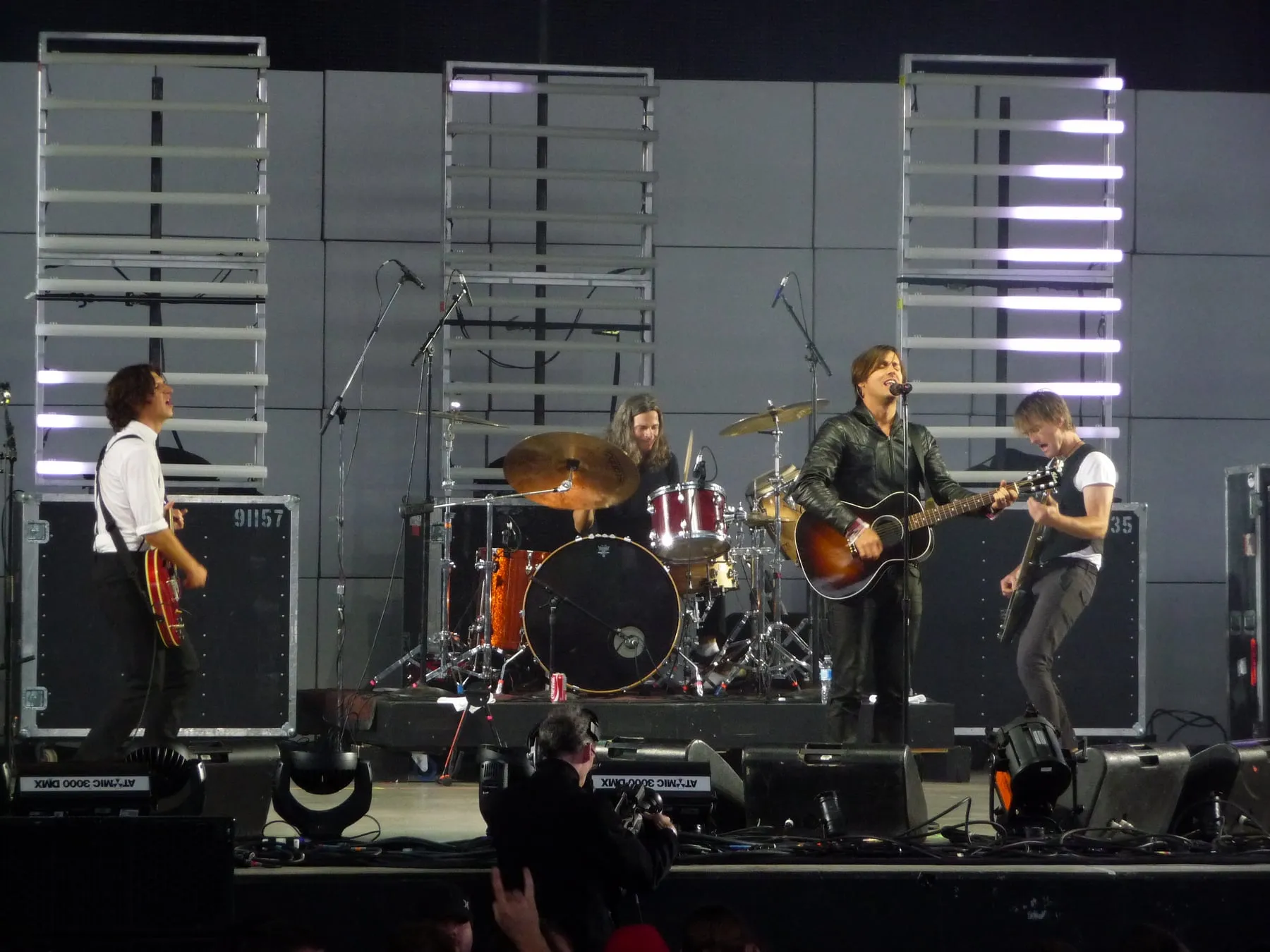
Photo by Charwinger21 , licensed under CC BY-SA 4.0 · Wikimedia Commons
Rank #343
Our Lady Peace
Toronto alt-rockers and one of Canada's biggest 90s rock exports.
From Wikipedia
Our Lady Peace is a Canadian alternative rock band formed in Toronto, Ontario in 1992. Led by lead vocalist Raine Maida since its formation, the band currently also features Duncan Coutts on bass, Steve Mazur on guitars, and Jason Pierce on drums. The band has sold several million albums worldwide, won four Juno Awards, and won ten MuchMusic Video Awards—the most MMVAs ever awarded to a band. Nineteen of their singles have reached the Top Ten on one of Canada's singles charts. Between 1996 and 2016, Our Lady Peace was the third best-selling Canadian band and the ninth best-selling Canadian artist overall in Canada.
Members
- Jeremy Taggart
Studio Albums
- 1994 Naveed
- 1997 Clumsy
- 1999 Happiness… Is Not a Fish That You Can Catch
- 2000 Unplugged
- 2000 Spiritual Machines
- 2002 Gravity
- 2005 Healthy in Paranoid Times
- 2009 Burn Burn
- 2012 Curve
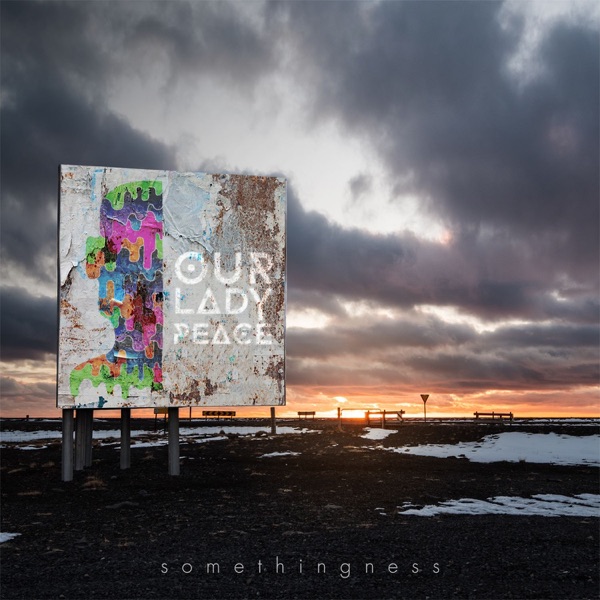
- 2018 Somethingness
- 2022 Spiritual Machines II
Source: MusicBrainz
Deep Dive
Overview
Our Lady Peace is a Canadian alternative rock band that emerged from Toronto in 1992 and became one of the nation’s most commercially successful rock exports. Led throughout their existence by vocalist Raine Maida, the band anchored Canadian rock radio through the latter half of the 1990s and into the 2000s, establishing a blueprint for post-grunge success in a country that had produced relatively few arena-filling rock acts. Between 1996 and 2016, they ranked as the third best-selling Canadian band and ninth best-selling Canadian artist overall in their home market—a testament to their sustained commercial presence across three decades.
Formation Story
Our Lady Peace coalesced in Toronto in 1992, with Raine Maida as the band’s founding voice and creative anchor. Maida’s presence defined the group from inception; his distinctive vocal timbre and songwriting approach set the band apart from the wave of American grunge and post-grunge bands saturating rock radio at the time. The Toronto scene of the early 1990s provided the launching pad for a group that would eventually include Jeremy Taggart on drums, Duncan Coutts on bass, and Steve Mazur on guitars. The city’s alternative rock infrastructure, underdeveloped compared to Seattle or Los Angeles but hungry for homegrown talent, allowed the band to build a loyal fanbase before major-label attention arrived.
Breakthrough Moment
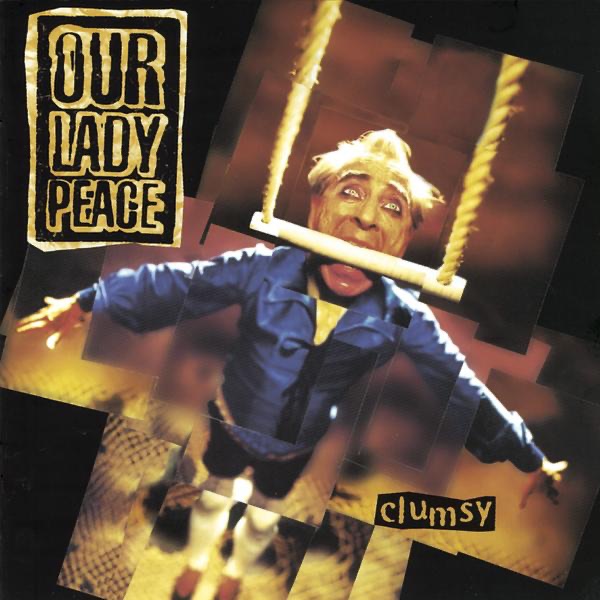
The band’s breakthrough came with their second album, Clumsy (1997), which established them as more than a regional curiosity. Clumsy captured the attention of Canadian radio programmers and audiences across the country, propelling the band into the mainstream conversation about contemporary rock. The album’s success positioned Our Lady Peace as representatives of a distinctly Canadian alternative rock identity, separate from both British Britpop and American grunge lineage. Their commercial momentum accelerated through the late 1990s, with Happiness… Is Not a Fish That You Can Catch (1999) consolidating their status as arena-level performers and radio staples.
Peak Era
The early 2000s marked Our Lady Peace’s commercial and critical apex. Spiritual Machines (2000) and Gravity (2002) represented the band at the height of their creative ambition and commercial reach. During this period, nineteen of their singles reached the Top Ten on Canadian singles charts, a remarkable consistency that underscored their command of domestic rock radio. The band’s ability to produce hits across multiple albums—not merely as one-album wonders—demonstrated both songwriting depth and an evolving sonic palette. This era also saw them accumulate four Juno Awards and establish themselves as one of Canada’s most awarded rock acts, with ten MuchMusic Video Awards collectively, the most ever awarded to a single band at that time.
Musical Style
Our Lady Peace trafficked in alternative rock with distinct post-grunge inflections, though their sound proved more melodic and less guitar-centric than many of their international contemporaries. Maida’s vocals—clear, often introspective, occasionally soaring into anthemic territory—drove most arrangements rather than serving as mere accompaniment to instrumental prowess. The band’s production choices across their discography reflected the studio aesthetics of their era: Spiritual Machines embraced electronic textures and layered arrangement, while Gravity leaned into a more stripped, direct rock approach. Their songwriting typically balanced introspection with accessibility, crafting songs built for radio airplay without sacrificing lyrical complexity. Duncan Coutts’s bass and Jeremy Taggart’s drumming provided a rhythmically solid foundation that allowed Mazur’s guitar work to function as textural enhancement rather than dominating force, a choice that distinguished them from heavier post-grunge acts.
Major Albums
Naveed (1994)
The band’s debut introduced Maida’s vocal approach and established the alternative rock foundation they would develop across subsequent records, proving strong enough to justify the major-label backing that followed.
Clumsy (1997)
The album that transformed the band from local act to national concern, Clumsy showcased a sharper songwriting focus and larger production scope, becoming the cornerstone of their breakthrough period.
Spiritual Machines (2000)
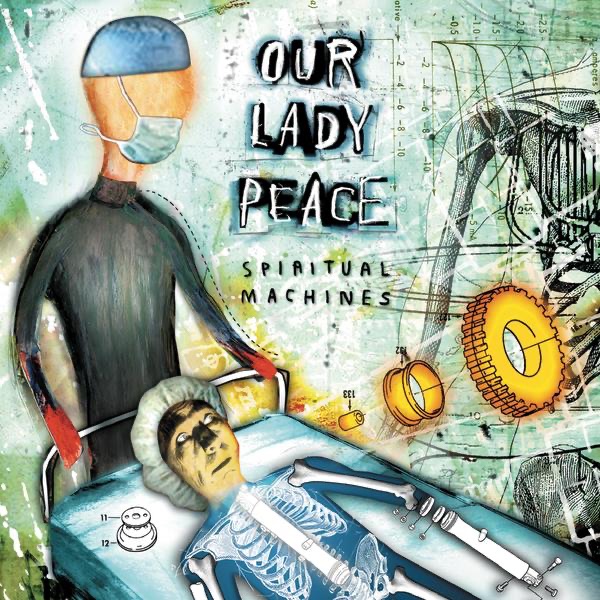
Ambitious and expansive, Spiritual Machines incorporated electronic production and thematic conceptual elements, representing the band’s most adventurous studio work during their commercial peak.
Gravity (2002)
A return to a more grounded rock approach, Gravity proved that the band could achieve commercial success through direct songwriting and streamlined arrangement rather than studio experimentation.
Curve (2012)
Ten years into their career, Curve demonstrated sustained songwriting vitality and their ability to remain relevant across changing rock radio landscapes.
Spiritual Machines II (2022)
A direct sequel to their 2000 album, Spiritual Machines II marked their return to themes and sonic territory explored two decades earlier, suggesting a cyclical approach to their legacy.
Signature Songs
- Starseed — An earworm of immediate melodic appeal that showcased Maida’s ability to craft radio-friendly hooks without sacrificing emotional depth.
- Superman’s Dead — Among their most recognizable tracks, demonstrating the band’s knack for pairing introspective lyrics with stadium-ready arrangement.
- Naveed — The title track from their debut, establishing the template for their songwriting approach and vocal presentation.
- Innocent Man — Representative of their mid-period work, balancing accessibility with compositional sophistication.
- Too Late for Roses — A showcase for the band’s melodic sensibilities and Maida’s expressive vocal range.
Influence on Rock
Our Lady Peace’s primary contribution to rock music lay in proving that Canadian alternative rock could achieve sustained commercial success without relocating to the United States or adopting wholesale American post-grunge mannerisms. Their prominence helped establish Toronto and Canada more broadly as viable sources of rock talent, influencing how major labels approached Canadian A&R in the decades that followed. While not pioneers of a specific sonic innovation, they demonstrated that melodic, accessible alternative rock with introspective lyrics could command mainstream radio without compromise, a lesson that rippled through early-2000s rock radio programming. Their consistency across multiple albums also served as a model for how alternative rock bands could maintain commercial relevance across shifting genre fashions rather than burning bright as one-album phenomena.
Legacy
Our Lady Peace remains embedded in Canadian popular culture in a way few rock bands achieve, with their discography spanning three decades of domestic radio presence and streaming availability. The band’s decision to return to Spiritual Machines conceptual territory with Spiritual Machines II (2022) signaled an ongoing creative engagement with their own history rather than nostalgia-driven repetition. Their Juno Award recognition and MuchMusic prominence established them as fixtures of Canadian music industry infrastructure, while their consistent touring presence has maintained their connection to live audiences. The breadth of their commercial success—measured in sustained chart presence and sales across multiple album cycles—positioned them as benchmarks against which subsequent Canadian rock acts have been measured.
Fun Facts
- The band released Unplugged in 2000, capturing acoustic arrangements of their material during their commercial peak, demonstrating both the strength of their songwriting and their comfort with stripped-down interpretations.
- With nineteen Top Ten singles on Canadian charts, Our Lady Peace’s ratio of hit singles to total output remains among the highest of any rock band from their era.
- Their ten MuchMusic Video Award wins established a record for any single band, reflecting both the music video prominence of their era and the strength of their visual presentation alongside their sonic output.
Discography & Previews
Click any album to expand its track list. Each track plays a 30-second preview streamed from Apple Music. Tap the link icon next to a track to open it in Apple Music for full playback.


- 1 R.K. Intro ↗ 0:06
- 2 Right Behind You (Mafia) ↗ 3:13
- 3 R.K. 2029 ↗ 0:15
- 4 In Repair ↗ 3:58
- 5 Life ↗ 4:23
- 6 Middle of Yesterday ↗ 3:55
- 7 Are You Sad ↗ 5:07
- 8 R.K. 2029, Pt. 2 ↗ 0:12
- 9 Made to Heal ↗ 3:47
- 10 R.K. 1949-97 ↗ 0:44
- 11 Everyone's a Junkie ↗ 3:37
- 12 R.K. On Death ↗ 0:40
- 13 All My Friends ↗ 3:37
- 14 If You Believe ↗ 3:34
- 15 The Wonderful Future ↗ 20:00

- 1 Angels / Losing / Sleep ↗ 4:32
- 2 Will the Future Blame Us ↗ 4:26
- 3 Picture ↗ 3:36
- 4 Where Are You ↗ 4:07
- 5 Wipe That Smile Off Your Face ↗ 4:24
- 6 Love and Trust ↗ 3:21
- 7 Boy ↗ 4:35
- 8 Apology ↗ 3:47
- 9 The World On a String ↗ 3:25
- 10 Don't Stop ↗ 3:46
- 11 Walking In Circles ↗ 3:33
- 12 Al Genina (Leave the Light On) ↗ 2:15



- 1 RK1.Age of Spiritual Machines ↗ 0:14
- 2 Stop Making Stupid People Famous (feat. P***y Riot) ↗ 3:07
- 3 Holes ↗ 3:18
- 4 RK2.Consciousness ↗ 0:29
- 5 The Message ↗ 3:57
- 6 Wish You Well ↗ 4:45
- 7 Rk3.Ubi ↗ 0:22
- 8 Future Disease ↗ 5:18
- 9 19 Days ↗ 3:39
- 10 Run ↗ 2:58
- 11 RK4.Escape Velocity (feat. EMTEE) ↗ 1:02
- 12 Simulation ↗ 2:52
- 13 Good Die Young ↗ 3:26
- 14 RK5.Turing Test ↗ 0:17
- 15 Temporary Healing ↗ 4:53