
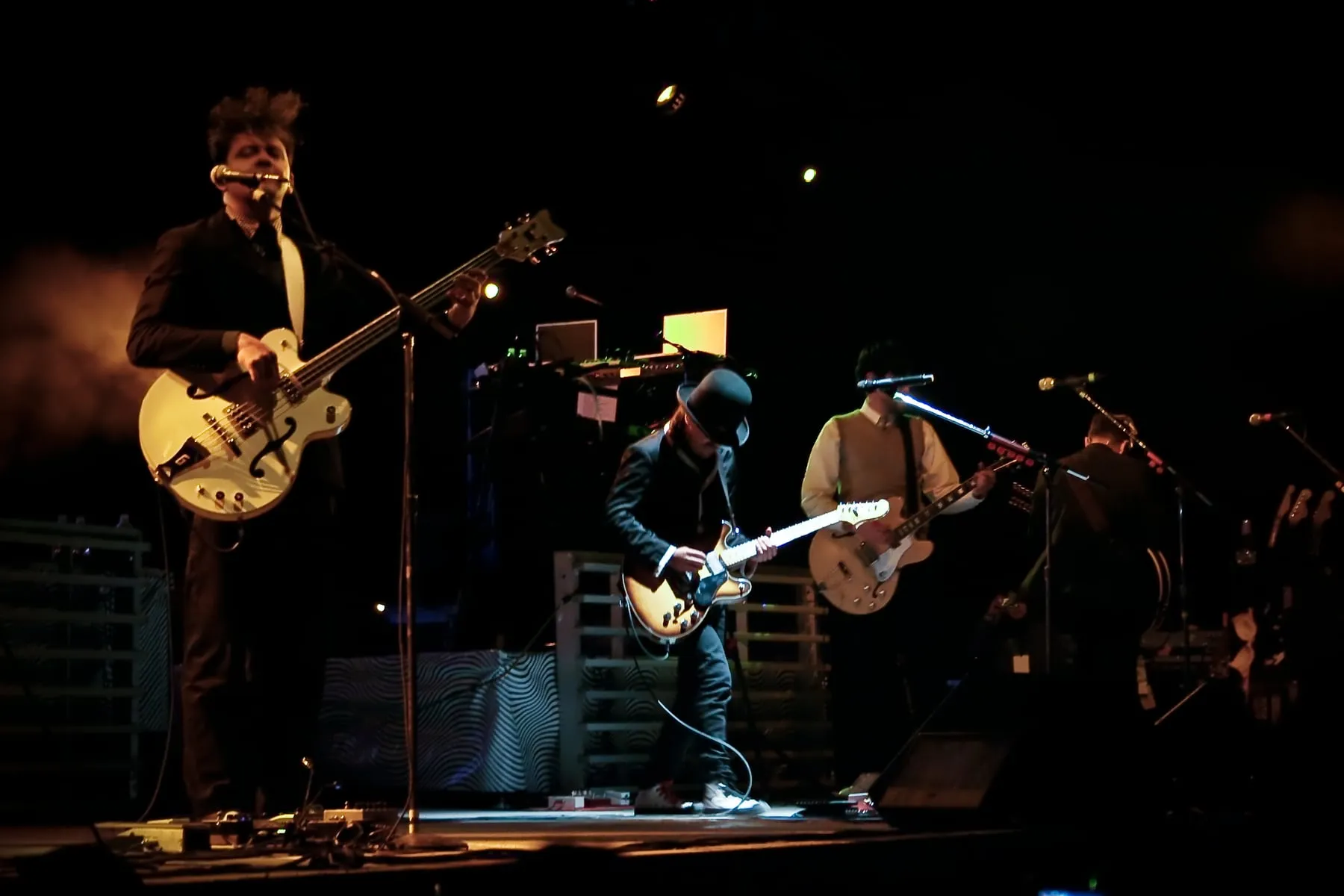
Photo by Karhton , licensed under CC BY 2.0 · Wikimedia Commons
Rank #265
Café Tacuba
Mexico City eclectics whose music spans rock en español, electronica, and more.
From Wikipedia
Café Tacuba is a Mexican rock band formed in 1989 in Naucalpan de Juárez, State of Mexico. The group gained popularity in the early 1990s. They were founded in 1989, before they had the current lineup of Rubén Isaac Albarrán Ortega, Emmanuel del Real Díaz, José Alfredo "Joselo" Rangel Arroyo, and Enrique "Quique" Rangel Arroyo, their friend Roberto Silva played the keyboards for a short period of time. Since the Cuatro Caminos World Tour, Luis "El Children" Ledezma has played the drums in every concert but is not considered an official member of the band, as well as Ramiro Del Real Díaz, who joined the band as a support musician playing the guitar since 2015.
Members
- Emmanuel del Real (1989–present)
- Enrique Rangel Arroyo (1989–present)
- Joselo Rangel (1989–present)
- Rubén Albarrán (1989–present)
Deep Dive
Overview
Café Tacuba stands as one of Mexico’s most prominent alternative rock bands, emerging from Mexico City in 1989 and gaining widespread popularity throughout the 1990s. The group’s music synthesizes rock en español with electronic elements, indie sensibilities, and experimental arrangements, positioning them as eclectics within both Mexican rock and the broader Latin American alternative music landscape. Their formation during the tail end of the 1980s placed them at the vanguard of a new generation of Mexican rock artists who moved beyond the previous era’s conventions.
Formation Story
Café Tacuba was founded in 1989 in the Mexico City metropolitan area, specifically in Iztapalapa, by four core members: Rubén Albarrán, Emmanuel del Real, Joselo Rangel, and Enrique Rangel Arroyo. The band coalesced around a shared vision of experimental rock that drew from Mexico’s rich musical heritage while incorporating contemporary alternative and electronic influences. In their early years, the group’s lineup was supplemented by additional musicians, including keyboardist Roberto Silva, who contributed for a brief period during the band’s formative stage. By the early 1990s, the core quartet had solidified their working relationship and begun to develop the stylistic identity that would define their subsequent albums.
Breakthrough Moment
Café Tacuba’s rise to prominence occurred in the early 1990s, a period when Mexican alternative rock was still establishing itself as a legitimate commercial and artistic force. The group’s distinctive approach—melding rock en español with electronic textures and unconventional song structures—resonated with audiences across Mexico and beyond. Their growing reputation during this era established them as central figures in a movement that challenged traditional assumptions about what Mexican rock could sound like, opening doors for subsequent generations of alternative artists working in Spanish-language contexts.
Peak Era
The 1990s represented Café Tacuba’s most creatively fertile and commercially successful period. During this decade, the band solidified their reputation as innovators within alternative rock and Latin rock circles, touring extensively and building a fanbase that extended across Mexico and into the broader Spanish-speaking world. Their willingness to experiment with electronic production, incorporate diverse rhythmic influences, and abandon conventional verse-chorus structures set them apart from more traditional rock acts and established them as intellectual and sonic leaders within the Mexican rock community. The band’s performances and recorded work during this era demonstrated a commitment to pushing the boundaries of what rock music sung in Spanish could encompass.
Musical Style
Café Tacuba’s sound defies easy categorization, intentionally blending multiple genres and cultural influences into cohesive arrangements. Their music incorporates the foundational elements of rock en español—Spanish-language lyrics combined with electric rock instrumentation—while layering in electronica, sampling, and production techniques drawn from contemporary alternative and experimental music. The band’s songwriting emphasizes complex arrangements, unconventional time signatures, and rhythmic sophistication. Vocally, Rubén Albarrán’s delivery ranges across multiple registers and emotional registers, from conversational passages to more soaring moments, serving as a flexible instrument within the broader sonic palette. The band’s approach reflects the broader trajectory of 1990s alternative rock, but filtered through the specific cultural and linguistic context of Mexico, resulting in music that sounds distinctly Mexican while remaining engaged with global contemporary trends.
Major Albums
Untitled Debut (1992)
Café Tacuba’s first album introduced their eclectic blend of rock, electronic elements, and experimental production, establishing the group as serious innovators within the Mexican music scene.
Re (1994)
The album demonstrated the band’s growing confidence in blending diverse influences, featuring arrangements that combined traditional instrumentation with electronic textures and unconventional structures.
Avalancha de exitos (1996)
This release solidified their status as leading figures in Latin American alternative rock, showcasing their ability to write memorable songs without sacrificing experimental sensibilities.
Cuatro caminos (1998)
By this album, Café Tacuba had established a mature sound that balanced accessibility with complexity, and the accompanying Cuatro Caminos World Tour expanded their reach internationally while introducing drummer Luis Ledezma, who would become a permanent fixture in their live performances.
Signature Songs
- Eres — A track that exemplifies the band’s gift for melody and emotional directness within arrangements that remain unconventional and textured.
- La negra — Showcases the band’s engagement with Mexican traditional music alongside contemporary rock sensibilities.
- Afirma — Demonstrates their ability to construct complex arrangements while maintaining lyrical clarity and emotional impact.
Influence on Rock
Café Tacuba’s emergence and sustained success helped legitimize alternative rock as a viable form for Spanish-language music in a period when English-language alternative rock dominated global attention. By demonstrating that rock music could be experimental, intellectually sophisticated, and sung entirely in Spanish, they opened creative and commercial pathways for subsequent Mexican and Latin American rock artists. Their eclecticism—refusal to be bound by genre conventions or stylistic purity—modeled a different approach to rock music-making in Latin America, one that balanced artistic ambition with cultural specificity. The band’s influence extended beyond rock proper into broader Latin American music discourse, contributing to the 1990s’ growing recognition of Mexico City’s music scene as a site of creative innovation.
Legacy
Café Tacuba remains active as of the present day, maintaining their position within Mexico’s rock landscape more than three decades after their formation. Their longevity and continued presence in live performance—particularly through the ongoing participation of Luis Ledezma on drums and later the addition of support musicians including guitarist Ramiro del Real—demonstrates the durability of their foundational vision. The band’s recording catalog, spanning from their early 1990s breakthrough through subsequent decades, has maintained a place in streaming platforms and digital catalogs, ensuring their music remains accessible to both longtime listeners and new generations discovering Mexican alternative rock. Their status as early architects of a distinct Mexican alternative rock identity places them within the historical continuum of rock music in Latin America.
Fun Facts
- The band’s name, Café Tacuba, references a small café in Mexico City and has remained unchanged throughout their three-decade career.
- Roberto Silva’s early contributions on keyboards highlighted the band’s openness to collaborative arrangements during their formative period, though his participation lasted only briefly before the core quartet established themselves as the primary working unit.
- The Cuatro Caminos World Tour marked a significant expansion of the band’s international profile while also establishing the long-term touring partnership with drummer Luis Ledezma, whose involvement in live performances began during this period.