
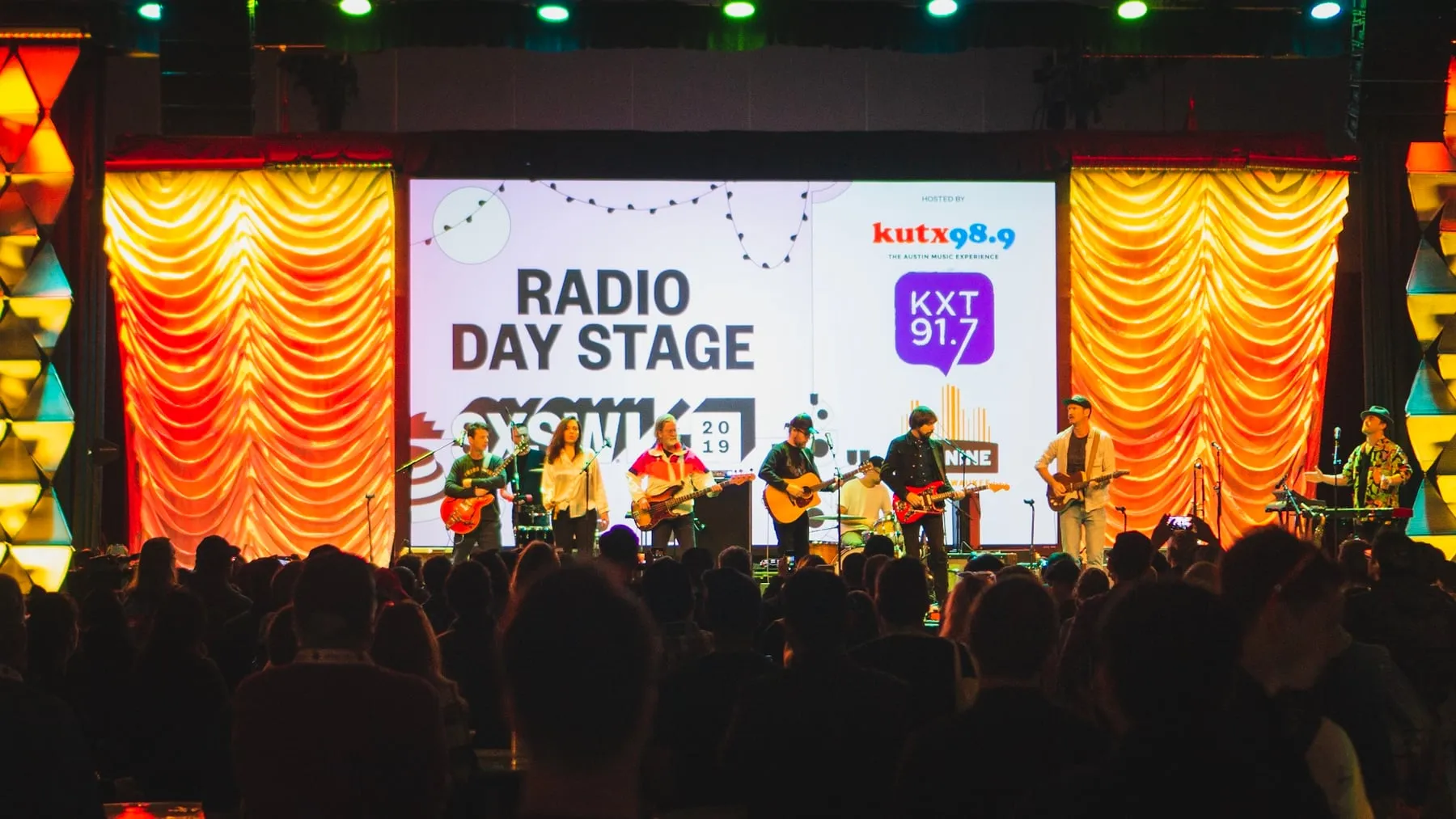
Photo by Paul Hudson from United Kingdom , licensed under CC BY 2.0 · Wikimedia Commons
Rank #335
Broken Social Scene
Toronto indie-rock collective and 2000s Canadian indie hub.
From Wikipedia
Broken Social Scene is a Canadian indie rock band and musical collective including as few as six and as many as nineteen members, formed by Kevin Drew and Brendan Canning in 1999. Alongside Drew and Canning, the other core members of the band are Justin Peroff (drums), Andrew Whiteman (guitar) and Charles Spearin (guitar). Other longtime members and collaborators include Evan Cranley, Sam Goldberg (guitar), James Shaw and David French. Vocalists Leslie Feist, Emily Haines, Amy Millan, Lisa Lobsinger and Ariel Engle have made significant contributions to the band's studio albums and live performances across its career.
Members
- Brendan Canning
Studio Albums
- 2001 Feel Good Lost
- 2002 You Forgot It in People
- 2004 Broken Social Scene
- 2010 Forgiveness Rock Record
- 2017 Hug of Thunder
- 2026 Remember the Humans
Source: MusicBrainz
Deep Dive
Overview
Broken Social Scene is a Canadian indie rock band and musical collective formed in Toronto in 1999 by Kevin Drew and Brendan Canning. The group operates as a fluid ensemble, ranging from six core members to as many as nineteen musicians depending on the project or performance. Rooted in art rock and alternative sensibilities, Broken Social Scene emerged as a defining force in Canadian indie rock during the 2000s, functioning simultaneously as a recording project, a live phenomenon, and a creative hub that fostered connections among Toronto’s broader independent music scene.
Formation Story
Kevin Drew and Brendan Canning formed Broken Social Scene in 1999, establishing the group’s base in Toronto. From the outset, the collective operated around a flexible core: Drew and Canning anchored the project, while Justin Peroff contributed drums, and guitarists Andrew Whiteman and Charles Spearin became permanent fixtures in the ensemble’s sound. Rather than a traditional four- or five-piece rock band, Broken Social Scene embraced a collaborative model that invited a rotating cast of musicians and vocalists. Longtime members including Evan Cranley, Sam Goldberg, James Shaw, and David French brought additional instrumental textures, while vocalists—most notably Leslie Feist, Emily Haines, Amy Millan, Lisa Lobsinger, and Ariel Engle—added layered vocal harmonies and distinct melodic perspectives across recordings and live shows.
Breakthrough Moment
Broken Social Scene released their debut album, Feel Good Lost, in 2001. The following year, 2002, brought You Forgot It in People, a double album that marked a significant expansion of the group’s sonic ambitions and introduced their intricate, orchestral approach to indie rock. These early recordings established the band’s reputation within the Canadian underground and signaled their intention to create densely layered, emotionally expansive music that eschewed the spare aesthetic dominating much of 1990s indie rock. By the early 2000s, Broken Social Scene had become recognized as one of Canada’s most vital independent acts, though they remained less visible in American mainstream music discourse than many of their British or U.S. counterparts.
Peak Era
The mid-2000s represented Broken Social Scene’s creative and commercial peak. In 2004, the band released their eponymous third album, Broken Social Scene, which crystallized the collective’s vision and brought the group broader recognition. This period saw the ensemble at its most cohesive and ambitious, synthesizing influences from art rock, post-rock, and psychedelia into a distinctive sound that reflected Toronto’s independent music culture. The mid-2000s marked the height of their ability to command attention as a touring attraction and recording entity, though their sprawling membership and collaborative ethos ensured that each project remained distinct in instrumentation and arrangement.
Musical Style
Broken Social Scene’s sound is characterized by densely orchestrated arrangements, layered guitars, and a rich instrumental palette that often includes strings and keyboards. Their approach owes debts to art rock traditions and post-rock atmospherics, but their emphasis on melody and vocal harmonies distinguishes them from purely instrumental or ambient-leaning contemporaries. The band’s production is typically lush and detailed, with multiple vocalists trading and layering vocals to create a widescreen effect. Songs often build gradually, introducing elements across verses and choruses rather than relying on conventional rock structures. The revolving cast of vocalists means that no single voice dominates; instead, the human element is often distributed across the ensemble, reinforcing the collective identity. Andrew Whiteman and Charles Spearin’s guitar work tends toward textural and modal exploration rather than traditional rock soloing, creating washes of sound that support rather than dominate the compositions.
Major Albums
Feel Good Lost (2001)
The band’s debut established their multilayered instrumental approach and collaborative ethos, introducing the core ensemble’s ability to blend indie rock sensibilities with orchestral ambition.
You Forgot It in People (2002)
A double album that expanded the band’s sonic scope significantly, showcasing their skill at arranging complex pieces across extended running times and cementing their reputation as innovators in Canadian indie rock.
Broken Social Scene (2004)
Their self-titled third album represented the creative peak of this era, balancing accessibility with experimental impulses and featuring some of their most memorable instrumental and vocal arrangements.
Forgiveness Rock Record (2010)
Released after a six-year gap, this album marked the band’s return and demonstrated their continued evolution, reasserting their presence after a period of relative quiet.
Hug of Thunder (2017)
This later album confirmed the collective’s enduring creative capacity, arriving more than a decade into their career and proving their ability to remain vital without chasing trends.
Signature Songs
- “Feels Good Lost” — The opening statement from their 1999 formation period, establishing the band’s early aesthetic.
- “Park Life” — A showcase for the ensemble’s ability to layer vocals and instruments into an emotionally resonant whole.
- “Anthems for a Seventeen Year Old Girl” — Features Leslie Feist on vocals and exemplifies the band’s gift for crafting melodically sophisticated indie rock compositions.
Influence on Rock
Broken Social Scene’s primary influence lies in demonstrating the viability of the indie rock collective model in the 2000s. Their success—both critical and in terms of sustained touring and recording—offered an alternative to the traditional rock band hierarchy. In doing so, they influenced how Canadian indie rock was perceived internationally and influenced similar projects that embraced fluid membership, orchestral instrumentation, and collaborative songwriting. The band functioned as a cultural hub, fostering relationships among Toronto-based musicians and helping establish the city as a meaningful center for independent rock music production during the 2000s. Their aesthetic of densely layered, melodically conscious indie rock influenced the broader sound palette of the decade’s art rock and post-rock movements.
Legacy
Broken Social Scene’s legacy centers on their role as a distinctive voice in 2000s indie rock and as exemplars of the collective-based band model. Their continued activity—releasing Remember the Humans in 2026—demonstrates sustained artistic engagement across more than twenty-five years. The band’s status as a Toronto institution and their influence on Canadian independent music remains significant. Their recordings from the early and mid-2000s are widely available on streaming platforms and continue to reach listeners discovering the era’s alternative rock catalog. The ensemble’s flexible approach to membership and instrumentation established a template that other groups have adopted, and their work stands as a document of how Canadian indie rock evolved during a particularly fertile creative period.
Fun Facts
- The band’s membership can range from six core musicians to as many as nineteen members across different projects and live configurations, making them one of rock’s most fluid ensembles in terms of size and lineup changes.
- Broken Social Scene are based at Arts & Crafts Productions, a Canadian independent label that has become closely associated with Toronto’s indie rock infrastructure.
- Leslie Feist, one of the band’s most prominent vocalists, went on to a significant solo career while maintaining her connection to the collective.
Discography & Previews
Click any album to expand its track list. Each track plays a 30-second preview streamed from Apple Music. Tap the link icon next to a track to open it in Apple Music for full playback.

- 1 I Slept With Bonhomme At The CBC ↗ 5:26
- 2 Guilty Cubicles ↗ 3:04
- 3 Love And Mathematics ↗ 5:45
- 4 Passport Radio ↗ 5:45
- 5 Alive In 85 ↗ 5:15
- 6 Prison Province ↗ 1:43
- 7 Blues For Uncle Gibb ↗ 6:59
- 8 Stomach Song ↗ 4:30
- 9 Mossbraker ↗ 5:33
- 10 Feel Good Lost ↗ 1:52
- 11 Last Place ↗ 8:26
- 12 Cranley's Gonna Make It ↗ 5:27

- 1 Capture The Flag ↗ 2:09
- 2 KC Accidental ↗ 3:51
- 3 Stars And Sons ↗ 5:09
- 4 Almost Crimes (Radio Kills Remix) ↗ 4:23
- 5 Looks Just Like The Sun ↗ 4:23
- 6 Pacific Theme ↗ 5:09
- 7 Anthems For A Seventeen Year-Old Girl ↗ 4:36
- 8 Cause = Time ↗ 5:31
- 9 Late Nineties Bedroom Rock For The Missionaries ↗ 3:47
- 10 Shampoo Suicide ↗ 4:05
- 11 Lover's Spit ↗ 6:22
- 12 I'm Still Your F*g ↗ 4:24
- 13 Pitter Patter Goes My Heart ↗ 2:24

- 1 Our Faces Split the Coast In Half ↗ 3:42
- 2 Ibi Dreams of Pavement (A Better Day) ↗ 4:28
- 3 7/4 (Shoreline) ↗ 4:54
- 4 Finish Your Collapse and Stay For Breakfast ↗ 1:24
- 5 Major Label Debut ↗ 4:28
- 6 Fire Eye'd Boy ↗ 3:59
- 7 Windsurfing Nation ↗ 4:36
- 8 Swimmers ↗ 2:56
- 9 Hotel ↗ 4:36
- 10 Handjobs For the Holidays ↗ 4:39
- 11 Superconnected ↗ 5:40
- 12 Bandwitch ↗ 6:59
- 13 Tremola Debut ↗ 0:59
- 14 It's All Gonna Break ↗ 9:55

- 1 World Sick ↗ 6:48
- 2 Chase Scene ↗ 3:31
- 3 Texico Bitches ↗ 3:50
- 4 Forced To Love ↗ 3:35
- 5 All To All ↗ 4:50
- 6 Art House Director ↗ 3:32
- 7 Highway Slipper Jam ↗ 4:27
- 8 Ungrateful Little Father ↗ 6:42
- 9 Meet Me In the Basement ↗ 3:44
- 10 Sentimental X's ↗ 5:40
- 11 Sweetest Kill ↗ 5:09
- 12 Romance To the Grave ↗ 4:48
- 13 Water In Hell ↗ 4:25
- 14 Me and My Hand ↗ 2:05


- 1 Not Around Anymore ↗ 3:52
- 2 Only The Good I Keep ↗ 3:27
- 3 Mission Accomplished (Kingfisher) ↗ 3:13
- 4 The Call ↗ 4:13
- 5 Relief ↗ 3:28
- 6 And I Think Of You ↗ 5:52
- 7 This Briefest Kiss ↗ 6:01
- 8 Life Within The Ground ↗ 4:24
- 9 Hey Amanda ↗ 3:31
- 10 Paying For Your Love ↗ 3:29
- 11 What Happens Now ↗ 5:29
- 12 Parking Lot Dreams ↗ 2:44