
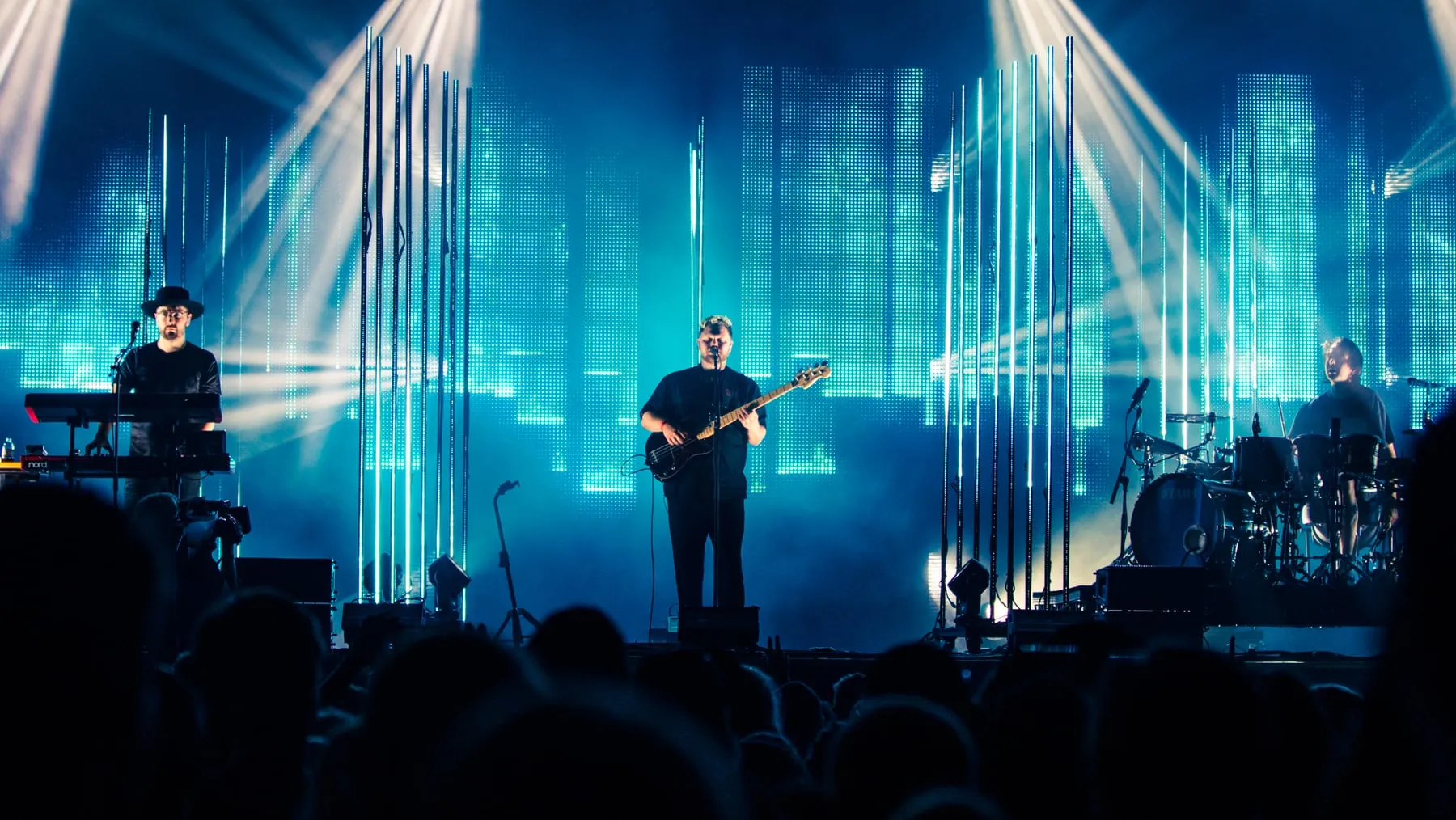
Photo by ThorntonDrury , licensed under CC BY-SA 4.0 · Wikimedia Commons
Rank #374
alt-J
Leeds-formed art-pop band of choral harmonies and quirky structure.
From Wikipedia
Alt-J are an English indie rock band formed in 2007 in Leeds. Their lineup includes Joe Newman, Thom Sonny Green (drums), Gus Unger-Hamilton (keyboards/vocals), and formerly Gwil Sainsbury (guitar/bass).
Studio Albums
- 2012 An Awesome Wave
- 2014 This Is All Yours
- 2017 Relaxer
- 2022 The Dream
Source: MusicBrainz
Deep Dive
Overview
alt-J are an English indie rock band formed in Leeds who emerged in the early 2010s as practitioners of art-pop marked by densely layered choral harmonies, angular instrumentation, and structural unpredictability. Across four studio albums from 2012 to 2022, the band has occupied an unusual position within indie rock—too ornate and conceptually restless for mainstream radio, yet too melodically engaging and pop-leaning for pure art-rock audiences. Their sound synthesizes elements of folktronica, indie pop, and art rock into arrangements that prioritize strangeness and precision in equal measure.
Formation Story
alt-J coalesced in Leeds in 2007 and 2008, a period when the city’s indie music scene remained secondary to London’s cultural dominance. The core lineup that would record their debut consisted of Joe Newman, Thom Sonny Green on drums, Gus Unger-Hamilton handling keyboards and vocals, and guitarist and bassist Gwil Sainsbury. The four musicians shared an approach to songwriting that rejected conventional verse-chorus-verse dynamics in favor of fragmented, almost puzzle-box arrangements where melodies interlocked across multiple vocal lines and no instrument held a stable role. This aesthetic emerged partly from the constraints of their formation years, when the band worked to define an identity distinct from the post-punk revivalists and Arctic Monkeys-derived acts dominating British indie rock.
Breakthrough Moment
alt-J’s debut album An Awesome Wave, released in 2012, announced the band to a wider audience with immediate critical recognition. The record’s lead single and its moody, polyrhythmic production style generated substantial streaming plays on platforms like Spotify, which by 2012 had begun reshaping how independent artists built fanbases outside traditional radio. An Awesome Wave combined lo-fi textures with almost madrigal-like vocal arrangements, creating an aesthetic that felt simultaneously homemade and intricately orchestrated. The album’s success was neither commercial in a conventional sense nor confined to the underground; instead, it found an audience among listeners seeking formally adventurous indie rock that avoided both the bombast of legacy alt-rock and the slickness of contemporary pop. This position—artful but accessible, strange but listenable—became the band’s defining commercial niche.
Peak Era
The period spanning This Is All Yours (2014) and Relaxer (2017) represented alt-J’s most prominent phase. This Is All Yours demonstrated the band’s growing confidence in dissonance and abstraction, pushing the choral harmonies and rhythmic games further into avant-garde territory while maintaining enough melodic hooks to sustain engagement. Relaxer, arriving three years later, found the band developing a slightly more spacious sound, with cleaner production and a willingness to let phrases breathe rather than compress every moment into ornamental density. Both albums consolidated a devoted fanbase of listeners drawn to experimental indie rock, and both cemented the band’s reputation among music critics and tastemakers as serious compositional artists working within the indie rock idiom.
Musical Style
alt-J’s sound rests on the foundation of densely stacked vocals—often featuring Newman, Green, and Unger-Hamilton singing in unconventional harmony arrangements that reference both choral traditions and modern vocal processing. Harmonically, the band tends toward chromatic movement and unexpected chord substitutions, avoiding the major-key straightforwardness of mainstream indie pop. Rhythmically, their songs frequently employ polyrhythmic patterns and syncopations that place drums and melodic voices in productive tension rather than simple lockstep. Instrumentation combines electronic elements—synthesizers, drum machines, sampled sounds—with organic instruments like acoustic guitar and bass, often deployed in non-traditional ways; a guitar may provide textural color rather than lead melody, or disappear entirely in favor of keyboard drones. The band’s production style, particularly on their earlier work, embraced a specific form of lo-fi aesthetic that sounded intentionally rough and compressed, as though recorded in a bedroom studio, which lent the intricate arrangements an almost punkish refusal of polish. Vocally, Newman’s tenor voice carries most of the lead melody, but it is frequently doubled, harmonized against, or interrupted by Unger-Hamilton’s contributions, fragmenting any sense of singular vocal authority that might steady the listener’s orientation within a song.
Major Albums
An Awesome Wave (2012)
The debut that established alt-J’s fundamental sonic identity—intricate choral harmonies, angular production, and song structures that prioritize surprise over convention. The album’s success in independent and streaming contexts demonstrated that audiences existed for formally ambitious indie pop beyond legacy rock frameworks.
This Is All Yours (2014)
A follow-up that deepened commitment to dissonance and compositional risk, pushing the band’s avant-garde impulses further forward while retaining melodic accessibility. The album showed alt-J were not a one-album act but genuine composers expanding their vision.
Relaxer (2017)
The third album found the band working with cleaner, more spacious production that allowed individual elements—vocals, drums, synths—to occupy distinct sonic planes rather than compete for attention. Relaxer represented a maturing of their aesthetic, trading density for strategic placement.
The Dream (2022)
A return after a five-year gap, The Dream demonstrated the band’s continued evolution and commitment to unconventional songwriting within the indie rock landscape, reasserting their presence in contemporary music.
Signature Songs
- “Breezeblocks” — The densest example of alt-J’s choral approach, featuring tightly wound harmonies and a production style that sounds intentionally compressed and strange.
- “Matilda” — A showcase for the band’s ability to build melody from layered voices and atmospheric electronics, balancing accessibility with formal oddity.
- “Gorgeous” — Demonstrates the band’s knack for unexpected structural turns and syncopated rhythmic games within an otherwise melodically coherent framework.
- “Interlude: I Used to Live in Tokyo” — Exemplifies alt-J’s minimalist side and willingness to experiment with silence and negative space in arrangement.
- “3WW” — One of the band’s most directly rhythmic and propulsive pieces, showing their capacity for percussive drive beneath layered vocals.
Influence on Rock
alt-J arrived at a moment when indie rock’s traditional gatekeepers—college radio, independent record stores, music magazines—had been substantially displaced by streaming services and algorithmic recommendation. Their success demonstrated that formally adventurous, deliberately strange indie pop could build significant audiences outside conventional commercial machinery. The band’s influence traces through subsequent art-pop acts and experimental indie artists who took their emphasis on choral arrangement, rhythmic complexity, and production-as-instrument as a template for how to remain uncompromisingly creative while still engaging listeners seeking something more than straightforward rock or pop. They exemplified a broader 2010s tendency within indie rock toward eclecticism and formal play, showing that accessibility and strangeness need not be opposing forces.
Legacy
alt-J’s sustained activity across four decades—from 2007 to 2022 and continuing—positions them as a durable presence within indie rock rather than a generational flash. Their discography demonstrates consistent evolution without abandonment of core identity; each album pushed the compositional envelope while remaining recognizable as alt-J. The band’s choice to work with major-label infrastructure (Atlantic Records) while maintaining artistic autonomy in songwriting and arrangement illustrates one viable path for formally ambitious artists navigating contemporary music industry structures. Streaming platforms have been central to their career, with An Awesome Wave becoming a fixture on alternative and indie playlists that reach millions of listeners, ensuring ongoing exposure for both catalog work and new releases. Their music remains a reference point for artists and listeners interested in the intersection of pop accessibility and art-rock abstraction.
Fun Facts
- The band’s name, alt-J, represents the keyboard combination necessary to produce the Δ (delta) symbol on a computer, reflecting their embrace of obscurity and inside references even in self-naming.
- Gwil Sainsbury departed the band after Relaxer, with the remaining trio of Newman, Green, and Unger-Hamilton continuing as a three-piece for The Dream and beyond, necessitating shifts in instrumental arrangement and songwriting approach.
- alt-J recorded their debut An Awesome Wave with minimal budget and resources, reflecting the lean conditions of mid-2000s independent music production, before the album’s critical and streaming success opened wider industry opportunities.
Discography & Previews
Click any album to expand its track list. Each track plays a 30-second preview streamed from Apple Music. Tap the link icon next to a track to open it in Apple Music for full playback.


- 1 Intro ↗ 4:38
- 2 Arrival In Nara ↗ 4:13
- 3 Nara ↗ 4:56
- 4 Every Other Freckle ↗ 3:36
- 5 Left Hand Free ↗ 2:54
- 6 Garden of England - Interlude ↗ 1:08
- 7 Choice Kingdom ↗ 4:17
- 8 Hunger of the Pine ↗ 5:00
- 9 Warm Foothills ↗ 3:45
- 10 The Gospel of John Hurt ↗ 5:16
- 11 Pusher ↗ 3:29
- 12 Bloodflood, Pt. II ↗ 5:19
- 13 Leaving Nara ↗ 3:01
- 14 Lovely Day (Bonus Track) ↗ 4:02

