
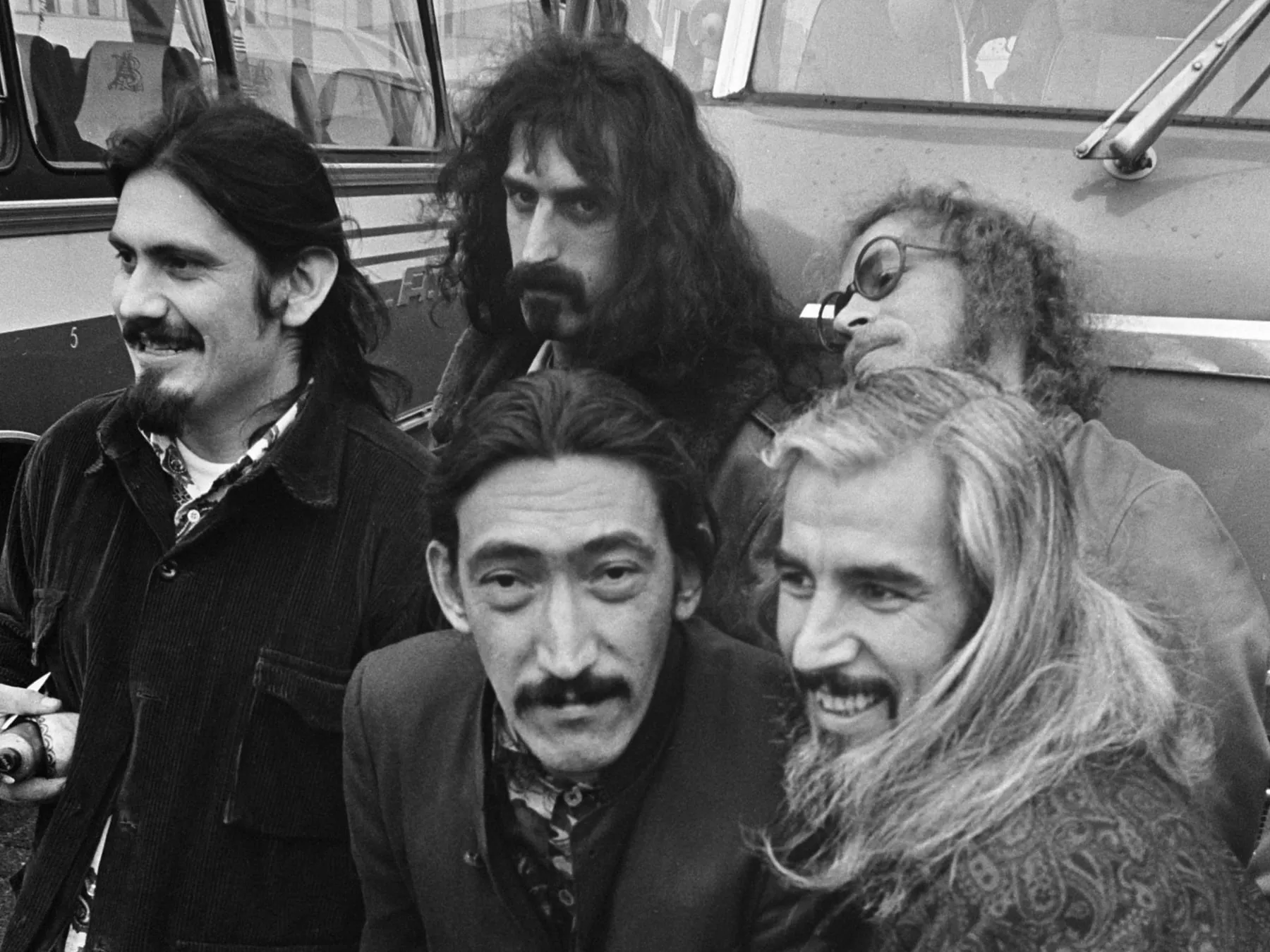
Photo by Ron Kroon for Anefo , licensed under CC0 · Wikimedia Commons
Rank #125
The Mothers of Invention
From Wikipedia
The Mothers of Invention was an American rock band from California. Formed on May 9, 1965, their work is marked by the use of sonic experimentation, innovative album art, and elaborate live shows. Originally an R&B band called the Soul Giants, the band's first lineup comprised Ray Collins, David Coronado, Ray Hunt, Roy Estrada, and Jimmy Carl Black. Frank Zappa was asked to take over as the guitarist when a fight between Collins and Hunt led to the latter's being fired. Zappa insisted they perform his original material—a decision that resulted in Coronado's leaving because he did not agree to the change—and on Mother's Day in 1965 the band changed its name to the Mothers. Record executives demanded the name be changed again, and so, "out of necessity", Zappa later said, "We became the Mothers of Invention", referring to the proverb "Necessity is the mother of invention".
Members
- Frank Zappa
- Jimmy Carl Black
- Ray Collins
- Roy Estrada
Discography & Previews
Browse through and click an album to open and play 30-second previews streamed from Apple Music.

Freak Out!
1966 · 15 tracks
- 1 Hungry Freaks, Daddy ↗ 3:30
- 2 I Ain't Got No Heart ↗ 2:36
- 3 Who Are the Brain Police? ↗ 3:33
- 4 Go Cry On Somebody Else's Shoulder ↗ 3:41
- 5 Motherly Love ↗ 2:46
- 6 How Could I Be Such a Fool? ↗ 2:13
- 7 Wowie Zowie ↗ 2:53
- 8 You Didn't Try to Call Me ↗ 3:19
- 9 Any Way the Wind Blows ↗ 2:56
- 10 I'm Not Satisfied ↗ 2:39
- 11 You're Probably Wondering Why I'm Here ↗ 3:38
- 12 Trouble Every Day ↗ 5:50
- 13 Help, I'm a Rock ↗ 4:43
- 14 It Can't Happen Here ↗ 3:57
- 15 The Return of the Son of Monster Magnet ↗ 12:20

Absolutely Free
1967 · 15 tracks
- 1 Plastic People ↗ 3:41
- 2 The Duke of Prunes ↗ 2:13
- 3 Amnesia Vivace ↗ 1:01
- 4 The Duke Regains His Chops ↗ 1:53
- 5 Call Any Vegetable ↗ 2:15
- 6 Invocation and Ritual Dance of the Young Pumpkin ↗ 6:59
- 7 Soft-Sell Conclusion ↗ 1:41
- 8 Big Leg Emma ↗ 2:32
- 9 Why Don'tcha Do Me Right? ↗ 2:39
- 10 America Drinks ↗ 1:53
- 11 Status Back Baby ↗ 2:54
- 12 Uncle Bernie's Farm ↗ 2:10
- 13 Son of Suzy Creamcheese ↗ 1:34
- 14 Brown Shoes Don't Make It ↗ 7:29
- 15 America Drinks and Goes Home ↗ 2:48

We’re Only in It for the Money
1968 · 19 tracks
- 1 Are You Hung Up? ↗ 1:25
- 2 Who Needs the Peace Corps? ↗ 2:34
- 3 Concentration Moon ↗ 2:22
- 4 Mom & Dad ↗ 2:16
- 5 Telephone Conversation ↗ 0:49
- 6 Bow Tie Daddy ↗ 0:33
- 7 Harry, You're a Beast ↗ 1:21
- 8 What's the Ugliest Part of Your Body? ↗ 1:03
- 9 Absolutely Free ↗ 3:24
- 10 Flower Punk ↗ 3:04
- 11 Hot Poop ↗ 0:27
- 12 Nasal Retentive Calliope Music ↗ 2:03
- 13 Let's Make the Water Turn Black ↗ 2:01
- 14 The Idiot Bastard Son ↗ 3:19
- 15 Lonely Little Girl ↗ 1:10
- 16 Take Your Clothes Off When You Dance ↗ 1:33
- 17 What's the Ugliest Part of Your Body? (Reprise) ↗ 0:58
- 18 Mother People ↗ 2:32
- 19 The Chrome Plated Megaphone of Destiny ↗ 6:25

Cruising With Ruben & the Jets
1968 · 13 tracks
- 1 Cheap Thrills ↗ 2:40
- 2 Love of My Life ↗ 3:08
- 3 How Could I Be Such a Fool? ↗ 3:34
- 4 Deseri ↗ 2:09
- 5 I'm Not Satisfied ↗ 4:08
- 6 Jelly Roll Gum Drop ↗ 2:24
- 7 Anything ↗ 3:05
- 8 Later That Night ↗ 3:01
- 9 You Didn't Try to Call Me ↗ 3:58
- 10 Fountain of Love ↗ 3:23
- 11 No. No. No. ↗ 2:16
- 12 Any Way the Wind Blows ↗ 3:02
- 13 Stuff Up the Cracks ↗ 4:39

Uncle Meat
1969 · 31 tracks
- 1 Uncle Meat: Main Title Theme ↗ 1:56
- 1 Uncle Meat Film Excerpt, Pt. 1 ↗ 37:36
- 2 The Voice of Cheese ↗ 0:27
- 2 Tengo Na Minchia Tanta ↗ 3:46
- 3 Nine Types of Industrial Pollution ↗ 6:00
- 3 Uncle Meat Film Excerpt, Pt. 2 ↗ 3:51
- 4 Zolar Czakl ↗ 0:55
- 4 King Kong Itself (As Played By the Mothers In a Studio) ↗ 0:51
- 5 Dog Breath, In the Year of the Plague ↗ 4:00
- 5 King Kong (Its Magnificence As Interpreted By Dom DeWild) ↗ 1:19
- 6 The Legend of the Golden Arches ↗ 3:28
- 6 King Kong (As Motorhead Explains It) ↗ 1:45
- 7 Louie Louie (Live At the Royal Albert Hall In London) ↗ 2:19
- 7 King Kong (The Gardner Varieties) ↗ 6:20
- 8 The Dog Breath Variations ↗ 1:49
- 8 King Kong (As Played By 3 Deranged Good Humor Trucks) ↗ 0:31
- 9 Sleeping In a Jar ↗ 0:51
- 9 King Kong (Live On a Flat Bed Diesel In the Middle of a Race Track At a Miami Pop Festival...The Underwood Remifications) ↗ 7:29
- 10 Our Bizarre Relationship ↗ 1:05
- 11 The Uncle Meat Variations ↗ 4:46
- 12 Electric Aunt Jemima ↗ 1:46
- 13 Prelude to King Kong ↗ 3:39
- 14 God Bless America (Live At the Whisky a Go-Go) ↗ 1:11
- 15 A Pound for a Brown On the Bus ↗ 1:29
- 16 Ian Underwood Whips It Out (Live On Stage In Copenhagen) ↗ 5:05
- 17 Mr. Green Genes ↗ 3:14
- 18 We Can Shoot You ↗ 2:03
- 19 If We'd All Been Living In California... ↗ 1:14
- 20 The Air ↗ 2:57
- 21 Project X ↗ 4:49
- 22 Cruisin' for Burgers ↗ 2:21

Weasels Ripped My Flesh
1970 · 11 tracks
- 1 Didja Get Any Onya? ↗ 3:43
- 2 Directly from My Heart to You ↗ 5:19
- 3 Prelude to the Afternoon of a Sexually Aroused Gas Mask ↗ 3:35
- 4 Toads of the Short Forest ↗ 4:47
- 5 Get a Little ↗ 2:34
- 6 The Eric Dolphy Memorial Barbecue ↗ 6:52
- 7 Dwarf Nebula Processional March & Dwarf Nebula ↗ 2:12
- 8 My Guitar Wants to Kill Your Mama ↗ 3:36
- 9 Oh No ↗ 1:45
- 10 The Orange County Lumber Truck ↗ 3:21
- 11 Weasles Ripped My Flesh ↗ 2:05

Burnt Weeny Sandwich
1970 · 9 tracks

-
 Freak Out!The Mothers of Invention196615 tracks
 -
 Absolutely FreeThe Mothers of Invention196715 tracks
 -
 We’re Only in It for the MoneyThe Mothers of Invention196819 tracks
 -
 Cruising With Ruben & the JetsThe Mothers of Invention196813 tracks
 -
 Uncle MeatThe Mothers of Invention196931 tracks
 -
 Weasels Ripped My FleshThe Mothers of Invention197011 tracks
 -
 Burnt Weeny SandwichThe Mothers of Invention19709 tracks
 -
 One Size Fits AllThe Mothers of Invention19759 tracks
Deep Dive
Overview
The Mothers of Invention was an American rock band formed in California in 1965 that became one of the defining forces of 1960s experimental and psychedelic rock. Led by guitarist and composer Frank Zappa, the band distinguished itself through relentless sonic innovation, complex arrangements, and a theatrical approach to rock performance that challenged commercial norms. Over a prolific recording period spanning from 1966 to 1975, they released a succession of albums that merged blues rock fundamentals with jazz fusion, musique concrète, and avant-garde sensibilities, establishing themselves as architects of progressive rock before the term fully crystallized.
Formation Story
The Mothers of Invention emerged from an earlier blues-rock outfit called the Soul Giants, active in California in the mid-1960s. The original Soul Giants lineup included Ray Collins, David Coronado, Ray Hunt, Roy Estrada, and Jimmy Carl Black. The catalyst for the band’s transformation came when Frank Zappa was recruited as guitarist following internal conflict within the existing lineup. Zappa’s arrival proved decisive: he insisted the band perform his original compositions rather than cover material, a shift that led David Coronado to depart due to creative disagreement. On Mother’s Day 1965, the renamed band became the Mothers, but record executives objected to the name’s connotations, forcing a second change. Zappa recounted that they became the Mothers of Invention “out of necessity,” a reference to the proverb “Necessity is the mother of invention.” By May 1965, the core working lineup—Zappa, Ray Collins, Roy Estrada, and Jimmy Carl Black—was solidified and ready to record.
Breakthrough Moment
The Mothers of Invention announced their arrival with Freak Out! in 1966, a debut album that set the template for their artistic direction and introduced audiences to the band’s uncompromising approach to rock music. The record’s blend of blues-rock energy with experimental studio production and unconventional song structures caught the attention of critics and adventurous listeners, establishing the band as a serious creative force beyond typical rock fare. The album’s success opened doors for touring and subsequent releases, allowing Zappa and his collaborators to develop their distinctive sound in the studio and on stage, where their elaborate live performances became legendary for their unpredictability and musical complexity.
Peak Era
The years from 1967 to 1970 marked the Mothers of Invention’s most fertile creative period. Absolutely Free (1967) expanded on the sonic experimentation of their debut, while We’re Only in It for the Money (1968) and Cruising With Ruben & the Jets (1968)—released in the same year—demonstrated the band’s ability to operate across multiple stylistic territories simultaneously. Uncle Meat (1969) pushed their arrangements further into jazz and orchestral territory, while Weasels Ripped My Flesh and Burnt Weeny Sandwich (both 1970) maintained the band’s commitment to angular, unpredictable compositions and densely layered production. Throughout this stretch, the band balanced commercial accessibility with artistic risk-taking, never sacrificing compositional rigor for radio-friendliness. The Grand Wazoo (1972), Over‐Nite Sensation (1973), and One Size Fits All (1975) continued their trajectory into the 1970s, though these later releases suggested a gradual shift toward more structured arrangements.
Musical Style
The Mothers of Invention’s sound defied easy categorization, combining foundational blues-rock instrumentation with elements of jazz fusion, experimental rock, psychedelic textures, and avant-garde techniques. Zappa’s compositions typically featured intricate guitar work ranging from bluesy leads to dissonant, atonal passages, often within a single track. Ray Collins contributed vocals that ranged from blues-inflected singing to spoken-word passages, while Roy Estrada’s bass playing and Jimmy Carl Black’s drumming provided rhythmic anchors that frequently fractured and reformed around Zappa’s unpredictable harmonic and structural choices. The band’s use of studio production was deliberate and sophisticated, incorporating multitrack overdubbing, sound manipulation, and musique concrète techniques that were unconventional in rock music at the time. Their songs rarely followed traditional verse-chorus structures, instead favoring extended instrumental passages, genre shifts within single compositions, and satirical or absurdist lyrical content. This approach made them influential pioneers of progressive and experimental rock, establishing a template that later bands would adapt and expand upon.
Major Albums
Freak Out! (1966)
The Mothers of Invention’s debut introduced their core aesthetic: dense arrangements, sonic experimentation, and rock compositions informed by blues, jazz, and classical music. The album established Zappa as a composer of serious ambition within the rock idiom.
Absolutely Free (1967)
Their second album deepened the exploration of orchestral rock and avant-garde production techniques, demonstrating that their debut’s approach was not a one-off but a sustained artistic direction.
We’re Only in It for the Money (1968)
A satirical engagement with 1960s counterculture and commercial rock music, this album solidified the band’s reputation for sharp-edged social commentary delivered through uncompromising compositional sophistication.
Uncle Meat (1969)
Uncle Meat showcased the band’s most ambitious orchestral and jazz-fusion arrangements, featuring complex instrumental passages and demonstrating Zappa’s growing mastery of large-scale compositional form.
Over‐Nite Sensation (1973)
This album marked a shift toward more rhythmically driving, funk-influenced material while retaining the band’s harmonic complexity and layered production approach.
Signature Songs
- “Hungry Freaks, Daddy” — A blues-rock vehicle for Ray Collins’s vocals that became emblematic of the band’s ability to embed social commentary within accessible song structures.
- “Who Are the Brain Police?” — An unsettling, atonal number exemplifying the band’s willingness to abandon conventional melody for artistic effect.
- “Cosmik Debris” — A funk-inflected composition demonstrating the band’s rhythmic versatility and Zappa’s satirical wordplay.
- “Don’t Eat the Yellow Snow” — A psychedelic, multi-part suite that combined humor, experimentation, and memorable melodic hooks.
Influence on Rock
The Mothers of Invention’s refusal to accept the boundaries between rock, jazz, avant-garde classical music, and blues established a template for progressive rock that would shape the genre throughout the 1970s and beyond. Their demonstration that rock music could accommodate complex time signatures, atonal harmonies, conceptual sophistication, and theatrical presentation without sacrificing intensity or audience engagement influenced progressive acts across multiple generations. The band’s fusion of blues-rock fundamentals with experimental studio techniques and orchestral ambition proved that rock music was a legitimate vehicle for compositional ambition comparable to classical or jazz. Their irreverent approach to rock convention and their embrace of musical risk-taking encouraged subsequent artists to view the rock album as a canvas for experimentation rather than a vehicle for maximizing commercial appeal.
Legacy
The Mothers of Invention’s catalog remains essential listening for understanding how rock music expanded artistically during the 1960s and early 1970s. Their body of work from Freak Out! through One Size Fits All represents one of the most consistent and ambitious sustained outputs in rock history, marked by an uncompromising commitment to compositional sophistication and sonic experimentation. The band’s influence extends across rock, progressive rock, and experimental music traditions, with their approach to instrumentation, arrangement, and conceptual rigor remaining relevant to musicians and listeners engaged with challenging, non-commercial rock music. The existence of the official Mothers of Invention website and ongoing archival work ensures that their contributions to rock history remain accessible, while the band’s studio recordings continue to find new audiences through streaming platforms and reissues, cementing their status as transformative figures in rock’s evolution.
Fun Facts
- The band’s name change from the Mothers to the Mothers of Invention was imposed by record executives rather than chosen by the band itself, with Zappa later reframing the forced decision as a philosophical reference to necessity driving invention.
- Ray Collins, the original vocalist, came from the Soul Giants lineup alongside Roy Estrada, making them among the few members who witnessed the band’s transition from R&B to experimental rock.
- The band recorded a 1970 performance at the “Piknik” Show in Uddel, Netherlands, a documented live performance that would not be officially released until 2004, decades after their initial run.