
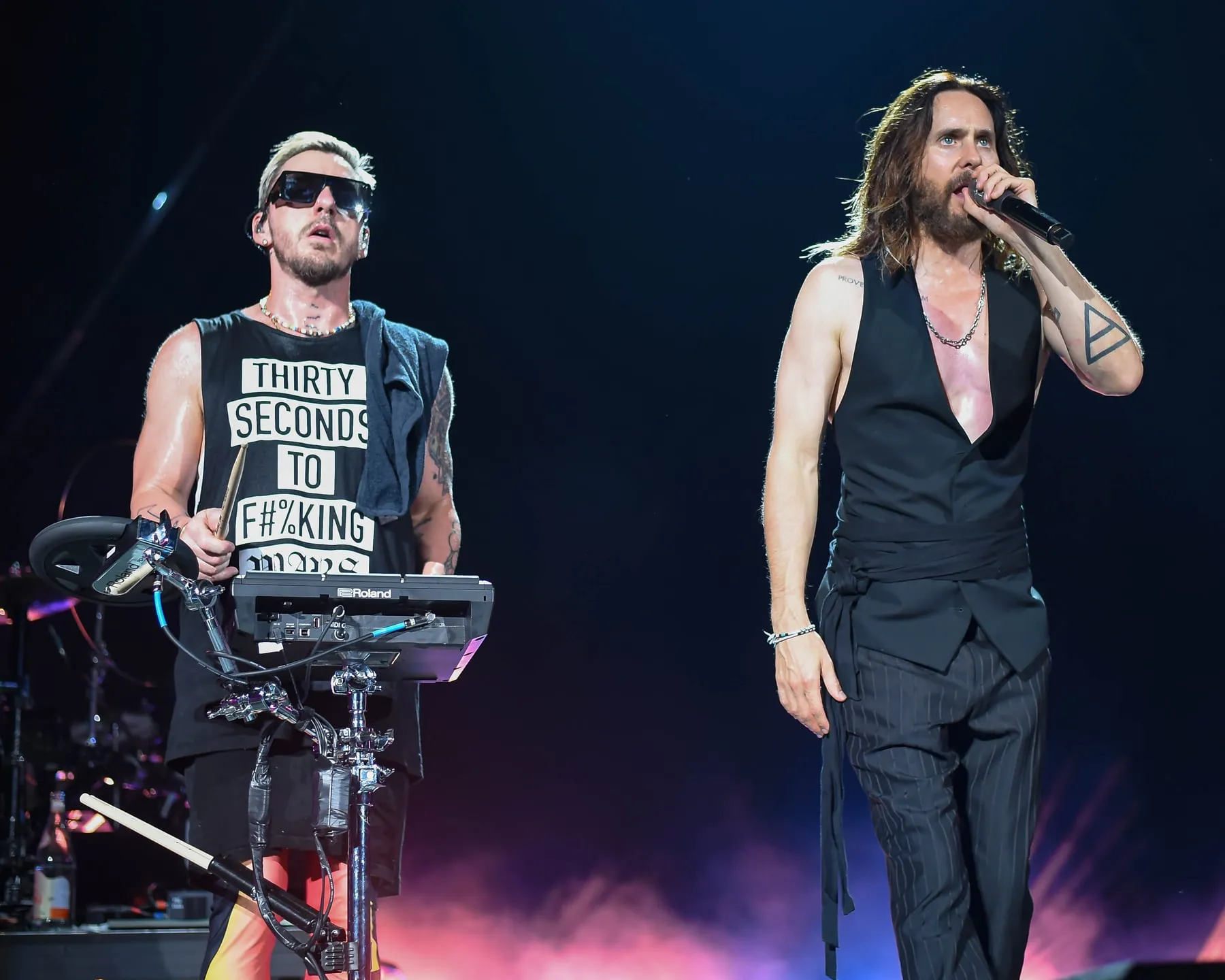
Photo by Rick Munroe , licensed under CC BY-SA 4.0 · Wikimedia Commons
Rank #299
30 Seconds to Mars
From Wikipedia
Thirty Seconds to Mars is an American rock band formed in Los Angeles, California, in 1998. The band consists of brothers Jared Leto and Shannon Leto, with various line-up changes throughout its history, most notably involving Tomo Miličević.
Members
- Jared Leto
- Shannon Leto
Discography & Previews
Browse through and click an album to open and play 30-second previews streamed from Apple Music.

30 Seconds to Mars
2002 · 11 tracks


This Is War
2009 · 13 tracks
- 1 Escape ↗ 2:24
- 2 Night of the Hunter ↗ 5:41
- 3 Kings and Queens ↗ 5:48
- 4 This Is War ↗ 5:27
- 5 100 Suns ↗ 1:58
- 6 Hurricane ↗ 6:12
- 7 Closer To the Edge ↗ 4:33
- 8 Vox Populi ↗ 5:43
- 9 Search and Destroy ↗ 5:38
- 10 Alibi ↗ 6:00
- 11 Stranger In a Strange Land ↗ 6:54
- 12 L490 ↗ 4:27
- 13 Kings and Queens (LA Riots Main Vocal Mix) ↗ 6:12

Love Lust Faith + Dreams
2013 · 12 tracks

AMERICA
2018 · 12 tracks
- 1 Walk on Water ↗ 3:05
- 2 Dangerous Night ↗ 3:20
- 3 Rescue Me ↗ 3:38
- 4 One Track Mind (Ft. a$Ap Rocky) ↗ 4:21
- 5 Monolith ↗ 1:38
- 6 Love Is Madness (feat. Halsey) ↗ 3:55
- 7 Great Wide Open ↗ 4:49
- 8 Hail to the Victor ↗ 3:22
- 9 Dawn Will Rise ↗ 3:57
- 10 Remedy ↗ 3:17
- 11 Live Like a Dream ↗ 4:07
- 12 Rider ↗ 2:58

It’s the End of the World but It’s a Beautiful Day
2023 · 11 tracks
-
 30 Seconds to Mars30 Seconds to Mars200211 tracks
 -
 A Beautiful Lie30 Seconds to Mars200512 tracks
 -
 This Is War30 Seconds to Mars200913 tracks
 -
 Love Lust Faith + Dreams30 Seconds to Mars201312 tracks
 -
 AMERICA30 Seconds to Mars201812 tracks
 -
 It’s the End of the World but It’s a Beautiful Day30 Seconds to Mars202311 tracks
Deep Dive
Overview
30 Seconds to Mars is an American rock band formed in Los Angeles in 1998, built on the foundation of brothers Jared Leto and Shannon Leto. The band operates at the intersection of alternative rock and progressive rock, blending intricate instrumental arrangements with atmospheric production and emotionally driven vocals. From their self-titled debut through a catalog spanning two decades, 30 Seconds to Mars has inhabited a distinctive space in rock music—neither purely pop-oriented nor exclusively experimental, but grounded in a progressive sensibility that resists easy categorization.
Formation Story
The band emerged from Los Angeles in 1998, originating in a city with a deep lineage of both rock innovation and commercial pop ambition. Jared Leto, who had already established himself in television and film, and his brother Shannon Leto formed the core of the project. The duo’s decision to pursue rock music placed them in a specific moment: the late 1990s were seeing the aftermath of grunge’s mainstream explosion and the rise of nu-metal, yet also a rekindling of interest in more textured, layered alternative sounds. 30 Seconds to Mars drew from progressive rock’s structural complexity and alternative rock’s willingness to embrace electronic elements and non-traditional song forms. Throughout the band’s history, various musicians have cycled through the lineup, with Tomo Miličević becoming a notable contributor whose additions to the band’s instrumental palette marked significant creative turns.
Breakthrough Moment
The band’s self-titled debut arrived in 2002, establishing their aesthetic but operating largely outside mainstream recognition. The genuine shift in visibility and industry attention came with the 2005 release of A Beautiful Lie. This album signaled a more refined approach to songwriting and production, combining orchestral arrangements with rock instrumentation and Jared Leto’s soaring vocal delivery. The record’s blend of introspection and sonic ambition caught the attention of alternative rock audiences, positioning the band beyond their Los Angeles base and into broader cultural conversation. A Beautiful Lie served as the proof-of-concept that the Leto brothers’ vision could resonate on a scale beyond cult followership.
Peak Era
The band’s most commercially potent and creatively adventurous period crystallized with This Is War in 2009 and extended through Love Lust Faith + Dreams in 2013. This Is War marked a turning point: the album embraced a more direct, urgent energy while maintaining the band’s progressive rock underpinnings. With Shannon Leto’s drumming providing a muscular backbone and Jared Leto’s lyrics exploring personal and existential themes, the record achieved a balance between accessibility and artistic depth. Love Lust Faith + Dreams continued this momentum, doubling down on the band’s willingness to layer genres—incorporating electronic production, anthemic choruses, and ambitious arrangements into a cohesive vision. This four-year stretch represented 30 Seconds to Mars at maximum influence, successfully navigating the increasingly fractured rock landscape of the 2010s.
Musical Style
30 Seconds to Mars operates within progressive rock traditions while embracing alternative rock’s eclecticism and willingness to incorporate non-rock elements. The band’s sonic foundation rests on Shannon Leto’s precise, dynamic drumming paired with layered guitar work and synthesizer textures that build atmosphere rather than dominate the foreground. Jared Leto’s voice functions as a primary textural instrument, capable of both intimate restraint and soaring melismatic display. The band’s production sensibility favors clarity and separation of instrumental lines, allowing listeners to discern the orchestral arrangements and keyboard work that often provide the songs’ harmonic structure. Lyrically, Leto has gravitated toward themes of struggle, transformation, and philosophical questioning, positioning the band’s work within the alternative rock tradition of personal introspection scaled up to arena-rock proportions. The sonic palette has evolved from the debut’s more restrained approach through increasingly adventurous electronic layering and orchestral ambition, particularly evident in the production choices of the 2009–2013 period.
Major Albums
30 Seconds to Mars (2002)
The band’s self-titled debut established their core aesthetic: progressive rock structures tempered by alternative sensibilities and production values rooted in clarity and precision. The album operated largely outside mainstream attention but introduced the Leto brothers’ foundational vision.
A Beautiful Lie (2005)
This album refined the band’s songwriting and showcased a more expansive production approach, incorporating orchestral arrangements and electronic elements that elevated the band’s profile within alternative rock circles.
This Is War (2009)
A landmark record that balanced urgency with complexity, This Is War featured some of the band’s most direct songs while maintaining progressive rock’s structural ambition. The album represented a creative and commercial peak.
Love Lust Faith + Dreams (2013)
Building on This Is War’s momentum, this record doubled down on anthemic songwriting and electronic production, cementing 30 Seconds to Mars’ position as major alternative rock figures navigating the 2010s landscape.
AMERICA (2018)
Released five years after the previous studio record, AMERICA demonstrated the band’s continued creative engagement despite the shifting music industry landscape.
Signature Songs
- The Kill — A propulsive alternative rock track that became synonymous with the band’s 2005 breakthrough period, balancing electronic production with traditional rock dynamics.
- Kings and Queens — An epic, orchestrally-influenced anthem that showcased Jared Leto’s vocal range and the band’s progressive rock ambitions.
- This Is War — The title track and spiritual centerpiece of the 2009 album, embodying the record’s urgent, confrontational energy.
- Closer to the Edge — A song that exemplified the band’s ability to construct layered, multi-sectional compositions with emotional resonance.
Influence on Rock
30 Seconds to Mars operated within a lineage stretching from progressive rock through alternative rock into the contemporary era, demonstrating that ambitious instrumental and vocal arrangements could coexist with electronic production and introspective lyricism. The band influenced subsequent alternative rock acts to embrace orchestral textures and complex song structures without abandoning the accessibility that defines alternative rock as a mainstream genre. Their work in the 2005–2013 period particularly affected how alternative rock bands approached production and arrangement during a moment when the format was increasingly fragmented by streaming economics and declining radio support. By maintaining a progressive rock ethos while working within alternative rock’s commercial and stylistic parameters, 30 Seconds to Mars demonstrated one viable path for ambitious rock music in an era skeptical of such ambition.
Legacy
30 Seconds to Mars’ legacy rests on their sustained commitment to progressive rock structures and orchestral ambition within alternative rock contexts. The band has remained active and touring throughout the 2010s and 2020s, maintaining a significant streaming and concert audience despite the broader decline of rock’s cultural centrality. Their catalogue, spanning from 1998 through 2023’s It’s the End of the World but It’s a Beautiful Day, documents the evolution of alternative and progressive rock across two and a half decades. The band’s longevity and refusal to default to easy nostalgia have ensured their relevance among audiences valuing instrumental sophistication and thematic depth in contemporary rock.
Fun Facts
- Jared Leto’s simultaneous career as a prominent actor and rock musician places him in a rare category of performers successfully navigating both film and music industries at significant levels.
- The band’s DIY ethos in their early years contrasted sharply with the resources eventually made available to them, yet they maintained artistic control over their sound and vision throughout major label association.
- 30 Seconds to Mars emerged from Los Angeles during a period when the city’s rock output was often overshadowed by its pop and hip-hop industries, making the band’s alternative rock positioning a counter-narrative to Los Angeles music’s dominant directions.