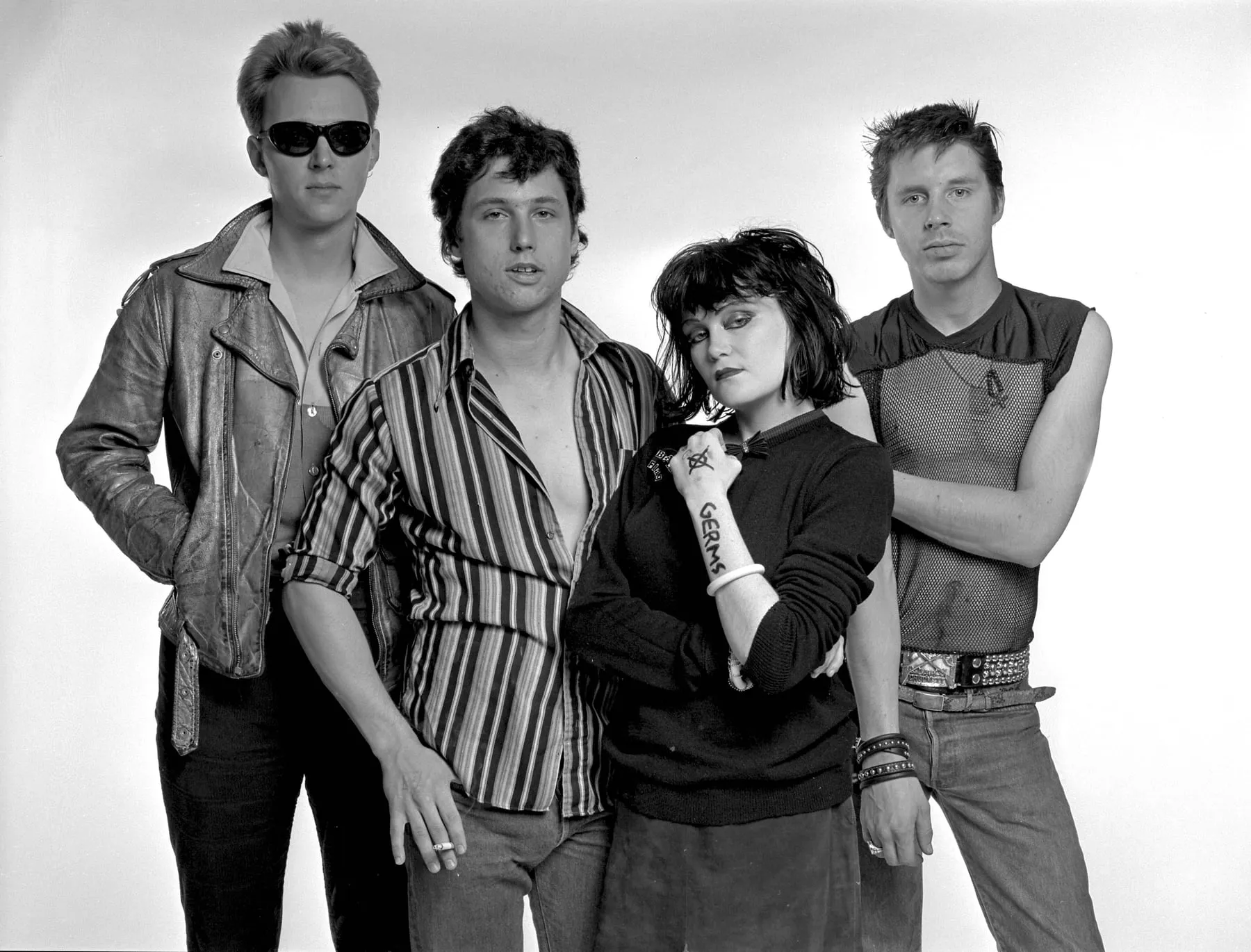
Photo by George Rose, Los Angeles Times , licensed under CC BY 4.0 · Wikimedia Commons
Rank #102
X
From Wikipedia
X is an American punk rock band formed in Los Angeles. The original members are vocalist Exene Cervenka, vocalist-bassist John Doe, guitarist Billy Zoom and drummer D. J. Bonebrake. The band released seven studio albums from 1980 to 1993. After a period of inactivity during the mid-to-late 1990s, X reunited in the early 2000s and continued to tour. In June 2024, X announced a final album and farewell tour, but went on to clarify that they would still perform live together as a group, albeit not in a "touring" capacity.
Members
- Billy Zoom (1977–1987)
- D. J. Bonebrake (1977–present)
- Exene Cervenka (1977–present)
- John Doe (1977–present)
- Dave Alvin (1987–1988)
- Tony Gilkyson (1987–1994)
Discography & Previews
Browse through and click an album to open and play 30-second previews streamed from Apple Music.

Los Angeles
1980 · 9 tracks

Wild Gift
1981 · 13 tracks
- 1 The Once over Twice ↗ 2:31
- 2 We're Desperate ↗ 2:00
- 3 Adult Books ↗ 3:19
- 4 Universal Corner ↗ 4:33
- 5 I'm Coming Over ↗ 1:15
- 6 It's Who You Know ↗ 2:17
- 7 In This House That I Call Home ↗ 3:35
- 8 Some Other Time ↗ 2:17
- 9 White Girl ↗ 3:27
- 10 Beyond and Back ↗ 2:49
- 11 Back 2 the Base ↗ 1:33
- 12 When Our Love Passed out on the Couch ↗ 1:57
- 13 Year 1 ↗ 1:18

Under the Big Black Sun
1982 · 11 tracks
- 1 The Hungry Wolf ↗ 3:48
- 2 Motel Room in My Bed ↗ 2:42
- 3 Riding with Mary ↗ 3:41
- 4 Come Back to Me ↗ 3:46
- 5 Under the Big Black Sun ↗ 3:28
- 6 Because I Do ↗ 2:24
- 7 Blue Spark ↗ 2:09
- 8 Dancing with Tears in My Eyes ↗ 2:15
- 9 Real Child of Hell ↗ 3:01
- 10 How I (Learned My Lesson) ↗ 2:16
- 11 The Have Nots ↗ 4:45

More Fun in the New World
1983 · 13 tracks
- 1 The New World ↗ 3:27
- 2 We're Having Much More Fun ↗ 3:09
- 3 True Love ↗ 2:16
- 4 Poor Girl ↗ 2:54
- 5 Make the Music Go Bang ↗ 3:05
- 6 Breathless ↗ 2:18
- 7 I Must Not Think Bad Thoughts ↗ 4:15
- 8 Devil Doll ↗ 3:08
- 9 Painting the Town Blue ↗ 3:20
- 10 Hot House ↗ 2:59
- 11 Drunk In My Past ↗ 2:54
- 12 I See Red ↗ 3:02
- 13 True Love, Pt. 2 ↗ 5:02

Ain’t Love Grand
1985 · 11 tracks

See How We Are
1987 · 11 tracks

Alphabetland
2020 · 11 tracks

-
 Los AngelesX19809 tracks
 -
 Wild GiftX198113 tracks
 -
 Under the Big Black SunX198211 tracks
 -
 More Fun in the New WorldX198313 tracks
 -
 Ain’t Love GrandX198511 tracks
 -
 See How We AreX198711 tracks
 -
 AlphabetlandX202011 tracks
 -
 Smoke & FictionX202410 tracks
Deep Dive
Overview
X is an American punk rock band formed in Los Angeles in 1977, standing among the most distinctive acts to emerge from the late-1970s punk and new wave underground. Fronted by dual vocalists Exene Cervenka and bassist-vocalist John Doe, with guitarist Billy Zoom and drummer D. J. Bonebrake completing the original lineup, X synthesized raw punk aggression with melodic sophistication and poetic lyricism, creating a template that would influence alternative rock for decades. Their seven studio albums released between 1980 and 1993 marked them as central figures in the Los Angeles punk scene and pioneers of the sound that would evolve into alternative rock.
Formation Story
X coalesced in Los Angeles in 1977 at the height of punk’s first wave, a moment when the genre’s energy was beginning to fracture into more experimental directions. Exene Cervenka and John Doe, the dual vocal core, founded the band alongside Billy Zoom on guitar and D. J. Bonebrake on drums. Los Angeles in the late 1970s was not yet the center of American punk that New York and London had become, but the city harbored a scrappy, determined underground scene centered on venues like the Whisky a Go Go and the Roxy Theatre. X emerged from that scene as a band uninterested in punk orthodoxy; they brought literary ambition to the form, with Cervenka’s delivery ranging from spoken word to keening melody and Doe’s bass lines carrying as much melodic weight as any lead guitar. From their inception, the band was marked by an unusual creative egalitarianism and a commitment to songwriting that treated punk as a starting point rather than a ceiling.
Breakthrough Moment
X released their debut album, Los Angeles, in 1980 on the Dangerhouse label, an announcement of intent that immediately established them as major players in the L.A. underground. The record arrived fully formed, with sharp production and a songwriting maturity that separated them from first-wave punk contemporaries. Their second album, Wild Gift (1981), deepened that promise, moving to Slash Records and gaining wider underground distribution. By Under the Big Black Sun (1982), X had achieved sufficient momentum to sign with Elektra, a major label deal that signaled their transition from cult concern to commercially viable act. These three albums in rapid succession—1980 to 1982—marked X’s emergence from the Los Angeles scene into national visibility, with Under the Big Black Sun serving as the album that brought their distinctive fusion of punk energy and art-rock sophistication to a broader listening public.
Peak Era
The mid-1980s constituted X’s creative and commercial zenith. More Fun in the New World (1983) solidified their position as leaders of a new punk-derived underground, demonstrating a band at full command of their aesthetic and able to sustain intensity across entire albums. Ain’t Love Grand (1985) continued that trajectory, showcasing a band comfortable in the alternative rock idiom that had crystallized around bands influenced by punk’s original fervor but unbound by its stylistic constraints. During this period, X moved through lineup changes that would define the band’s later sound: Billy Zoom departed in 1987, replaced by Dave Alvin for a brief tenure in 1987–1988, with Tony Gilkyson joining as a second guitarist for See How We Are (1987) and remaining through 1994. The albums of the mid-1980s represented the band at their most confident, having cracked the alternative rock mainstream while retaining the intellectual edge and lyrical ambition that had always set them apart.
Musical Style
X’s sound married punk’s raw velocity and attitude with post-punk’s structural sophistication and new wave’s accessibility. Exene Cervenka’s vocals operated across an unusual range—from urgent, almost spoken delivery to wailing, banshee-like intensity—while John Doe’s bass lines eschewed the traditional rhythm section role in favor of melodic counterpoint that rivaled the guitar work. Billy Zoom’s guitar playing synthesized rockabilly snap and punk aggression, creating a rhythmic drive distinct from the feedback-heavy or arpeggiated styles of many punk-era guitarists. D. J. Bonebrake’s drumming maintained propulsive momentum while leaving space for Cervenka and Doe’s vocal interplay. The band’s songwriting typically favored short, focused compositions built around memorable hooks and lyrical specificity, a sensibility that emerged from the punk tradition but wedded to melodic sophistication more common in art rock. By the mid-1980s, as they incorporated additional guitarists and expanded production, X’s sound broadened without losing its core identity: they remained primarily a guitar-driven rock band, but one comfortable with texture, restraint, and dynamics in ways that punk had traditionally discouraged.
Major Albums
Los Angeles (1980)
The debut established X’s foundational aesthetic: urgent, guitar-driven songs anchored by Cervenka and Doe’s complementary vocals and intelligent, street-level lyricism.
Wild Gift (1981)
The second album deepened the band’s sonic palette while maintaining the raw energy of their initial arrival, confirming their arrival as major voices in the Los Angeles underground.
Under the Big Black Sun (1982)
X’s most widely accessible statement, this third album brought their sophisticated approach to punk-derived rock to a national alternative audience and became their commercial breakthrough.
More Fun in the New World (1983)
A peak-era effort that showcased the band’s command of melody, dynamics, and arrangement, More Fun stood as one of the finest alternative rock albums of the 1980s.
See How We Are (1987)
This album introduced guitarist Tony Gilkyson to the lineup and documented the band adapting to the departure of Billy Zoom while maintaining their essential identity.
Signature Songs
- “Los Angeles” — The title track from their debut, a statement of place and identity that became the band’s unofficial anthem.
- “Johnny Hit and Run Paulene” — A showcase for the vocal interplay between Cervenka and Doe and the rhythmic snap of Zoom’s guitar.
- “Soul Desert” — A standout from Wild Gift demonstrating the band’s ability to build tension through melody and arrangement.
- “Under the Big Black Sun” — The title track from their third album, a distillation of X’s songwriting maturity and sonic confidence.
- “Burning House of Love” — A mid-1980s highlight capturing the band’s balance of intensity and melodic sophistication.
Influence on Rock
X’s influence on alternative rock and punk’s evolution cannot be overstated. By treating punk as a starting point rather than a dogmatic endpoint, they created a template that subsequent generations of alternative and indie rock bands would follow: the incorporation of punk’s directness and energy with art rock’s ambition and new wave’s accessibility. Their dual-vocal approach, particularly the non-traditional female frontman partnership of Cervenka and Doe, expanded the possibilities for vocal arrangement in rock music. The band’s intellectual approach to songwriting—drawing on literary and poetic traditions—elevated punk’s lyrical aspirations at a moment when the genre risked calcification into cliché. Their influence flows through the alternative rock movements of the 1980s and beyond, with bands from the Replacements to Sonic Youth to later post-punk and indie rock acts drawing on the template X established.
Legacy
After releasing Hey Zeus! in 1993, X entered a period of relative inactivity during the mid-to-late 1990s, a fallow period that lasted until their reunion in the early 2000s. The reunited band continued to tour sporadically, performing at festivals and on dedicated concert dates, maintaining their presence in rock’s landscape as elder statespeople of the punk-to-alternative continuum. In June 2024, X announced Alphabetland (2020) and Smoke & Fiction (2024), returning to the studio and signaling continued creative engagement. The band clarified that while they announced a farewell tour, they would continue to perform live together as a group, albeit without the touring schedule that had defined their earlier decades. X’s story—from Los Angeles punk pioneers to international alternative rock figures to latter-day touring act—represents one of punk’s most successful evolutions, a band that grew and changed while maintaining the intellectual edge and melodic sophistication that had always distinguished them from their peers.
Fun Facts
- Exene Cervenka and John Doe’s complementary vocal approach—neither voice fitting traditional frontman expectations—was a deliberate aesthetic choice that influenced decades of subsequent rock bands.
- Billy Zoom’s departure in 1987 marked a significant transition in the band’s sound; while subsequent guitarists including Dave Alvin and Tony Gilkyson brought their own styles, Zoom’s rockabilly-inflected approach had been central to X’s original identity.
- The band recorded for multiple major labels across their career, including Dangerhouse, Slash Records, Elektra, and Big Life, reflecting both their commercial viability and the evolving landscape of rock music distribution.