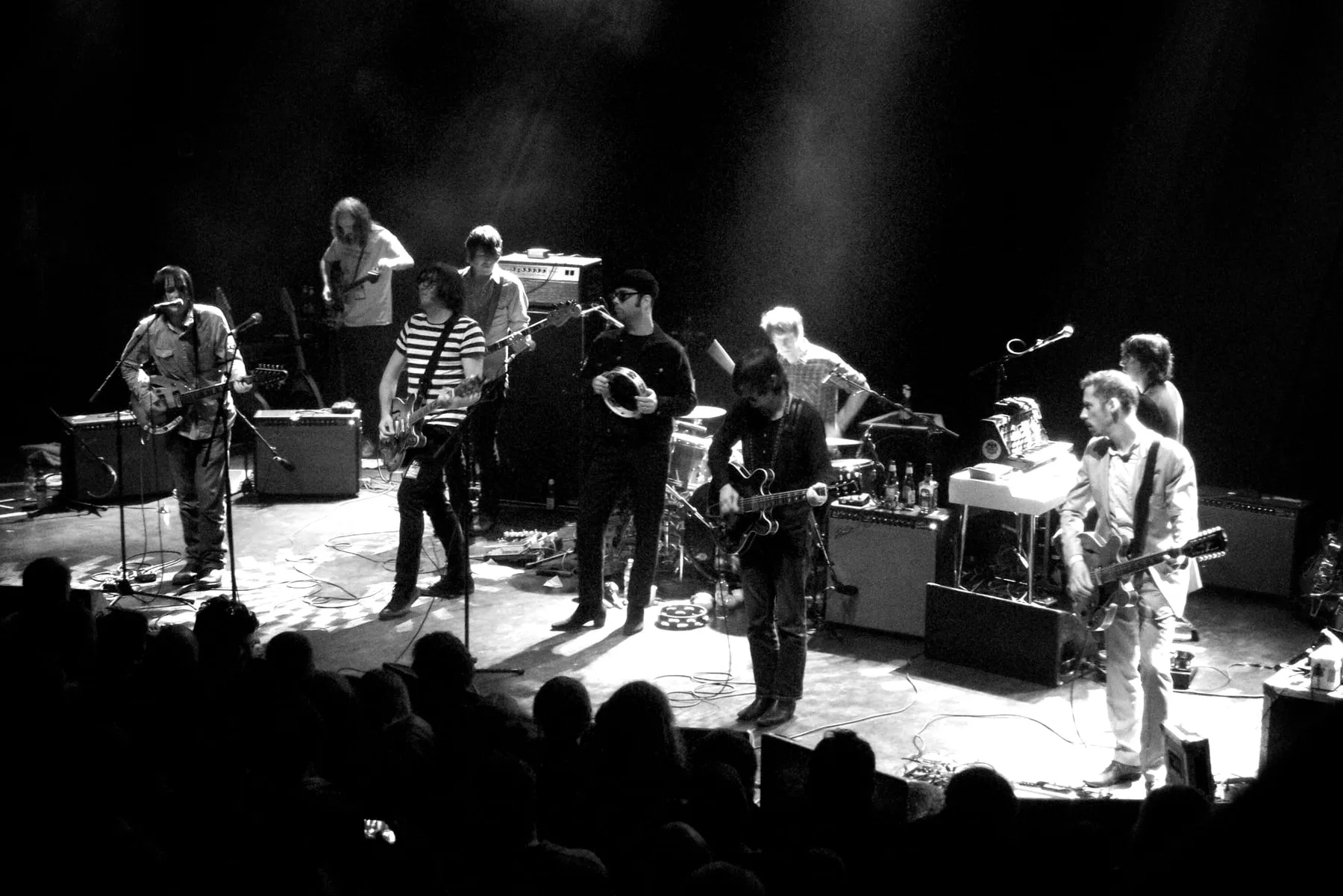
Photo by Aurelien Guichard from London, United Kingdom , licensed under CC BY-SA 2.0 · Wikimedia Commons
Rank #408
The Brian Jonestown Massacre
From Wikipedia
The Brian Jonestown Massacre is an American rock band founded and led by Anton Newcombe. It was formed in San Francisco in 1990 and has featured a revolving cast of members since forming.
Members
- Anton Newcombe
Discography & Previews
Browse through and click an album to open and play 30-second previews streamed from Apple Music.

Methodrone
1995 · 16 tracks
- 1 Evergreen ↗ 3:25
- 2 Wisdom ↗ 5:21
- 3 Crushed ↗ 6:09
- 4 That Girl Suicide ↗ 3:41
- 5 Wasted ↗ 4:22
- 6 Everyone Says ↗ 4:16
- 7 Short Wave ↗ 2:48
- 8 She Made Me ↗ 4:42
- 9 Hyperventilation ↗ 9:53
- 10 Records ↗ 1:50
- 11 I Love You ↗ 4:11
- 12 End of the Day ↗ 5:10
- 13 Outback ↗ 4:08
- 14 She's Gone ↗ 7:18
- 15 Untitled (Methodrone) ↗ 4:53
- 16 In India You (Bonus Track) ↗ 3:43

Take It From the Man!
1996 · 17 tracks
- 1 Vacuum Boots ↗ 2:57
- 2 Who? ↗ 2:53
- 3 Caress ↗ 2:29
- 4 (David Bowie I Love You) Since I Was Six ↗ 3:24
- 5 Straight up and Down ↗ 4:30
- 6 Monster ↗ 3:15
- 7 Take It from the Man ↗ 2:41
- 8 B.S.A. ↗ 4:42
- 9 Mary Please ↗ 4:10
- 10 Monkey Puzzle ↗ 4:03
- 11 F****r ↗ 2:12
- 12 Dawn ↗ 2:04
- 13 Cabin Fever ↗ 7:56
- 14 In My Life ↗ 2:22
- 15 Be Song ↗ 3:26
- 16 My Man Syd ↗ 1:49
- 17 Straight up and Down (Long Version) ↗ 11:01

Their Satanic Majesties' Second Request
1996 · 19 tracks
- 1 All Around You (Intro) ↗ 5:36
- 2 Cold to the Touch ↗ 3:20
- 3 Donovan Said ↗ 4:42
- 4 In India You ↗ 3:41
- 5 No Come Down ↗ 5:48
- 6 (Around You) Everywhere ↗ 0:56
- 7 Jesus ↗ 6:31
- 8 Before You ↗ 1:59
- 9 Miss June '75 ↗ 7:34
- 10 Anemone ↗ 5:34
- 11 Baby (Prepraise) ↗ 0:30
- 12 Feelers ↗ 5:28
- 13 Bad Baby ↗ 8:22
- 14 Cause, I Lover ↗ 1:17
- 15 (Baby) Love of My Life ↗ 1:06
- 16 Slowdown (F**k Tomorrow) ↗ 3:43
- 17 Here It Comes ↗ 3:04
- 18 All Around You (Outro) ↗ 4:50
- 19 To Crazy to Care (Bonus Track) ↗ 1:24
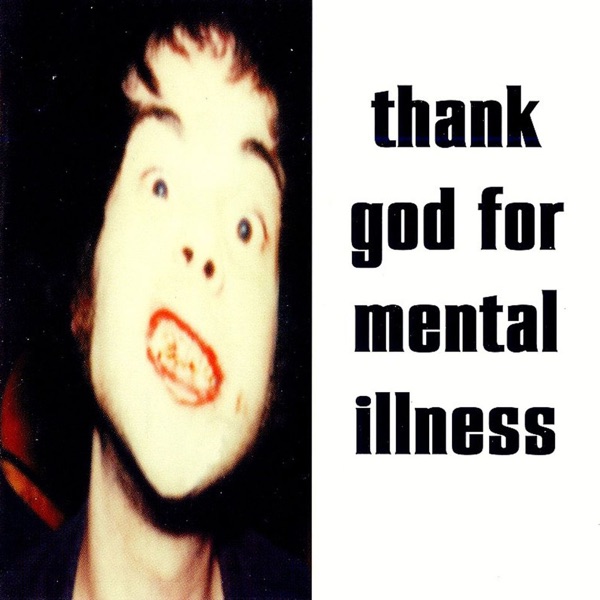
Thank God for Mental Illness
1996 · 14 tracks
- 1 Spanish Bee ↗ 3:48
- 2 It Girl ↗ 2:12
- 3 13 ↗ 2:35
- 4 Ballad of Jim Jones ↗ 2:14
- 5 Those Memories ↗ 2:01
- 6 Stars ↗ 3:15
- 7 Free and Easy ↗ 2:28
- 8 Down ↗ 3:52
- 9 Cause I Love Her ↗ 1:14
- 10 Too Crazy to Care ↗ 1:22
- 11 Talk - Action ↗ 2:07
- 12 True Love ↗ 3:32
- 13 Sound of Confusion ↗ 33:03
- 14 Cold to the Touch (Bonus Track) ↗ 3:22

Give It Back!
1997 · 13 tracks
- 1 Super - Sonic ↗ 5:16
- 2 This Is Why You Love Me ↗ 1:55
- 3 Satellite ↗ 3:39
- 4 Malela ↗ 3:10
- 5 Salaam ↗ 1:44
- 6 Whoever You Are ↗ 4:42
- 7 Sue ↗ 8:30
- 8 (You Better Love Me) Before I Am Gone ↗ 3:35
- 9 #1 Hit Jam ↗ 4:55
- 10 Servo ↗ 3:23
- 11 The Devil May Care (Mom & Dad Don't) ↗ 6:04
- 12 Their Satanic Majesties' Second Request (Enrique's Dream) ↗ 5:35
- 13 It's Summer (Bonus Track) ↗ 3:39
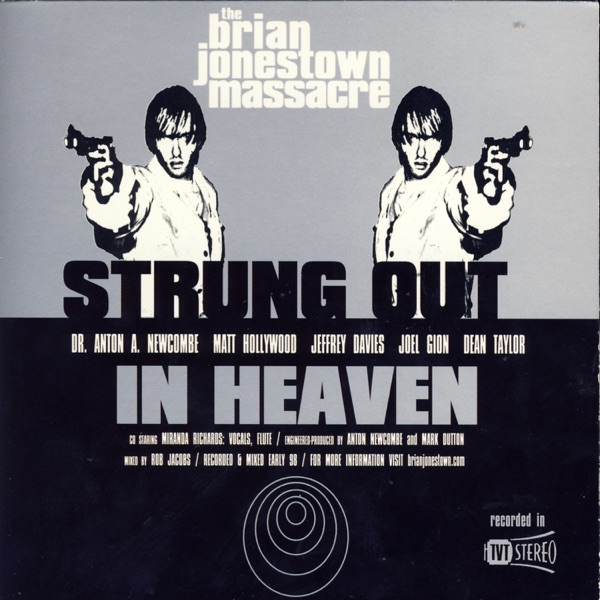
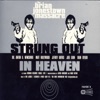
Strung Out in Heaven
1998 · 13 tracks

...And This Is Our Music
2003 · 17 tracks
- 1 Introesque ↗ 1:00
- 2 Starcleaner ↗ 2:29
- 3 Here to Go ↗ 5:15
- 4 When Jokers Attack ↗ 3:43
- 5 Prozac Vs. Heroin ↗ 3:58
- 6 Geezers ↗ 5:18
- 7 Maryanne ↗ 2:06
- 8 You Look Great When I'm F****d Up ↗ 6:51
- 9 Here It Comes ↗ 3:14
- 10 What Did You Say? ↗ 0:44
- 11 Prozac Vs. Heroin Revisited ↗ 4:37
- 12 New Low in Getting High ↗ 3:42
- 13 Somethings Go Without Saying ↗ 2:25
- 14 Tschusse ↗ 4:38
- 15 Pregnancy Test ↗ 2:18
- 16 Right Way ↗ 0:47
- 17 If Love Is the Drug Then I Want to Od (Bonus Track) ↗ 4:01

My Bloody Underground
2008 · 14 tracks
- 1 Bring Me the Head of Paul McCartney On Heather Mill's Wooden Peg (Dropping Bombs On the White House) ↗ 6:28
- 2 Infinite Wisdom Tooth / My Last Night In Bed With You ↗ 6:07
- 3 Who F*****g Pissed In My Well? ↗ 4:33
- 4 We Are the N*****s of the World ↗ 5:20
- 5 Who Cares Why ↗ 8:21
- 6 Yeah - Yeah ↗ 4:30
- 7 Golden - Frost ↗ 3:44
- 8 Just Like Kicking Jesus ↗ 4:38
- 9 Ljosmyndir ↗ 4:08
- 10 Automatic F****t for the People ↗ 5:47
- 11 Darkwave Driver / Big Drill Car ↗ 7:42
- 12 Monkey Powder ↗ 6:55
- 13 Black Hole Symphony ↗ 10:20
- 14 The Origin of Love ↗ 6:10
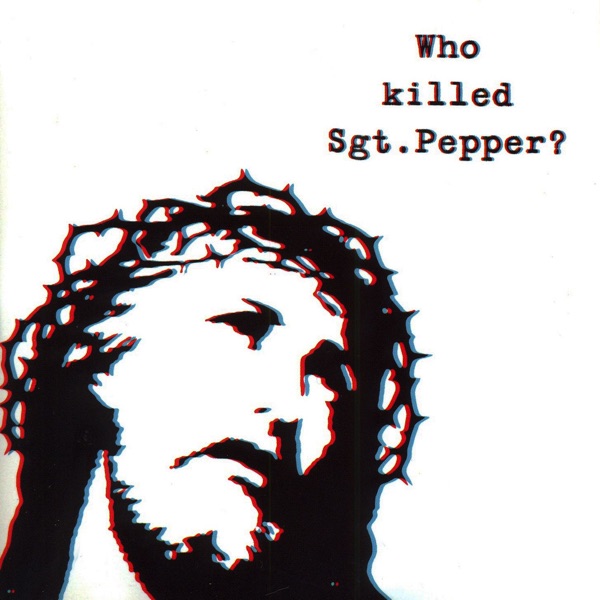
Who Killed Sgt. Pepper?
2010 · 13 tracks
- 1 Tempo 116.7 (Reaching for Dangerous Levels of Sobriety) ↗ 5:26
- 2 Tunger Hnifur ↗ 4:04
- 3 Lets Go F*****g Mental ↗ 4:41
- 4 White Music ↗ 2:13
- 5 This Is the First of Your Last Warning (Icelandic) ↗ 6:00
- 6 This Is the One Thing We Did Not Want To Have Happen ↗ 7:10
- 7 The One ↗ 4:15
- 8 Someplace Else Unknown ↗ 6:24
- 9 Detka! Detka! Detka! ↗ 5:21
- 10 Super F****d ↗ 6:36
- 11 Our Time ↗ 2:57
- 12 Feel It ↗ 6:15
- 13 Felt Tipped Pictures of Ufos ↗ 10:20

Aufheben
2012 · 11 tracks
- 1 Panic in Babylon ↗ 4:39
- 2 Viholliseni Maalla ↗ 4:37
- 3 Gaz Hilarant ↗ 2:41
- 4 Illuminomi ↗ 3:49
- 5 I Wanna Hold Your Other Hand ↗ 4:29
- 6 Face Down on the Moon ↗ 5:08
- 7 Clouds Are Lies ↗ 3:21
- 8 Stairway to the Best Party ↗ 4:21
- 9 Seven Kinds of Wonderful ↗ 5:21
- 10 Walking up to Hand Grenades ↗ 5:34
- 11 Blue Order New Monday ↗ 7:09

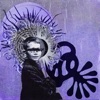
Revelation
2014 · 13 tracks
- 1 Vad Hände Med Dem? ↗ 4:41
- 2 What You Isn't ↗ 5:30
- 3 Unknown ↗ 1:56
- 4 Memory Camp ↗ 5:40
- 5 Days, Weeks and Moths ↗ 4:20
- 6 Duck and Cover ↗ 4:43
- 7 Food for Clouds ↗ 5:18
- 8 Second Sighting ↗ 3:41
- 9 Memorymix ↗ 4:36
- 10 Fist Full of Bees ↗ 5:46
- 11 Nightbird ↗ 3:26
- 12 Xibalba ↗ 3:23
- 13 Goodbye (Butterfly) ↗ 4:42


Don't Get Lost
2017 · 14 tracks
- 1 Open Minds Now Close ↗ 8:15
- 2 Melodys Actual Echo Chamber ↗ 3:52
- 3 Resist Much Obey Little ↗ 4:03
- 4 Charmed I'm Sure ↗ 3:00
- 5 Groove Is In the Heart ↗ 4:43
- 6 One Slow Breath ↗ 7:11
- 7 Throbbing Gristle ↗ 6:24
- 8 Fact 67 ↗ 6:35
- 9 Dropping Bombs On the Sun ↗ 6:32
- 10 Ufo Paycheck ↗ 4:09
- 11 Geldenes Herz Menz ↗ 3:28
- 12 Acid 2 Me Is No Worse Than War ↗ 5:27
- 13 Nothing New To Trash Like You ↗ 3:37
- 14 Ich Bin Klang ↗ 4:48


Forgotten Graves
2018 · 2 tracks


Fire Doesn’t Grow on Trees
2022 · 10 tracks

The Future Is Your Past
2023 · 10 tracks
-
 MethodroneThe Brian Jonestown Massacre199516 tracks
 -
 Take It From the Man!The Brian Jonestown Massacre199617 tracks
 -
 Their Satanic Majesties' Second RequestThe Brian Jonestown Massacre199619 tracks
 -
 Thank God for Mental IllnessThe Brian Jonestown Massacre199614 tracks
 -
 Give It Back!The Brian Jonestown Massacre199713 tracks
 -
 Strung Out in HeavenThe Brian Jonestown Massacre199813 tracks
 -
 ...And This Is Our MusicThe Brian Jonestown Massacre200317 tracks
 -
 My Bloody UndergroundThe Brian Jonestown Massacre200814 tracks
 -
 Who Killed Sgt. Pepper?The Brian Jonestown Massacre201013 tracks
 -
 AufhebenThe Brian Jonestown Massacre201211 tracks
 -
 RevelationThe Brian Jonestown Massacre201413 tracks
 -
 Mini Album Thingy WingyThe Brian Jonestown Massacre20157 tracks
 -
 Third World PyramidThe Brian Jonestown Massacre20169 tracks
 -
 Don't Get LostThe Brian Jonestown Massacre201714 tracks
 -
 Something ElseThe Brian Jonestown Massacre20189 tracks
 -
 Forgotten GravesThe Brian Jonestown Massacre20182 tracks
 -
 The Brian Jonestown MassacreThe Brian Jonestown Massacre20199 tracks
 -
 Fire Doesn’t Grow on TreesThe Brian Jonestown Massacre202210 tracks
 -
 The Future Is Your PastThe Brian Jonestown Massacre202310 tracks
Deep Dive
Overview
The Brian Jonestown Massacre is an American psychedelic rock band formed in San Francisco in 1990 and led throughout its existence by founder Anton Newcombe. Operating at the margins of commercial viability for over three decades, the band has become synonymous with prolific, often chaotic artistic output and an uncompromising commitment to psychedelic experimentation. Their legacy rests not on chart success or mainstream recognition but on a catalog of dozens of albums released at a relentless pace, each one a snapshot of Newcombe’s creative impulses at a given moment.
Formation Story
The Brian Jonestown Massacre emerged from San Francisco in 1990, a city with deep roots in psychedelic rock and a thriving underground music scene. Founded and led by Anton Newcombe, the band took its name from Brian Jones, the founding guitarist of the Rolling Stones, fused with “Jonestown,” a reference to the 1978 Guyana tragedy. From its inception, the Massacre operated as essentially a one-man project with a revolving cast of collaborators and members. This fluid lineup structure would become the band’s defining characteristic, allowing Newcombe to pursue wildly divergent sonic directions without the constraints of a fixed ensemble. The early years positioned the band squarely within the San Francisco underground, drawing on the city’s acid rock inheritance while embracing the more unpolished aesthetics of lo-fi and DIY punk culture.
Breakthrough Moment
The Brian Jonestown Massacre’s initial breakthrough came with their dual release strategy in 1995, when they issued both Spacegirl and Other Favorites and Methodrone in the same year. These records introduced listeners to Newcombe’s prolific approach and established the band’s sonic signature: dense, guitar-heavy psychedelia layered with effects, drone passages, and vocal melodies buried beneath walls of instrumentation. Spacegirl and Other Favorites showcased a more accessible side of the project, while Methodrone pushed further into experimental territory. This rapid-fire release schedule set a precedent. Over the next two years, the band issued four more albums—Take It From the Man! (1996), Their Satanic Majesties’ Second Request (1996), Thank God for Mental Illness (1996), and Give It Back! (1997)—establishing the Massacre as one of rock’s most prolific acts and cementing Newcombe’s reputation as a tireless creative force, regardless of commercial reception.
Peak Era
The band’s most intensely creative and visible period spanned the mid-to-late 1990s through the early 2000s. Strung Out in Heaven (1998) represented a consolidation of their psychedelic approach, while Bravery Repetition and Noise (2001)—released in two versions within the same year—showed Newcombe refining his sprawling vision into more coherent structures without sacrificing experimental depth. …And This Is Our Music (2003) continued this trajectory, establishing a body of work that, while rarely charting or receiving mainstream airplay, had become essential listening for psychedelic rock enthusiasts and underground music collectors. By this point, the Massacre had built a devoted international following, particularly in Europe, where their uncompromising approach resonated with audiences attuned to independent and experimental rock. The sheer volume and consistency of output—never going more than a few years without releasing new material—kept the project in motion even as individual members came and went.
Musical Style
The Brian Jonestown Massacre’s sound sits at the intersection of 1960s acid rock, 1980s post-punk, and 1990s lo-fi aesthetics. Newcombe’s approach is characterized by heavily layered guitar work, often fed through effects processors that blur melody into texture, paired with persistent drumming that frequently eschews conventional song structure in favor of hypnotic, repetitive patterns. Vocals, when present, are frequently submerged in the mix, treated as another textural element rather than a focal point. The production varies wildly across their catalog—some recordings embrace a murky, tape-saturated quality that mimics bootleg recordings, while others achieve a surprising clarity despite their experimental pretensions. Lyrically, the band has explored themes of alienation, mental states, and societal critique, though the words themselves are often difficult to parse beneath the instrumental density. This willingness to obscure vocals and forgo traditional verse-chorus-verse structures distinguishes them from mainstream rock acts and positions them firmly within the avant-garde psychedelic tradition.
Major Albums
Spacegirl and Other Favorites (1995)
The band’s debut established a template of psychedelic eclecticism, blending relatively accessible melodies with fuzzy, lo-fi production and a sense of chaotic experimentation that would define much of their work to follow.
Strung Out in Heaven (1998)
A more focused entry that consolidated three years of rapid releases, Strung Out in Heaven demonstrated the band’s ability to craft extended psychedelic journeys while maintaining compositional coherence and thematic unity across an album length.
Bravery Repetition and Noise (2001)
Released in two versions within the same year, this double-titled album represented Newcombe at a creative peak, balancing drone-heavy passages with moments of melodic clarity and showing increased sophistication in arrangement without sacrificing the project’s essential rawness.
My Bloody Underground (2008)
After a seven-year gap, the band’s return showcased a continued evolution in production quality and compositional ambition, proving the project remained vital despite Newcombe’s well-documented personal struggles.
Who Killed Sgt. Pepper? (2010)
A provocative title that directly invoked the Beatles’ most iconic album, this record reasserted the Massacre’s place in psychedelic rock lineage while exploring darker, more introspective territory.
Signature Songs
- “Spacegirl and Other Favorites” — The title track from their debut, establishing the band’s psychedelic aesthetic and melodic sensibility.
- “Anemone” — A fan favorite that exemplifies the band’s ability to craft affecting melodies beneath layers of psychedelic distortion.
- “Revelation” — One of their most hypnotic and drone-oriented compositions, demonstrating the group’s willingness to explore minimalism within maximalist textures.
- “Don’t Get Lost” — Featured on their 2017 album of the same name, showcasing the band’s continued ability to refresh their sound across multiple decades.
Influence on Rock
The Brian Jonestown Massacre’s influence extends primarily through their tireless expansion of what independent psychedelic rock could achieve outside mainstream structures. Their prolific output and uncompromising artistic vision inspired countless underground and bedroom rock producers to embrace quantity and experimentation as valid alternatives to the perfectionism and gatekeeping of major-label rock. The band’s career demonstrated that a psychedelic rock project could sustain itself for decades on the margins, building a devoted international fanbase through sheer persistence and the quality of their catalog, even without radio play or significant commercial success. Their approach—treating each album as a discrete artistic statement while maintaining a consistent sonic and thematic throughline—became a model for underground rock acts unwilling to conform to commercial expectations or industry timelines.
Legacy
The Brian Jonestown Massacre remains a towering figure in underground psychedelic rock, with a discography of over twenty-five studio albums spanning more than three decades. Their legacy rests on the principle that artistic integrity and prolific output need not depend on mainstream recognition or commercial viability. Recent albums like The Future Is Your Past (2023) confirm that Newcombe continues to pursue his vision with undiminished energy, proving the project’s staying power well into its fourth decade. The band’s story resonates particularly with independent musicians and DIY advocates who view their refusal to compromise or slow down as an act of creative resistance. Streaming platforms have democratized access to their vast catalog, introducing new generations of listeners to their work and solidifying their position as one of psychedelic rock’s most essential, if perpetually underappreciated, acts.
Fun Facts
- The band’s name conflates Brian Jones, the Rolling Stones’ founding guitarist, with “Jonestown,” a reference to the 1978 mass suicide event in Guyana, reflecting Newcombe’s provocative approach to nomenclature and theme.
- Between 1995 and 1997, the Massacre released six studio albums in three years, establishing themselves as one of rock’s most prolific acts and demonstrating Newcombe’s inexhaustible creative output.
- The band has released multiple versions and variations of the same album in the same year (notably Bravery Repetition and Noise in 2001 and dual 2018 releases), a practice that reflects Newcombe’s perfectionism and his willingness to present different configurations of the same material.
- San Francisco’s psychedelic rock heritage, stretching back through Jefferson Airplane and the Grateful Dead, provided the cultural and sonic foundation upon which the Massacre built their project in 1990.