
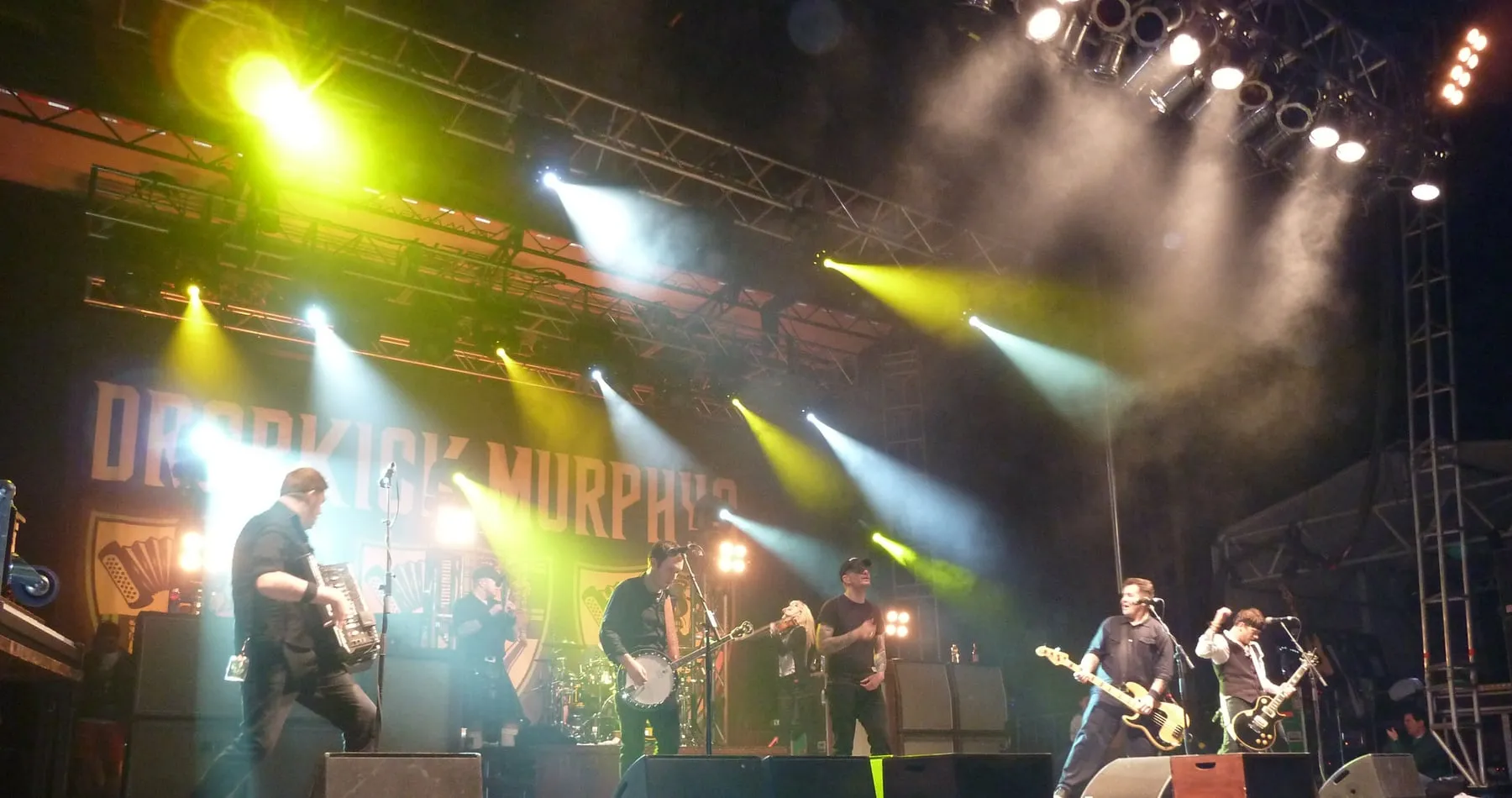
Photo by Darkterp , licensed under CC0 · Wikimedia Commons
Rank #267
Dropkick Murphys
From Wikipedia
Dropkick Murphys are an Irish-American Celtic punk band formed in Quincy, Massachusetts, in 1996. The lineup consists of co-lead vocalist Ken Casey, drummer Matt Kelly, co-lead vocalist Al Barr, rhythm and lead guitarist James Lynch, lead guitarist and multi-instrumentalist Tim Brennan, multi-instrumentalist and rhythm guitarist Jeff DaRosa, and bassist Kevin Rheault. Casey has been the band's only constant member since the band formed. The band is known for their loud, energetic live shows.
Members
- Ken Casey
- Marc Orrell
Discography & Previews
Browse through and click an album to open and play 30-second previews streamed from Apple Music.

Do or Die
1998 · 16 tracks
- 1 Cadence to Arms ↗ 1:49
- 2 Do or Die ↗ 1:51
- 3 Get Up ↗ 2:06
- 4 Never Alone ↗ 2:54
- 5 Caught in a Jar ↗ 2:20
- 6 Memories Remain ↗ 2:26
- 7 Road of the Righteous ↗ 2:56
- 8 Far Away Coast ↗ 2:41
- 9 Fightstarter Karaoke ↗ 2:18
- 10 Barroom Hero ↗ 2:58
- 11 3rd Man In ↗ 2:19
- 12 Tenant Enemy #1 ↗ 2:13
- 13 Finnegan's Wake ↗ 2:19
- 14 Noble ↗ 2:35
- 15 Boys on the Docks ↗ 2:34
- 16 Skinhead on the Mbta ↗ 3:49

The Gang’s All Here
1999 · 16 tracks
- 1 Roll Call ↗ 0:32
- 2 Blood and Whiskey ↗ 1:48
- 3 Pipebomb on Lansdowne ↗ 1:51
- 4 Perfect Stranger ↗ 1:58
- 5 10 Years of Service ↗ 2:45
- 6 Upstarts and Broken Hearts ↗ 2:57
- 7 Devil's Brigade ↗ 1:28
- 8 Curse of a Fallen Soul ↗ 3:01
- 9 Homeward Bound ↗ 2:01
- 10 Going Strong ↗ 3:06
- 11 The Fighting 69th ↗ 3:13
- 12 Boston Asphalt ↗ 1:40
- 13 Wheel of Misfortune ↗ 3:50
- 14 The Only Road ↗ 2:12
- 15 Amazing Grace ↗ 2:39
- 16 The Gang's All Here ↗ 7:59

Mob Mentality
2000 · 12 tracks
- 1 Mob Mentality ↗ 2:04
- 2 In the Streets of London ↗ 1:13
- 3 Informer ↗ 1:57
- 4 Going Strong ↗ 2:27
- 5 Keep the Faith ↗ 2:54
- 6 Freedom ↗ 1:46
- 7 Boys On the Dock ↗ 2:26
- 8 Borstal Boys ↗ 2:43
- 9 The Kids Are Alright ↗ 2:31
- 10 Hang Up Your Boots ↗ 2:21
- 11 Knock Me Down ↗ 2:46
- 12 Mob Mentality (7" Version) ↗ 2:21

Sing Loud, Sing Proud!
2001 · 16 tracks
- 1 For Boston ↗ 1:33
- 2 The Legend of Finn Maccumhail ↗ 2:15
- 3 Which Side Are You on? ↗ 2:29
- 4 The Rocky Road to Dublin ↗ 2:37
- 5 Heroes from Our Past ↗ 3:31
- 6 Forever ↗ 3:09
- 7 The Gauntlet ↗ 2:48
- 8 Good Rats (feat. Shane MacGowan) ↗ 3:04
- 9 The New American Way ↗ 3:32
- 10 The Torch ↗ 3:18
- 11 The Fortunes of War ↗ 2:44
- 12 A Few Good Men ↗ 2:36
- 13 Ramble and Roll ↗ 2:00
- 14 Caps and Bottles ↗ 2:41
- 15 The Wild Rover ↗ 3:26
- 16 The Spicy Mchaggis Jig ↗ 3:27

Blackout
2003 · 14 tracks
- 1 Walk Away ↗ 2:51
- 2 Worker's Song ↗ 3:32
- 3 The Outcast ↗ 3:10
- 4 Black Velvet Band ↗ 3:03
- 5 Gonna Be a Blackout Tonight ↗ 2:41
- 6 World Full of Hate ↗ 2:22
- 7 Buried Alive ↗ 1:58
- 8 The Dirty Glass ↗ 3:38
- 9 Fields of Athenry ↗ 4:24
- 10 Bastards on Parade ↗ 3:51
- 11 As One ↗ 3:01
- 12 This Is Your Life ↗ 3:44
- 13 Time to Go ↗ 2:53
- 14 Kiss Me I'm #!@'faced ↗ 5:34

The Warrior’s Code
2005 · 14 tracks
- 1 Your Spirit's Alive ↗ 2:21
- 2 The Warrior's Code ↗ 2:32
- 3 Captain Kelly's Kitchen ↗ 2:49
- 4 The Walking Dead ↗ 2:07
- 5 Sunshine Highway ↗ 3:22
- 6 Wicked Sensitive Crew ↗ 2:59
- 7 The Burden ↗ 2:56
- 8 Citizen C.I.A. ↗ 1:28
- 9 The Green Fields of France (No Man's Land) ↗ 4:46
- 10 Take It and Run ↗ 2:44
- 11 I'm Shipping up to Boston ↗ 2:34
- 12 The Auld Triangle ↗ 2:41
- 13 Last Letter Home ↗ 3:27
- 14 Tessie ↗ 4:16
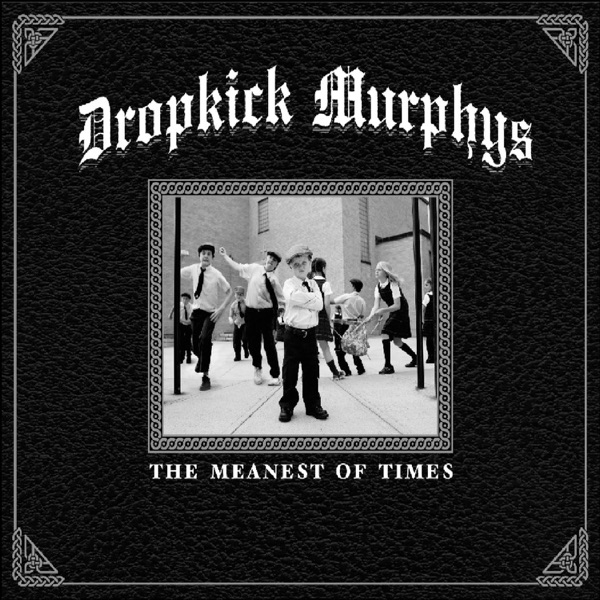
The Meanest of Times
2007 · 18 tracks
- 1 Famous For Nothing ↗ 2:47
- 2 God Willing ↗ 3:17
- 3 The State Of Massachusetts ↗ 3:52
- 4 Tomorrow's Industry ↗ 2:19
- 5 Echoes On "A".Street ↗ 3:18
- 6 Vice And Virtues ↗ 2:12
- 7 Surrender ↗ 3:15
- 8 (F)lannigan's Ball ↗ 3:39
- 9 I'll Begin Again ↗ 2:38
- 10 Fairmount Hill ↗ 3:58
- 11 Loyal To No One ↗ 2:25
- 12 Shattered ↗ 2:48
- 13 Rude Awakenings ↗ 3:24
- 14 Johnny, I Hardly Knew Ya ↗ 3:55
- 15 Never Forget ↗ 2:49
- 16 Forever (2007 Version) ↗ 3:46
- 17 The Thick Skin Of Defiance ↗ 2:47
- 18 Breakdown ↗ 2:28

Going Out in Style
2011 · 14 tracks
- 1 Hang 'Em High ↗ 3:59
- 2 Going Out In Style ↗ 4:09
- 3 The Hardest Mile ↗ 3:26
- 4 Cruel ↗ 4:22
- 5 Memorial Day ↗ 2:59
- 6 Climbing A Chair To Bed ↗ 3:00
- 7 Broken Hymns ↗ 5:03
- 8 Deeds Not Words ↗ 3:41
- 9 Take 'Em Down ↗ 2:11
- 10 Sunday Hardcore Matinee ↗ 2:43
- 11 1953 ↗ 4:14
- 12 Peg O' My Heart ↗ 2:21
- 13 Walk Don't Run ↗ 2:21
- 14 The Irish Rover ↗ 3:39

Signed and Sealed in Blood
2013 · 12 tracks
- 1 The Boys Are Back ↗ 3:19
- 2 Prisoner's Song ↗ 2:47
- 3 Rose Tattoo ↗ 5:07
- 4 Burn ↗ 2:40
- 5 Jimmy Collins' Wake ↗ 2:59
- 6 The Season's Upon Us ↗ 4:02
- 7 The Battle Rages On ↗ 2:17
- 8 Don't Tear Us Apart ↗ 3:02
- 9 My Hero ↗ 3:10
- 10 Out On The Town ↗ 3:02
- 11 Out Of Our Heads ↗ 3:12
- 12 End of The Night ↗ 5:17

11 Short Stories of Pain & Glory
2017 · 11 tracks

Turn Up That Dial
2021 · 14 tracks
- 1 Turn Up That Dial ↗ 3:43
- 2 L-EE-B-O-Y ↗ 3:24
- 3 Middle Finger ↗ 2:36
- 4 Queen Of Suffolk County ↗ 3:52
- 5 Mick Jones Nicked My Pudding ↗ 2:40
- 6 H.B.D.M.F. ↗ 4:08
- 7 Good As Gold ↗ 3:21
- 8 Smash Shit Up ↗ 3:49
- 9 Chosen Few ↗ 3:32
- 10 City By The Sea ↗ 3:47
- 11 I Wish You Were Here ↗ 4:22
- 12 We Shall Overcome ↗ 3:37
- 13 James Connolly ↗ 3:58
- 14 The Bonny ↗ 3:14
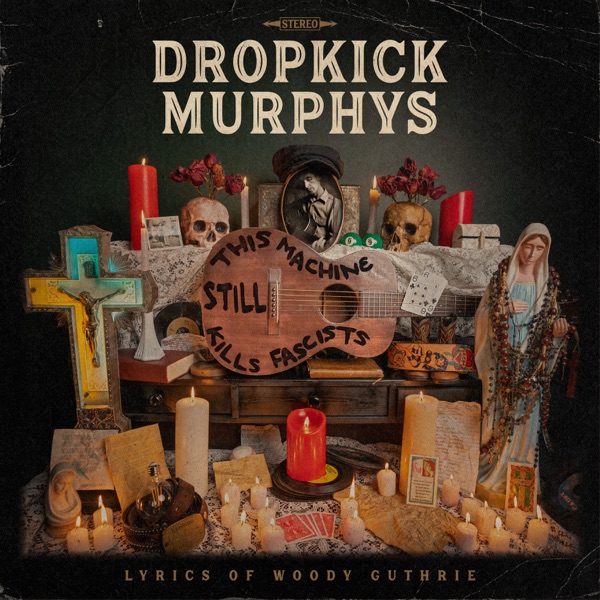
This Machine Still Kills Fascists
2022 · 14 tracks
- 1 Two 6's Upside Down ↗ 3:30
- 2 Talking Jukebox ↗ 3:13
- 3 Ten Times More ↗ 2:11
- 4 Never Git Drunk No More (feat. Nikki Lane) ↗ 3:26
- 5 All You Fonies ↗ 2:50
- 6 The Last One (feat. Evan Felker of Turnpike Troubadours) ↗ 3:33
- 7 Cadillac, Cadillac ↗ 2:53
- 8 Waters Are a'risin ↗ 3:03
- 9 Where Trouble Is At ↗ 2:34
- 10 Dig a Hole (feat. Woody Guthrie) ↗ 3:10
- 11 The Last One (Live at Ryman Auditorium) [Bonus Track] ↗ 3:42
- 12 Never Git Drunk No More (feat. Jaime Wyatt) (Live at Ryman Auditorium) [Bonus Track] ↗ 3:18
- 13 Where Trouble Is At (Live at Ryman Auditorium) [Bonus Track] ↗ 3:13
- 14 Cadillac, Cadillac (feat. Sammy Amara of Broilers) [Bonus Track] ↗ 2:53

Okemah Rising
2023 · 10 tracks
- 1 My Eyes Are Gonna Shine ↗ 2:12
- 2 Gotta Get To Peekskill (feat. Violent Femmes) ↗ 2:46
- 3 Watchin the World Go By ↗ 3:38
- 4 I Know How It Feels ↗ 2:47
- 5 Rippin Up the Boundary Line (feat. Jesse Ahern) ↗ 3:28
- 6 Hear the Curfew Blowin ↗ 3:04
- 7 Bring It Home (feat. Jaime Wyatt) ↗ 3:23
- 8 When I Was a Little Boy (feat. Jaime Wyatt) ↗ 2:33
- 9 Run Hitler Run ↗ 2:42
- 10 I'm Shipping Up To Boston (Tulsa Version) ↗ 2:24

For the People
2025 · 17 tracks
- 1 Who'll Stand With Us? ↗ 3:51
- 2 Longshot (feat. The Scratch) ↗ 3:27
- 3 The Big Man ↗ 2:54
- 4 Chesterfields and Aftershave ↗ 4:31
- 5 Bury the Bones (feat. The Mary Wallopers) ↗ 3:27
- 6 Kids Games ↗ 3:02
- 7 Sooner Kill 'Em First ↗ 3:17
- 8 Fiending for the Lies ↗ 2:42
- 9 Streetlights ↗ 4:13
- 10 School Days Over (feat. Billy Bragg) ↗ 3:28
- 11 The Vultures Circle High (feat. Al Barr) ↗ 4:22
- 12 One Last Goodbye "Tribute to Shane" (feat. The Scratch) ↗ 4:13
- 13 Dropped on My Head (Bonus Track) ↗ 2:55
- 14 Take Your Bow (Bonus Track) ↗ 3:58
- 15 Straight Edge (I Liked You Better) [Bonus Track] ↗ 2:58
- 16 A Hero Among Many (Bonus Track) ↗ 3:22
- 17 Sirens (Bonus Track) ↗ 3:44
-
 Do or DieDropkick Murphys199816 tracks
 -
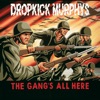 The Gang’s All HereDropkick Murphys199916 tracks
 -
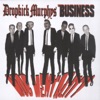 Mob MentalityDropkick Murphys200012 tracks
 -
 Sing Loud, Sing Proud!Dropkick Murphys200116 tracks
 -
 BlackoutDropkick Murphys200314 tracks
 -
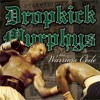 The Warrior’s CodeDropkick Murphys200514 tracks
 -
 The Meanest of TimesDropkick Murphys200718 tracks
 -
 Going Out in StyleDropkick Murphys201114 tracks
 -
 Signed and Sealed in BloodDropkick Murphys201312 tracks
 -
 11 Short Stories of Pain & GloryDropkick Murphys201711 tracks
 -
 Turn Up That DialDropkick Murphys202114 tracks
 -
 This Machine Still Kills FascistsDropkick Murphys202214 tracks
 -
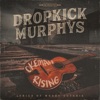 Okemah RisingDropkick Murphys202310 tracks
 -
 For the PeopleDropkick Murphys202517 tracks
Deep Dive
Overview
Dropkick Murphys are an Irish-American Celtic punk band that emerged from Quincy, Massachusetts, in 1996 and developed into one of the most distinctive voices in American rock. Operating at the intersection of punk rock’s rawness and Celtic folk instrumentation, the band has built a devoted following through relentless touring, high-energy live performances, and a catalog that balances singalong anthems with socially conscious narratives. Their ability to anchor punk energy with traditional Irish melodies and working-class themes set them apart from their contemporaries and established a template for how folk and punk could coexist without compromising either idiom.
Formation Story
Ken Casey founded Dropkick Murphys in Quincy, Massachusetts, in 1996, drawing on his own Irish-American heritage and the region’s rich immigrant culture. The band emerged from the Boston-area punk scene, where Casey’s vision was to fuse the aggression and urgency of punk rock with the instrumentation and sensibilities of Celtic folk music. The founding lineup began to take shape with the addition of core members who shared Casey’s commitment to both musical authenticity and the working-class storytelling that would become the band’s hallmark. Quincy, located in the suburbs south of Boston, provided not just a geographic base but a cultural one—a community with deep Irish roots that informed the band’s identity from the outset. Casey remained the only constant member throughout the band’s evolution, serving as the creative anchor and co-lead vocalist alongside Al Barr, who became a key voice in defining the band’s sonic and emotional range.
Breakthrough Moment
The Dropkick Murphys’ first two albums, Do or Die (1998) and The Gang’s All Here (1999), established their core sound and began to attract attention beyond Boston. With their third album, Mob Mentality (2000), the band achieved wider recognition, proving that their fusion of punk intensity and Celtic instrumentation resonated beyond regional boundaries. The early 2000s saw the band signing to Hellcat Records, a move that provided broader distribution and production support. Sing Loud, Sing Proud! (2001) solidified their commercial foothold and marked the moment when Dropkick Murphys transitioned from a strong regional act to a band with genuine national presence. Their relentless touring schedule—a cornerstone of their approach since formation—built a loyal fanbase that extended far beyond their Massachusetts roots.
Peak Era
The mid-to-late 2000s represented the band’s creative and commercial peak. The Warrior’s Code (2005) and The Meanest of Times (2007) showcased the band at their most confident, balancing infectious melodies with thematically rich songwriting. These albums deepened the band’s exploration of working-class dignity, immigrant experience, and community solidarity—themes that resonated strongly with their core audience. The production on these records captured the band’s live intensity while allowing individual instruments—tin whistles, fiddles, bagpipes, and traditional percussion alongside electric guitars and drums—to maintain clarity and character. The band’s loud, energetic live shows during this period became legendary, with Dropkick Murphys developing a reputation for performances that felt less like concerts and more like community celebrations. Their ability to move audiences from mosh-pit intensity to sing-along unity became a defining characteristic.
Musical Style
Dropkick Murphys’ sound is built on the collision of punk rock’s driving tempo and distorted guitars with authentic Celtic instrumentation: tin whistles, uilleann pipes, fiddles, and traditional bodhráns sit comfortably alongside electric bass and drums. The band’s songwriting typically favors memorable, often anthemic melodies that invite crowd participation, reflecting their live-show ethos. Vocally, Ken Casey and Al Barr trade lead duties across much of their catalog, with Casey bringing a gruff, streetwise delivery and Barr offering a more soaring, melodic approach; the contrast between the two voices became a textural signature. Lyrically, Dropkick Murphys distinguish themselves through their focus on working-class narratives, Irish-American identity, social justice themes, and the history of their community. The band’s arrangement sensibility owes as much to traditional Irish session music as it does to punk’s three-chord ethos, creating a sound that feels neither like diluted punk nor folky pastiche, but rather a genuine synthesis. The energy rarely flags, but the band demonstrates restraint when needed, allowing quieter moments to land with emotional weight.
Major Albums
Do or Die (1998)
The band’s debut established their core identity: upbeat punk energy married to Irish folk sensibility, with sing-along choruses and socially aware lyrics that would define their approach for decades.
The Gang’s All Here (1999)
The sophomore album refined the formula and expanded the band’s ambition, deepening their sound with stronger production and a more developed sense of how to balance punk urgency with melodic sophistication.
The Warrior’s Code (2005)
A landmark record that captured the band at peak creative confidence, showcasing mature songwriting, lush arrangements, and the kind of thematic coherence that made Dropkick Murphys more than a novelty fusion act.
Going Out in Style (2011)
After a four-year gap, the band returned with an album that demonstrated their ability to evolve without abandoning their core identity, continuing to explore working-class themes with undiminished energy and craft.
11 Short Stories of Pain & Glory (2017)
A collection that showed the band’s enduring ability to write compelling narratives set to memorable music, maintaining their commitment to social consciousness and community storytelling.
Signature Songs
- “Shipping Up to Boston” — One of the band’s most recognizable tracks, an anthem of defiant Irish-American pride wrapped in accelerating punk energy.
- “I’m Shipping Up to Boston” — A companion piece that became a stadium staple, adopted by sports fans and political movements alike.
- “The Boys Are Back” — A nostalgic, singalong declaration of community solidarity and working-class brotherhood.
- “Tessie” — A rowdy, traditional-inflected track that showcases the band’s ability to honor folk sources while maintaining punk vitality.
- “Dirty Glass” — A slower-burning number that highlights the band’s softer side while maintaining their characteristic intensity.
Influence on Rock
Dropkick Murphys’ sustained success validated a fusion that might have seemed niche—the combination of punk rock and Celtic folk—and proved it could achieve both critical credibility and genuine popular reach. Their influence extended to other bands exploring folk-punk hybrids, giving license to acts to draw authentically from their own cultural and regional backgrounds without apology. The band’s emphasis on live performance as the essential expression of their music influenced touring practices across rock and punk; their legendary shows became a model for how stage presence and audience connection could matter as much as studio production. Their socially conscious, working-class-focused lyrics opened space in rock for narratives that centered community, labor, and immigrant experience at a time when such themes were less prominent in mainstream rock discourse. Beyond direct musical imitation, Dropkick Murphys helped restore credibility to the notion that folk traditions and rock music could coexist not as separate camps but as integrated practice.
Legacy
Dropkick Murphys remain an active, touring force well into the 2020s, having released For the People in 2025—a testament to their continued creative vitality. The band’s catalog has achieved remarkable durability, with their songs becoming embedded in popular culture far beyond their original audience: tracks have appeared in major films, been adopted as sports anthems, and circulated through social media in ways that kept them culturally relevant across generations. Ken Casey’s role as the band’s sole constant member underscores the stability and clarity of vision that allowed Dropkick Murphys to maintain artistic coherence over nearly three decades. Their record with Hellcat Records provided them with a platform that balanced artistic control and distribution reach. More broadly, Dropkick Murphys’ career trajectory—a band from a working-class Boston suburb that built a sustainable, culturally significant career on authentic cultural expression and relentless work—stands as a model in rock of how genuine artistry and community connection can generate lasting influence and commercial viability without requiring major-label machinery or trend-chasing.
Fun Facts
- Ken Casey has been the only constant member of the band since its formation in 1996, serving as the creative anchor through all lineup changes and stylistic evolution.
- The band’s records are released through Hellcat Records, an independent label founded by Rancid’s Tim Armstrong, reflecting the broader punk community’s support for their project.
- Dropkick Murphys are known for their collaborations with traditional Irish musicians and their incorporation of authentic folk instrumentation—including uilleann pipes and tin whistles—played alongside electric instruments.
- The band’s hometown of Quincy, Massachusetts, is located in a region with significant Irish-American population and heritage, directly informing the cultural identity and storytelling at the heart of their music.