
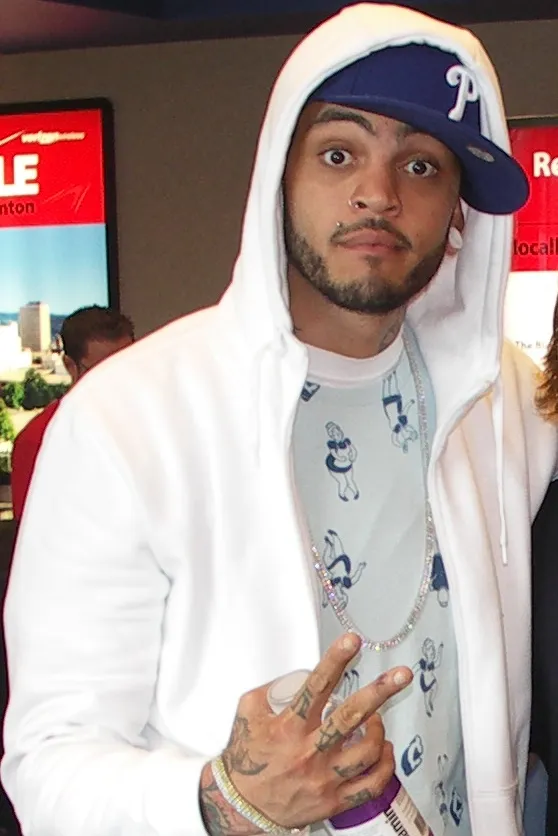
Photo by Cha0sc0ntroll at English Wikipedia , licensed under Public domain · Wikimedia Commons
Rank #361
Travie McCoy
From Wikipedia
Travis Lazarus "Travie" McCoy is an American rapper, singer, and songwriter. He is the co-founder and lead vocalist of the rap rock band Gym Class Heroes, which he formed in 1997 with his classmate Matt McGinley, after the two became acquainted with the East Coast punk rock scene.
Discography & Previews
Browse through and click an album to open and play 30-second previews streamed from Apple Music.

Lazarus
2010 · 10 tracks
- 1 Dr. Feel Good (feat. Cee Lo Green) ↗ 3:54
- 2 Superbad (11:34) ↗ 3:12
- 3 Billionaire (feat. Bruno Mars) ↗ 3:31
- 4 Need You ↗ 3:23
- 5 Critical (feat. Tim William) ↗ 3:17
- 6 Akidagain ↗ 3:42
- 7 We'll Be Alright ↗ 3:18
- 8 The Manual (feat. T-Pain & Young Cash) ↗ 4:10
- 9 After Midnight ↗ 3:46
- 10 Don't Pretend (feat. Colin Munroe) ↗ 3:06

Never Slept Better
2022 · 17 tracks
- 1 ..Never Slept Better.. ↗ 0:33
- 2 Stop It ↗ 3:49
- 3 Déjà Fait ↗ 3:56
- 4 Loved Me Back to Life ↗ 3:13
- 5 The Bridge (feat. Elohim) ↗ 4:04
- 6 Down and Out in L.A. ↗ 4:02
- 7 Matty’s Mattresses: Deluxe La ↗ 0:32
- 8 A Spoonful of Cinnamon ↗ 3:47
- 9 Another Round ↗ 4:00
- 10 Full Monarch ↗ 3:38
- 11 Matty’s Mattresses: From Larvae To Monarch ↗ 1:07
- 12 I am Pagliacci ↗ 3:47
- 13 The Best Part of Revenge ↗ 4:05
- 14 Karma Kama Sutra ↗ 3:50
- 15 Broken Barometer Blues ↗ 3:28
- 16 Matty’s Mattresses: Weatherproof ↗ 0:36
- 17 I’ll Never Be Loved (feat. Hamzaa) ↗ 4:08
-
 LazarusTravie McCoy201010 tracks
 -
 Never Slept BetterTravie McCoy202217 tracks
Deep Dive
Overview
Travis Lazarus “Travie” McCoy is an American rapper, singer, and songwriter who emerged from the rap rock movement of the late 1990s. Best known as the co-founder and lead vocalist of Gym Class Heroes, McCoy carved out a parallel solo career that demonstrated his range as both a performer and recording artist. His work spans rap rock, alternative hip-hop, reggae, and pop rap—a stylistic breadth that reflects the cross-genre eclecticism that defined early-2000s hip-hop and rock fusion.
McCoy’s significance lies in his role as a bridge between punk rock sensibilities and hip-hop aesthetics during a period when such hybridity was gaining mainstream traction. His solo output, while distinct from his band work, maintained that same willingness to blend genres and reject categorical boundaries.
Formation Story
Travis Lazarus McCoy was born in 1981, coming of age during the height of hip-hop’s East Coast golden age and the emergence of alternative rock on mainstream radio. Growing up immersed in both punk rock and rap music, McCoy developed an ear for the intersection of those worlds—a sensibility that would define his entire artistic trajectory. His early exposure to the East Coast punk rock scene provided him with a template for DIY ethos and genre-crossing experimentation that he would carry throughout his career.
In 1997, while still in his teens, McCoy joined with classmate Matt McGinley to form Gym Class Heroes. That partnership proved foundational to his early identity as an artist, but McCoy’s ambitions extended beyond band work. His solo career, launched nearly a decade after Gym Class Heroes’ formation, represented a chance to explore material and sonic territories distinct from the band’s direction.
Breakthrough Moment
McCoy’s first solo album, Lazarus, arrived in 2010 as a statement of artistic independence. Released through the label infrastructure that had supported his band work, the album showcased McCoy as a vocalist and solo composer, capable of anchoring songs without the full band arrangement. The release marked a pivotal moment in his career—a public declaration that his talents extended beyond collaborative band dynamics. Lazarus demonstrated that McCoy could sustain listener interest and critical attention as a solo artist, opening new commercial and creative pathways.
The album’s existence signaled to industry and audience alike that McCoy was not simply a frontman dependent on Gym Class Heroes’ machinery, but a multifaceted artist with his own vision and recording presence.
Peak Era
McCoy’s peak commercial and creative period as a solo artist spanned the 2010s, with Lazarus establishing the foundation for ongoing solo work. Throughout this decade, he balanced solo recording and performance with continued involvement in Gym Class Heroes, allowing him to maintain presence across multiple artistic platforms. His solo work during this era reflected the lessons learned from years of touring and writing with the band, while carving out space for more introspective and varied sonic experimentation.
The decade demonstrated that McCoy had cultivated a dedicated fanbase willing to follow him across different projects and styles, a testament to his established credibility within the rap rock and alternative hip-hop communities.
Musical Style
McCoy’s musicianship is rooted in the rap rock aesthetic that emerged in the late 1990s and early 2000s—a sound that married hip-hop rhythms and flow with rock instrumentation, punk attitudes, and alternative sensibilities. His vocal approach combines rapped verses with sung melodic passages, a dynamic that became his signature across both Gym Class Heroes and solo work. Lyrically, McCoy mines themes of ambition, resilience, and personal reflection, delivered with a conversational directness inherited from his hip-hop influences.
Genre-wise, McCoy’s palette extends across rap rock, alternative hip-hop, reggae, and pop rap, reflecting an artist uninterested in categorical purity. His production choices and song arrangements shift according to the emotional and sonic demands of each track, but throughout his work runs a consistent thread of punk-influenced attitude and hip-hop rhythmic sophistication. The reggae elements that surface in his discography add warmth and rhythmic lilt to his otherwise harder-edged foundation, creating points of melodic and textural relief within songs that might otherwise lock entirely into rap rock’s heavier aesthetic.
Major Albums
Lazarus (2010)
McCoy’s debut solo album established his capacity as a solo recording artist, balancing introspective songwriting with the energetic rap rock aesthetic he had perfected with Gym Class Heroes. The album demonstrated range across multiple song types and production approaches, proving McCoy’s versatility beyond his band role.
Never Slept Better (2022)
Released over a decade after Lazarus, this album marked McCoy’s return to solo recording and reflected his evolution as an artist and mature performer. The gap between releases underscored McCoy’s primary commitment to Gym Class Heroes while signaling his ongoing interest in solo work and personal artistic expression.
Signature Songs
- Billionaire (feat. Bruno Mars) — McCoy’s biggest solo hit, a motivational anthem that became a mainstream success and introduced him to audiences beyond rap rock’s core fanbase.
- Lazarus — The title track from his debut solo album, serving as a statement of artistic resurrection and renewal.
Influence on Rock
McCoy’s dual career—as both a band member and solo artist—helped legitimize the rapper-as-vocalist model within rock contexts. His work demonstrated that hip-hop artists could thrive in traditionally rock-dominated spaces and conversely that rock musicians could authentically inhabit hip-hop aesthetics without dilution. He was part of a broader mid-2000s to 2010s cohort that made rap rock a legitimate vehicle for serious artistic expression rather than novelty or crossover experiment.
Through Gym Class Heroes and his solo work, McCoy helped establish the template for subsequent artists seeking to blend punk rock’s D.I.Y. ethos with hip-hop’s rhythmic and lyrical sophistication. His genre flexibility influenced younger artists coming up in the post-genre landscape of 2010s popular music, where stylistic blending became increasingly normalized.
Legacy
Travis McCoy’s legacy rests on his sustained commitment to genre-crossing artistry across multiple decades. His solo work, though less voluminous than his band output, contributed to a broader cultural shift toward accepting and celebrating artists who refuse categorical boundaries. His presence in the rap rock space helped establish that genre as more than a novelty, attracting serious musicians and listeners who valued the synthesis of hip-hop and rock elements.
McCoy remains active as of 2022 and beyond, continuing to record and perform both as a solo artist and as part of Gym Class Heroes. His streaming presence across platforms maintains his music’s accessibility to contemporary audiences, while retrospective critical appreciation of early-2000s rap rock has positioned his entire body of work—band and solo—within a richer historical context than those years initially received.
Fun Facts
- McCoy formed Gym Class Heroes in 1997 while still a teenager, making him one of the youngest artists to establish a lasting rap rock act during the genre’s formative decade.
- His dual commitment to both solo and band work across the 2010s and beyond demonstrates his creative restlessness and refusal to be confined to a single artistic framework.
- McCoy’s discography spans four distinct genres—rap rock, alternative hip-hop, reggae, and pop rap—reflecting an artist whose influences and interests extend far beyond any single sonic template.