
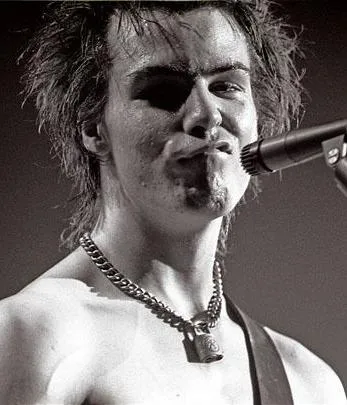
Photo by Chicago Art Department c/o: L. Schorr , licensed under CC BY 2.0 · Wikimedia Commons
Rank #430
Sid Vicious
From Wikipedia
John Simon Ritchie, better known by his stage name Sid Vicious, was an English musician, best known as the second bassist for the punk rock band Sex Pistols. After his death in 1979 at the age of 21, he remained an icon of the punk subculture; one of his friends noted that he embodied "everything in punk that was dark, decadent and nihilistic".
Deep Dive
Overview
Sid Vicious, born John Simon Ritchie, was an English punk rock bassist whose four-year career as the second bassist for the Sex Pistols made him one of the most recognizable figures in punk history. Though his musical tenure was brief and technically unremarkable—he joined the Sex Pistols late in their run and contributed minimally to their recorded output—Vicious transcended musicianship to become the living embodiment of punk’s dark underbelly. His persona, stage presence, and the circumstances of his early death at twenty-one cemented him as a cultural touchstone whose influence on punk aesthetics and mythology endured far beyond his lifetime.
Formation Story
John Simon Ritchie was born in 1957 in London, coming of age during the rise of glam rock and the early stirrings of punk in the mid-1970s. He gravitated toward the emerging punk scene in London, where underground clubs and the countercultural energy of the era provided fertile ground for his adoption of a provocative stage identity. The nickname “Sid Vicious” emerged from his association with the Sex Pistols and the punk underground, embodying the aggressive nihilism that defined the movement’s aesthetic. By the late 1970s, Vicious had become entrenched in the Sex Pistols orbit, eventually recruited as the band’s second bassist, replacing Glen Matlock.
Breakthrough Moment
Vicious joined the Sex Pistols during the band’s final chapter, at a point when they had already achieved notoriety and were fragmenting under the pressure of their own infamy. Rather than arriving at a moment of ascendancy, he inherited a fractured project in its death throes. The Sex Pistols disbanded in early 1977 following a disastrous American tour, before Vicious could meaningfully establish himself as a recorded musician. His presence on Sex Pistols records was minimal; he appeared on only a handful of tracks and sessions, with most of the band’s recorded legacy defined by his predecessor’s bass work. Vicious’s fame and notoriety stemmed not from musical achievement but from his embodiment of punk’s transgressive spirit and the media spectacle surrounding his behavior and lifestyle.
Peak Era
The period from 1976 to 1979 marked Vicious’s entire recording and performance career, a span coinciding almost exactly with punk rock’s initial explosion in the United Kingdom. His involvement with the Sex Pistols placed him at the epicenter of the movement during its commercial breakthrough and underground consolidation. Though the Sex Pistols’ active period as a functioning band was remarkably brief, the mythology that surrounded Vicious—his public antics, his relationships, and his self-destructive trajectory—gave him an outsize cultural profile that persisted even as his musical contributions remained marginal. His later solo work, including the album Sid Sings released posthumously in 1979, and subsequent compilations Vive Le Rock (2003) and Too Fast to Live (2004), were primarily curated from earlier recordings and material rather than new studio sessions.
Musical Style
Sid Vicious was not known as a technically proficient bassist; his musicianship was secondary to his stage presence and symbolic value within punk. His approach to bass was functional and often chaotic, aligned with punk rock’s deliberate rejection of technical virtuosity in favor of raw energy and attitude. Punk bass in its foundational form prioritized simplicity, repetition, and the propulsion of the rhythm section over melodic complexity or harmonic sophistication. Vicious embodied that ethos completely—his playing was rudimentary, fitting the Sex Pistols’ stripped-down, three-chord aggression. His vocals, heard on later recordings, carried the same unpolished, confrontational quality. What distinguished Vicious was not his instrumental ability but his presence: the sneer, the fashion, the willingness to be dangerous and offensive, all of which aligned perfectly with punk’s aesthetic of deliberate provocation and shock value.
Major Albums
Sid Sings (1979)
Released posthumously, Sid Sings presented Vicious as a vocalist and recording artist in his own right, capturing his solo material and demonstrating an attempt to carve out an identity beyond the Sex Pistols. The album underscored his fundamental limitations as a musician while preserving his raw, unfiltered presence on tape.
Vive Le Rock (2003)
This compilation drew from Vicious’s available catalog and archival material, repackaging his legacy for a new generation of punk historians and enthusiasts. It represented a curation of his scattered recordings and illustrated the modest body of work left behind after his death.
Too Fast to Live (2004)
Another retrospective effort, Too Fast to Live further documented the limited studio output available under Vicious’s name, collecting tracks spanning his brief recording career and underlining the scarcity of original material he produced.
Signature Songs
- “My Way” — A version of the classic standard that Vicious recorded, transforming the song into a punk statement through his raw vocal delivery and aggressive interpretation.
- “Belsen Was a Gas” — A controversial Vicious composition that exemplified punk’s use of shock and taboo subject matter to provoke and challenge audiences.
- “C’mon Everybody” — A cover that Vicious performed, demonstrating his attempt to reinterpret existing material through a punk lens.
Influence on Rock
Sid Vicious’s influence on rock and punk culture was disproportionate to his musical output. He became the archetypal punk icon—the visual and behavioral model for what punk promised to be: dangerous, nihilistic, unconcerned with respectability, and willing to transgress social boundaries. His image and persona shaped how punk was understood by the mainstream and by subsequent generations of musicians. Punk rock had emerged partly as a reaction against the technical complexity and perceived pretension of progressive rock; Vicious represented the logical extreme of that rejection, a musician whose inability to play bass was almost irrelevant next to his symbolic power. He influenced the aesthetics of punk fashion, attitude, and self-presentation far more than he influenced the music itself. Subsequent punk and post-punk acts absorbed not his technical vocabulary—he had none—but his attitude and his insistence that punk was as much about lifestyle and provocation as it was about sound.
Legacy
Sid Vicious died on February 2, 1979, at twenty-one, in circumstances that only deepened his mythological status within punk history. His death transformed him into punk’s most potent symbol of excess, self-destruction, and the darker implications of the movement’s nihilistic rhetoric. Rather than fade from memory, his legend grew; he became the visual shorthand for 1970s punk rock in popular culture, his image—the sneer, the bleached hair, the torn clothing—reproduced in endless reproductions and references. The Sex Pistols themselves have undergone periodic revivals, and Vicious’s portion of their legacy has been continuously reassessed by music historians and punk scholars. His records, modest as they are, have remained in print and in circulation through multiple reissues and compilations. Streaming platforms and digital archives have ensured that his work reaches new audiences, though always framed by the context of his short life and violent death. He remains a cautionary figure and a symbol of punk’s promise and peril, embodying everything the movement claimed to represent in its most extreme and destructive form.
Fun Facts
- Vicious was recruited to the Sex Pistols by Malcolm McLaren partly for his look and attitude rather than his bass skills, as the band was already in its final phase and McLaren prioritized shock value over musical competence.
- His stage name derived from a rabbit named Sid that belonged to Sex Pistols guitarist Steve Jones; “Vicious” was added for its menacing sound.
- Despite his minimal contributions to Sex Pistols studio recordings, Vicious performed extensively on the band’s final tours, including the infamous 1977 American dates.