
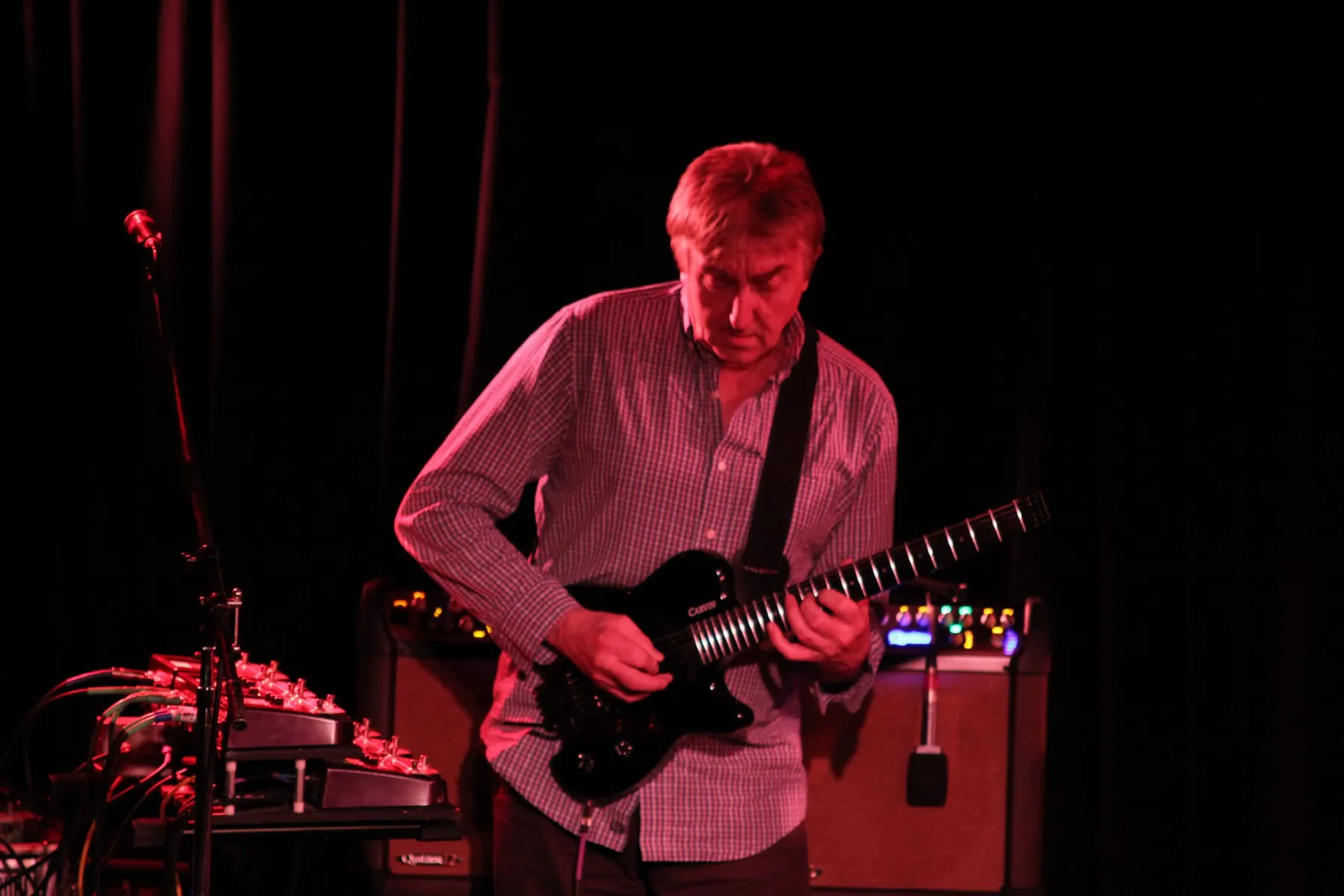
Photo by Chrisparks , licensed under CC BY-SA 4.0 · Wikimedia Commons
Rank #481
Allan Holdsworth
From Wikipedia
Allan Holdsworth was a British jazz and rock guitarist, violinist and composer. He contributed to numerous bands, including Soft Machine, U.K., The Tony Williams Lifetime, Pierre Moerlen's Gong, Bruford, Level 42, and Planet X, in addition to solo work in multiple genres.
Discography & Previews
Browse through and click an album to open and play 30-second previews streamed from Apple Music.

Velvet Darkness
1976 · 13 tracks
- 1 Good Clean Filth ↗ 5:24
- 2 Floppy Hat ↗ 2:46
- 3 Wish ↗ 4:21
- 4 Kinder ↗ 3:06
- 5 Velvet Darkness ↗ 4:43
- 6 Karzie Key ↗ 3:10
- 7 Last May ↗ 1:38
- 8 Gattox ↗ 4:54
- 9 Good Clean Filth (Alternate Take) ↗ 5:38
- 10 Kinder (Alternate Take) ↗ 3:07
- 11 Velvet Darkness (Alternate Take) ↗ 4:44
- 12 Karzie Key (Alternate Take) ↗ 2:15
- 13 Gattox (Alternate Take) ↗ 6:48


Wardenclyffe Tower
1992 · 11 tracks
- 1 5 to 10 ↗ 5:36
- 2 Sphere of Innocence ↗ 5:59
- 3 Wardenclyffe Tower ↗ 8:45
- 4 Dodgy Boat ↗ 5:38
- 5 Zarabeth ↗ 6:32
- 6 Against the Clock ↗ 4:58
- 7 Questions ↗ 4:05
- 8 Oneiric Moor ↗ 1:43
- 9 Tokyo Dream (Bonus Track) ↗ 5:06
- 10 The Un-Merry Go Round, Pt. 4 (Bonus Track) ↗ 3:01
- 11 The Un-Merry Go Round, Pt. 5 (Bonus Track) ↗ 1:59


Heavy Machinery
1996 · 10 tracks


-
 Velvet DarknessAllan Holdsworth197613 tracks
 -
 The Things You SeeAllan Holdsworth19807 tracks
 -
 i.o.u.Allan Holdsworth19828 tracks
 -
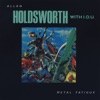 Metal FatigueAllan Holdsworth19856 tracks
 -
 AtavachronAllan Holdsworth19867 tracks
 -
 SandAllan Holdsworth19876 tracks
 -
 With a Heart in My SongAllan Holdsworth19887 tracks
 -
 SecretsAllan Holdsworth19898 tracks
 -
 Wardenclyffe TowerAllan Holdsworth199211 tracks
 -
 Hard Hat AreaAllan Holdsworth19937 tracks
 -
 None Too SoonAllan Holdsworth19969 tracks
 -
 Heavy MachineryAllan Holdsworth199610 tracks
 -
 The Sixteen Men of TainAllan Holdsworth199910 tracks
 -
 Flat Tire: Music for a Non-Existent MovieAllan Holdsworth20019 tracks
Deep Dive
Overview
Allan Holdsworth was a British guitarist, violinist, and composer whose career spanned from the 1970s to the early 2010s. Working across jazz fusion, progressive rock, and avant-garde contexts, Holdsworth became synonymous with technical mastery and harmonic sophistication on electric guitar. Unlike rock guitarists who built reputations on speed or sustain, Holdsworth pursued a vocabulary rooted in bebop phrasing and jazz improvisation, translating the language of alto saxophone and trumpet onto six strings and later the Chapman stick. His approach to the instrument—characterized by precise legato technique, unconventional fingering methods, and a refusal to rely on distortion—marked a distinct lineage in instrumental rock and jazz fusion.
Formation Story
Allan Holdsworth was born in 1946 in Yorkshire, England, during the post-war revival of British musical culture. He emerged from the progressive rock scene of the late 1960s, an era when rock musicians increasingly drew from jazz harmony and compositional sophistication. Rather than a formal “formation,” Holdsworth’s early career was defined by his participation in evolving ensembles and collaborative projects. His path to prominence came through work with pioneering British rock and jazz fusion acts, beginning in the early 1970s. By the time he entered his solo career in the mid-1970s, Holdsworth had already earned recognition as a session and touring musician whose technical abilities and harmonic sensibilities set him apart from his contemporaries.
Breakthrough Moment
Holdsworth’s transition to a solo career crystallized with Velvet Darkness in 1976, his debut studio album. This record established the foundational aesthetic he would refine across subsequent decades: intricate compositions rooted in jazz harmony, showcasing his ability to generate fluid, singable lines from chromatic chords and substitutions. The late 1970s and early 1980s saw his reputation solidify within musician circles, particularly after The Things You See (1980) and i.o.u. (1982). These early solo works positioned him as a guitarist’s guitarist—an artist whose influence among peers and jazz musicians often exceeded mainstream chart presence. The albums demonstrated that electric guitar could serve as a true improvisation vehicle in the jazz fusion tradition without resorting to rock cliché.
Peak Era
Holdsworth’s most artistically vital and commercially visible period ran from the mid-1980s through the late 1990s. Metal Fatigue (1985) represented a high point in integrating complex harmony with accessible compositional clarity, while Atavachron (1986) and Sand (1987) continued exploring his signature sound: clean, articulate picking punctuated by legato passages and harmonic reinterpretation of jazz standards and original compositions. Secrets (1989) consolidated his method, and Wardenclyffe Tower (1992) extended his range further. Throughout this period, Holdsworth maintained a consistent touring schedule and recording presence, working across Enigma Records, Relativity Records, and other progressive labels. His later work—including The Sixteen Men of Tain (1999) and Flat Tire: Music for a Non-Existent Movie (2001)—demonstrated sustained creative engagement with composition, arrangement, and improvisation well into the 2000s.
Musical Style
Holdsworth’s sound was defined by technical precision, harmonic sophistication, and an almost classical-music discipline applied to electric guitar. Rather than the blues-based vocabulary dominant in rock guitar, he drew from bebop, modal jazz, and the chromatic harmony of post-tonal composers. His technique emphasized smooth legato playing achieved through unconventional fingering—often using all four fingers of the fretting hand in sequences that other players would accomplish with pick-and-pull dynamics. This approach produced a singing, vocal quality to his lines, as if translating the phrasing of a jazz saxophonist directly to the fretboard. Harmonically, Holdsworth gravitated toward upper-structure triads, tritone substitutions, and suspended chords, creating restless, complex harmonic motion that avoided traditional I–IV–V progressions. His compositions often featured intricate rhythmic modulation and asymmetrical phrase lengths, pulling from progressive rock’s willingness to exceed four-bar and eight-bar structures. Though he worked primarily on electric guitar—often a Fender Stratocaster or semi-hollow body instruments—he also pursued the Chapman stick, an instrument suited to his polyphonic, melodically intricate approach. Over his career, his sound remained recognizable while shifting across contexts, from pure jazz fusion to more abstract, almost classical instrumental work.
Major Albums
Velvet Darkness (1976)
Holdsworth’s debut solo offering established the template for his career: intricate jazz-influenced compositions showcasing clean electric guitar technique and harmonic complexity that placed him outside mainstream rock convention.
i.o.u. (1982)
A lean, focused album consolidating his approach to melody and harmony while broadening his range of compositional textures and collaborative arrangements.
Metal Fatigue (1985)
Often cited as a career high, Metal Fatigue integrated complex harmony with memorable melodic content, demonstrating Holdsworth’s ability to write both challenging and emotionally resonant pieces.
Secrets (1989)
A mature statement showcasing refined compositional voice, varied instrumental textures, and consistent execution of his harmonic and technical vocabulary across diverse moods.
Wardenclyffe Tower (1992)
Named after Nikola Tesla’s experimental facility, this album explored abstract tonal territories while maintaining the singing, conversational quality of Holdsworth’s melodic approach.
The Sixteen Men of Tain (1999)
A late-career work demonstrating sustained creative engagement with jazz fusion vocabulary and intricate compositional architecture well into his sixties.
Signature Songs
- Velvet Darkness — The opening statement of his solo career, establishing his clean-toned, legato approach to electric guitar.
- The Things You See — A showcase for his ability to construct singable melodies from chromatic, non-traditional harmonic movement.
- Metal Fatigue — The title track exemplifying his capacity for both technical display and emotional resonance through carefully voiced chords and phrasing.
- Secrets — A demonstration of his mature compositional voice, integrating multiple instrumental colors and harmonic sophistication.
Influence on Rock
Holdsworth occupied a unique position in progressive rock and jazz fusion: respected among musicians and composers but rarely a household name. His influence radiated primarily through technical and harmonic innovation rather than commercial chart presence. He demonstrated that electric guitar could be deployed as a pure improvisation instrument in the jazz tradition, capable of the same harmonic subtlety and melodic invention as saxophone or piano. For younger guitarists in fusion, progressive metal, and jazz contexts, Holdsworth’s work provided proof that alternative techniques—legato playing, unconventional fingering patterns, precision without distortion—could rival rock’s volume-based vocabulary. His harmonic approach, drawing on jazz substitutions and upper-structure voicings, influenced the harmonic language of progressive metal and fusion throughout the 1990s and 2000s. While he worked within established jazz fusion idioms rather than creating entirely new genres, his uncompromising commitment to craft set a standard for instrumental musicianship in rock and jazz.
Legacy
Allan Holdsworth’s death in 2017 concluded a remarkable career spanning over four decades of studio recording and touring. His legacy rests primarily in the esteem held by fellow musicians, composers, and listeners deeply engaged with jazz fusion and progressive instrumental rock. His discography—spanning albums from 1976 through 2001 and released across labels including Enigma Records, Relativity Records, and others—remains in circulation and accessible through streaming services. Holdsworth never achieved the mainstream visibility of some rock guitarists, yet among musicians he retained consistent recognition as a master of his instrument and a rigorous composer. His technical contributions to electric guitar vocabulary and his uncompromising harmonic sophistication continue to serve as reference points for musicians seeking alternatives to blues-based or heavily distorted approaches. In the decades since his emergence in the progressive rock of the 1970s, Holdsworth’s work has been recognized as an important strand in the genealogy of fusion, progressive rock, and instrumental excellence.
Fun Facts
- Holdsworth worked across multiple genres and ensembles throughout his career, including appearances with Soft Machine, U.K., The Tony Williams Lifetime, Pierre Moerlen’s Gong, Bruford, Level 42, and Planet X, alongside his solo work.
- Rather than adopting the dominant rock guitar aesthetic of distortion and signal processing, Holdsworth built his sound on clean tone, legato technique, and harmonic sophistication drawn from jazz.
- He continued recording and touring actively into his sixties, releasing albums as late as 2001 that demonstrated sustained creative engagement with his compositional and improvisational vocabulary.