
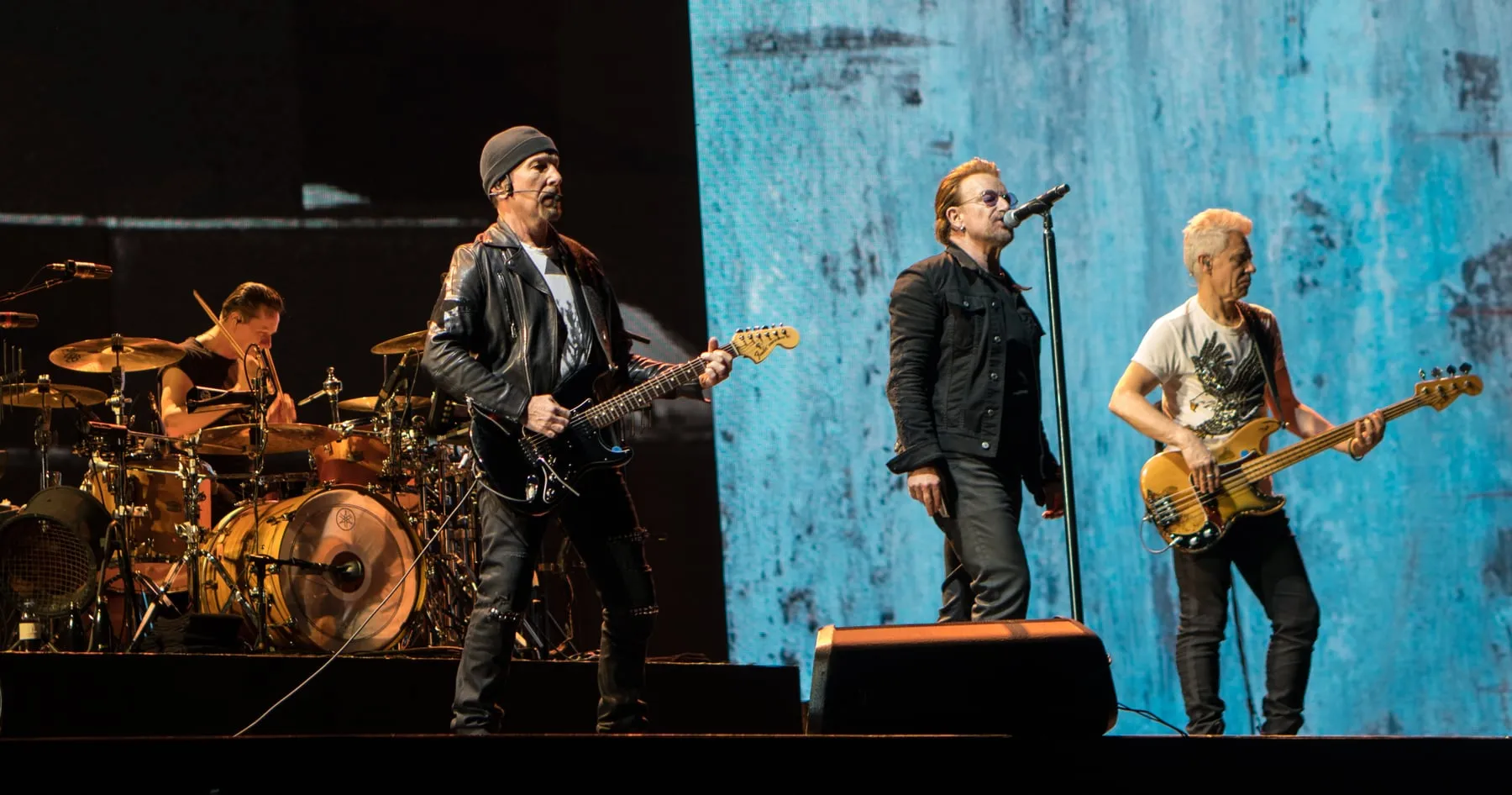
Photo by Remy , licensed under CC BY 4.0 · Wikimedia Commons
Rank #9
U2
Stadium-filling Irish rockers who fused post-punk drive with anthemic ambition.
From Wikipedia
U2 are an Irish rock band formed in Dublin in 1976. The group comprises Bono, the Edge, Adam Clayton, and Larry Mullen Jr.. Initially rooted in post-punk, U2's musical style has evolved throughout their career, yet has maintained an anthemic quality built on Bono's expressive vocals and the Edge's chiming, effects-based guitar sounds. Bono's lyrics, often embellished with spiritual imagery, focus on personal and sociopolitical themes. Popular for their live performances, the group have staged several elaborate tours over their career.
Members
- Dik Evans (1976–1978)
- Adam Clayton
- Bono
- Larry Mullen Jr.
- The Edge
Deep Dive
Overview
U2 are an Irish rock band formed in Dublin in 1976 who became one of the largest and most enduring rock acts of the late twentieth and early twenty-first centuries. Comprising Bono, the Edge, Adam Clayton, and Larry Mullen Jr., the group initially rooted themselves in post-punk before evolving toward a distinctly anthemic brand of alternative and pop rock. Their signature sound—built on Bono’s expressive, soaring vocals layered against the Edge’s chiming, effects-laden guitar textures—transcended the guitar-driven orthodoxy of their era and made them stadiums-filling acts across the globe. Over decades, U2 maintained an unmistakable sonic identity while remaining creatively restless, a quality that sustained their relevance across multiple musical generations.
Formation Story
U2 emerged from Dublin’s post-punk underground in 1976, when Larry Mullen Jr., Adam Clayton, and two guitar players—Dik Evans and the figure who would become known as the Edge—converged around a shared vision of what rock music could be. The band solidified around their core four members when Dik Evans departed in 1978, leaving the Edge as the sole guitarist and primary textural architect of their sound. This early lineup coalesced amid the broader post-punk ferment of the late 1970s, a period when British and Irish bands were deconstructing rock’s conventional forms and forging new languages from sparse, angular arrangements and unconventional production techniques. Dublin’s music scene at the time was considerably smaller and more provincial than London’s, yet it proved fertile ground for a band willing to chart its own course.
Breakthrough Moment
U2 released their debut album, Boy, in 1980 to critical attention and a growing cult following. The record introduced their essential compositional approach: sparse, shimmering guitar work suspended over tight, minimalist rhythm arrangements, with Bono’s vocals soaring above like a beacon. Their next two albums, October (1981) and War (1983), expanded their audience and consolidated their reputation as serious artists engaged with spiritual and political questions. War in particular marked a turning point, as the album and its supporting tours began to demonstrate the band’s capacity to connect emotionally with large crowds. By the time they released The Unforgettable Fire in 1984, U2 had transcended the post-punk underground and entered the wider rock mainstream, yet without compromising their artistic ambitions or distinctive sound.
Peak Era
The period spanning 1987 through the mid-1990s represented U2’s most commercially dominant and creatively fertile stretch. The Joshua Tree (1987) became a defining record of the 1980s, an album that fused the band’s post-punk sensibility with more expansive, almost stadium-rock arrangements without sacrificing their essential identity. The record established them as one of the world’s leading rock bands and inaugurated a series of increasingly elaborate world tours. The subsequent decade saw them navigate shifting musical landscapes with Achtung Baby (1991) and Zooropa (1993), albums that reflected the band’s willingness to incorporate electronic production, dance-rock rhythms, and experimental approaches while maintaining their core anthemic sensibility. This era consolidated U2’s position not merely as a successful rock band but as artists capable of genuine creative evolution, constantly testing their own boundaries while retaining a recognizable identity.
Musical Style
U2’s music is defined by the interplay between Bono’s vocal presence and the Edge’s distinctive guitar approach. Rather than favoring the distortion-heavy aesthetics common in rock, the Edge built his vocabulary around spatial effects—delay, reverb, and chorus—that created a shimmering, ethereal textural backdrop. Bono’s vocals, often soaring and emotionally direct, provided the emotional core, frequently carrying lyrics laden with spiritual and existential imagery. The rhythm section of Clayton’s bass and Mullen’s drumming remained relatively understated, creating space for the two primary voices to dominate. Across their career, U2 absorbed influences from post-punk forbears, art rock, and increasingly from electronic and dance production, yet always filtered these through their distinctive sensibility. Their anthemic quality—a gift for constructing songs that build to emotional crescendos—proved remarkably durable across different sonic approaches, whether in the spare post-punk of Boy or the dance-inflected textures of Achtung Baby.
Major Albums
Boy (1980)
U2’s debut announced a band with an unusually mature artistic vision. Recorded while its members were barely out of their teens, Boy presented post-punk minimalism reconceived as a vehicle for emotional directness rather than cool detachment. The Edge’s guitar work—economical, reverb-drenched, and melodically conscious—established the template that would define the band’s sound, while Bono’s lyrics engaged with themes of adolescent uncertainty and spiritual searching. The album’s spare production and intimate scale contrasted sharply with the stadium-scale ambitions they would later realize, yet it contained the essential elements—the vocal heroics, the spatial guitar textures, the anthemic song construction—that would eventually carry them to the world’s largest venues.
The Joshua Tree (1987)
The Joshua Tree stands as U2’s commercial and cultural apex, an album that synthesized their post-punk origins with expansive production and a sonic palette informed by American rock and folk traditions. The record achieved a rare balance between artistic credibility and mass appeal, generating multiple hit singles while maintaining thematic and sonic coherence across its running time. Its influence extended well beyond rock, shaping how alternative bands understood the possibility of stadium-scale emotional expression without surrendering artistic seriousness. The album’s supporting tour became a template for the large-scale rock tour as a total artistic experience, incorporating visual design, elaborate staging, and an emotional intensity that transcended conventional concert entertainment.
Achtung Baby (1991)
Following the massive success of The Joshua Tree, U2 pivoted radically toward electronic textures, dance-rock rhythms, and production approaches influenced by contemporary club and electronic music. Rather than diluting their identity, Achtung Baby demonstrated a band sufficiently confident in their core sensibility to undergo dramatic sonic reinvention. The album incorporated layered synthesizers, drum machines, and processed vocals alongside their traditional instruments, creating a hybrid sound that felt simultaneously contemporary and distinctly U2. The record’s thematic content shifted toward irony, sexual frankness, and postmodern play, marking a significant tonal departure from the spiritual earnestness of their previous work. Achtung Baby proved influential in demonstrating how established alternative and rock bands could engage with electronic production and contemporary dance music without losing artistic credibility.
Signature Songs
The band’s catalogue contains several songs that came to define them and their era. Songs from The Joshua Tree—particularly its most celebrated tracks—became anthems that transcended rock radio and entered the broader popular consciousness. Achtung Baby contributed further signature moments that demonstrated the band’s capacity for reinvention. Their live reputation was built substantially on their ability to perform with emotional intensity and technical precision, turning individual songs into extended emotional experiences through arrangement, improvisation, and Bono’s direct engagement with audiences.
Influence on Rock
U2’s impact on rock music proved multifaceted and long-lasting. They demonstrated that post-punk aesthetics could reach stadium-scale audiences without losing artistic credibility or emotional authenticity. Their success opened pathways for subsequent alternative rock bands to achieve commercial scale without perceived compromise. The band’s willingness to incorporate electronic production and experiment with their sound influenced how rock musicians understood the relationship between artistic tradition and contemporary production techniques. Bono’s vocal approach—soaring, emotionally direct, and substantially present in the mix—became a model that subsequent rock and pop vocalists engaged with or reacted against. The Edge’s guitar sound and production approach influenced innumerable subsequent guitarists and producers. More broadly, U2 helped establish the template for the global rock supergroup: a band capable of maintaining artistic momentum across decades, touring at the highest scale, and remaining culturally relevant across musical generation shifts.
Legacy
U2 remained active and touring into the 2020s, a longevity that reflected both their sustained commercial appeal and their commitment to creative engagement. The band continued releasing new material—Songs of Innocence (2014), Songs of Experience (2017), and Songs of Surrender (2023)—demonstrating an ongoing creative practice rather than reliance on nostalgia or legacy acts. Their touring continued to command enormous audiences and remain among the highest-grossing concert tours globally. The band’s music retained substantial presence in popular culture and streaming platforms, with their most celebrated albums remaining widely listened to across multiple generations. U2’s career trajectory—from post-punk originators to stadium titans to experimentally restless elder statesmen—established a model for artistic longevity and creative persistence that influenced how subsequent generations understood the possibilities of a sustained rock career.
Fun Facts
- The band’s name derives from a military reconnaissance aircraft, chosen because it suggested aviation and distance.
- Dik Evans, the original guitar player who departed in 1978, was replaced by the Edge, whose distinctive approach fundamentally shaped the band’s sound trajectory.
- U2 recorded and toured with substantial visual and theatrical elements, collaborating with designers and artists to create immersive concert experiences that transcended conventional rock show formats.
- The band’s spiritual themes and imagery, particularly prominent in their 1980s work, reflected genuine personal spiritual exploration rather than purely commercial packaging.