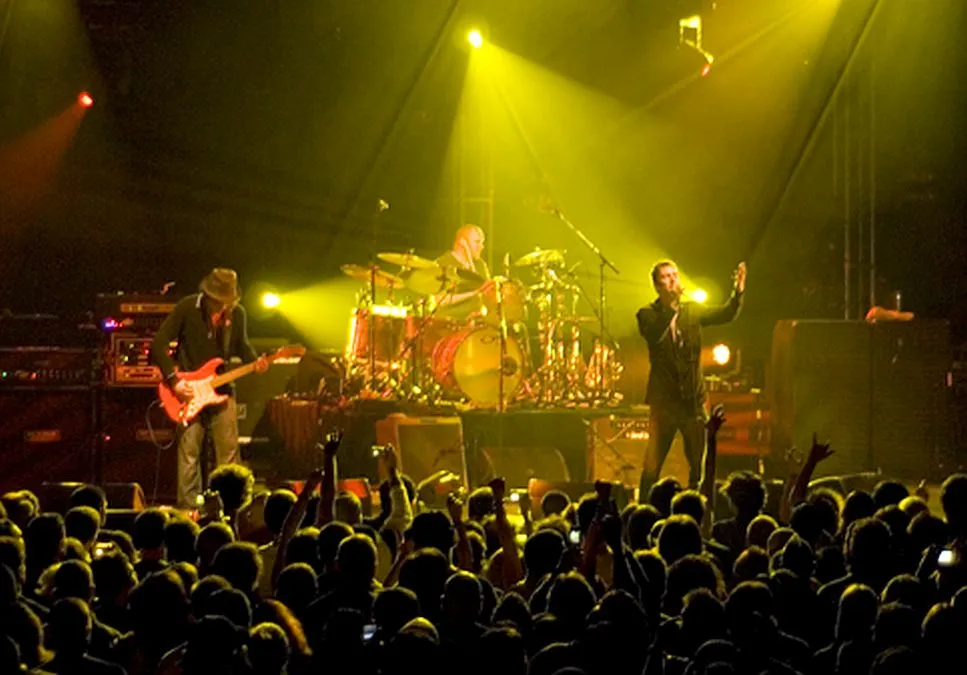
Photo by Maxcoles135 , licensed under Public domain · Wikimedia Commons
Rank #357
The Verve
Wigan band whose 'Urban Hymns' is one of Britpop's biggest sellers.
From Wikipedia
The Verve were an English rock band formed in Wigan in 1990 by lead vocalist Richard Ashcroft, guitarist Nick McCabe, bass guitarist Simon Jones and drummer Peter Salisbury. Guitarist and keyboard player Simon Tong later became a member in their first reunion only.
Members
- Simon Tong (1996–1999)
- Nick McCabe
- Peter Salisbury
- Richard Ashcroft
- Simon Jones
Studio Albums
- 1993 A Storm in Heaven
- 1995 A Northern Soul
- 1997 Urban Hymns
- 2008 Forth
Source: MusicBrainz
Deep Dive
Overview
The Verve were an English rock band formed in Wigan in 1990, emerging as one of Britpop’s most commercially significant acts. Built on the chemistry between Richard Ashcroft’s commanding vocals and Nick McCabe’s expansive guitar work, the band developed a sound that merged space rock and psychedelia with the raw energy of alternative rock. Their third album, Urban Hymns (1997), became one of the defining statements of 1990s British rock, establishing The Verve as stadium-level performers during an era when British guitar music dominated both domestic and international markets.
Formation Story
The Verve crystallized in Wigan, a post-industrial town in the North West of England, when Richard Ashcroft, Nick McCabe, Simon Jones, and Peter Salisbury came together in 1990. The quartet drew from the psychedelic and space rock traditions alongside the emerging alternative rock landscape of the early 1990s. Jones provided the foundational bass work while Salisbury’s drumming supplied the rhythmic architecture that would underpin the band’s increasingly ambitious arrangements. From their inception, The Verve operated in the shadow of both British psychedelic heritage and the guitar-driven alternative rock that dominated American college radio, positioning themselves at the intersection of these influences.
Breakthrough Moment
The Verve’s initial recognition came through their first two albums. A Storm in Heaven (1993) introduced their sound to a widening audience, establishing their credentials as serious artists working in psychedelic and space rock idioms. The follow-up, A Northern Soul (1995), deepened their reputation and expanded their fanbase within the emerging Britpop movement. However, it was Urban Hymns (1997) that transformed the band from respected alternative act into mainstream phenomenon. The album’s combination of sweeping orchestral arrangements, Ashcroft’s introspective yet anthemic vocal delivery, and McCabe’s soaring guitar textures resonated far beyond the UK, making Urban Hymns one of Britpop’s best-selling records and establishing The Verve as a major international act.
Peak Era
The period surrounding Urban Hymns (1997) represented The Verve’s creative and commercial apex. The album’s success established the band as arena-level performers capable of delivering both intimate emotional depth and large-scale sonic ambition. During this era, The Verve consolidated their position within British rock hierarchy, their music becoming a defining soundtrack to mid-to-late 1990s alternative rock. The album showcased their ability to construct songs around emotional crescendos and expansive instrumental passages, with production that emphasized space and texture over rawness. This period cemented The Verve’s legacy within Britpop, a movement that would eventually recede from cultural prominence but never lose its hold on British musical identity.
Musical Style
The Verve’s sound drew substantially from space rock and psychedelic rock traditions, refracted through the alternative rock aesthetic that dominated the 1990s. Nick McCabe’s guitar work formed the sonic centerpiece—characterized by atmospheric textures, soaring melodic lines, and the ability to move seamlessly between introspective beauty and explosive dynamics. Richard Ashcroft’s vocals functioned as a second lead instrument, capable of both fragile vulnerability and stadium-filling power. The band’s arrangements often built from sparse, exploratory passages into expansive crescendos, with production choices that foregrounded space and reverb. This sonic philosophy aligned them with the broader psychedelic revival of the 1990s while maintaining the immediacy and emotional directness valued in alternative rock. Over time, their material became increasingly orchestral and ambitious, incorporating keyboards and layered textures that pushed beyond traditional rock instrumentation.
Major Albums
A Storm in Heaven (1993)
The Verve’s debut established their commitment to psychedelic and space rock aesthetics, introducing the band’s core sonic vocabulary and Ashcroft’s commanding vocal presence to a widening audience of alternative rock listeners.
A Northern Soul (1995)
This second album deepened the band’s exploration of psychedelic textures and atmospheric guitar work, building on their debut’s foundation while strengthening their position within the emerging Britpop movement.
Urban Hymns (1997)
The Verve’s commercial and critical zenith, Urban Hymns combined sweeping arrangements, introspective songwriting, and stadium-scale ambition into one of Britpop’s most successful statements, establishing the band as major international performers.
Forth (2008)
Released after a decade of inactivity, Forth marked The Verve’s return to recording and represented their attempt to sustain relevance in a radically altered musical landscape, arriving at a point when Britpop’s cultural dominance had long since faded.
Signature Songs
- The band’s most recognizable tracks emerged from and around Urban Hymns, anchoring the album’s emotional and sonic architecture.
- Ashcroft’s vocal delivery on the album’s standout moments became emblematic of 1990s British rock’s capacity for both introspection and grandeur.
- McCabe’s guitar work on the album’s extended passages demonstrated his mastery of dynamic arrangement and textural sophistication.
- The band’s ability to construct songs around ascending emotional arcs made their material particularly suited to live performance and radio exposure.
Influence on Rock
The Verve’s success helped establish the template for 1990s Britpop as a globally significant movement, demonstrating that British guitar-based rock could achieve sustained commercial success on international markets. Their emphasis on atmospheric textures and psychedelic elements influenced the broader alternative rock landscape, contributing to a revival of interest in space rock and psychedelia during the 1990s. The band’s approach to dynamic arrangement—building from quiet, exploratory passages into powerful crescendos—became a model for numerous subsequent alternative rock and Britpop acts. Their integration of orchestral elements and ambitious production choices expanded the sonic palette available to rock bands working within the genre’s traditional parameters.
Legacy
The Verve’s position within rock history remains substantially tied to Urban Hymns and Britpop’s broader cultural moment. The album’s continued presence in streaming catalogs and periodic reissues ensure that new listeners encounter the band’s work, while their role in 1990s British rock maintains their relevance in historical discussions of the era. The band’s 2008 return with Forth demonstrated the durability of their creative partnership, even as the broader cultural context for Britpop had fundamentally shifted. The Verve remain emblematic of 1990s alternative rock’s capacity for both accessibility and artistic ambition, their music continuing to serve as a reference point for understanding how British guitar-based rock achieved mainstream prominence during that decade.
Fun Facts
- Simon Tong joined as guitarist and keyboard player during the band’s first reunion period (1996–1999), expanding their sonic capabilities during the Urban Hymns era and its immediate aftermath.
- The Verve’s formation in Wigan, a post-industrial North West town without the cultural cachet of London or Manchester, positioned them as outsiders within the geography of Britpop despite achieving mainstream success.
- The band’s decade-long hiatus before returning in 2008 reflected broader shifts in the music industry and cultural landscape, their eventual reunion arriving at a moment when 1990s nostalgia had become a recognized cultural force.
- EMI’s role as their primary label during their most commercially successful period connected The Verve to one of Britain’s largest and most historically significant record companies.
Discography & Previews
Click any album to expand its track list. Each track plays a 30-second preview streamed from Apple Music. Tap the link icon next to a track to open it in Apple Music for full playback.

- 1 Star Sail (2016 Remastered) ↗ 4:00
- 2 Slide Away (2016 Remastered) ↗ 4:03
- 3 Already There (2016 Remastered) ↗ 5:38
- 4 Beautiful Mind (2016 Remastered) ↗ 5:28
- 5 The Sun the Sea (2016 Remastered) ↗ 5:16
- 6 Virtual World (2016 Remastered) ↗ 6:17
- 7 Make It ‘Til Monday (2016 Remastered) ↗ 3:12
- 8 Blue (2016 Remastered) ↗ 3:19
- 9 Butterfly (2016 Remastered) ↗ 6:40
- 10 See You In the Next One (Have a Good Time) [2016 Remastered] ↗ 3:09

- 1 A New Decade (2016 Remastered) ↗ 4:13
- 2 This Is Music (2016 Remastered) ↗ 3:36
- 3 On Your Own (2016 Remastered) ↗ 3:34
- 4 So It Goes (2016 Remastered) ↗ 6:11
- 5 A Northern Soul (2016 Remastered) ↗ 6:33
- 6 Brainstorm Interlude (2016 Remastered) ↗ 5:11
- 7 Drive You Home (2016 Remastered) ↗ 6:42
- 8 History (2016 Remastered) ↗ 5:26
- 9 No Knock On My Door (2016 Remastered) ↗ 5:11
- 10 Life's an Ocean (2016 Remastered) ↗ 5:41
- 11 Stormy Clouds (2016 Remastered) ↗ 5:37
- 12 (Reprise) [2016 Remastered] ↗ 6:14

- 1 Bitter Sweet Symphony ↗ 5:57
- 2 Sonnet ↗ 4:21
- 3 The Rolling People ↗ 7:02
- 4 The Drugs Don't Work ↗ 5:05
- 5 Catching the Butterfly ↗ 6:27
- 6 Neon Wilderness ↗ 2:38
- 7 Space and Time ↗ 5:37
- 8 Weeping Willow ↗ 4:50
- 9 Lucky Man ↗ 4:54
- 10 One Day ↗ 5:03
- 11 This Time ↗ 3:51
- 12 Velvet Morning ↗ 4:58
- 13 Come On ↗ 15:15
