
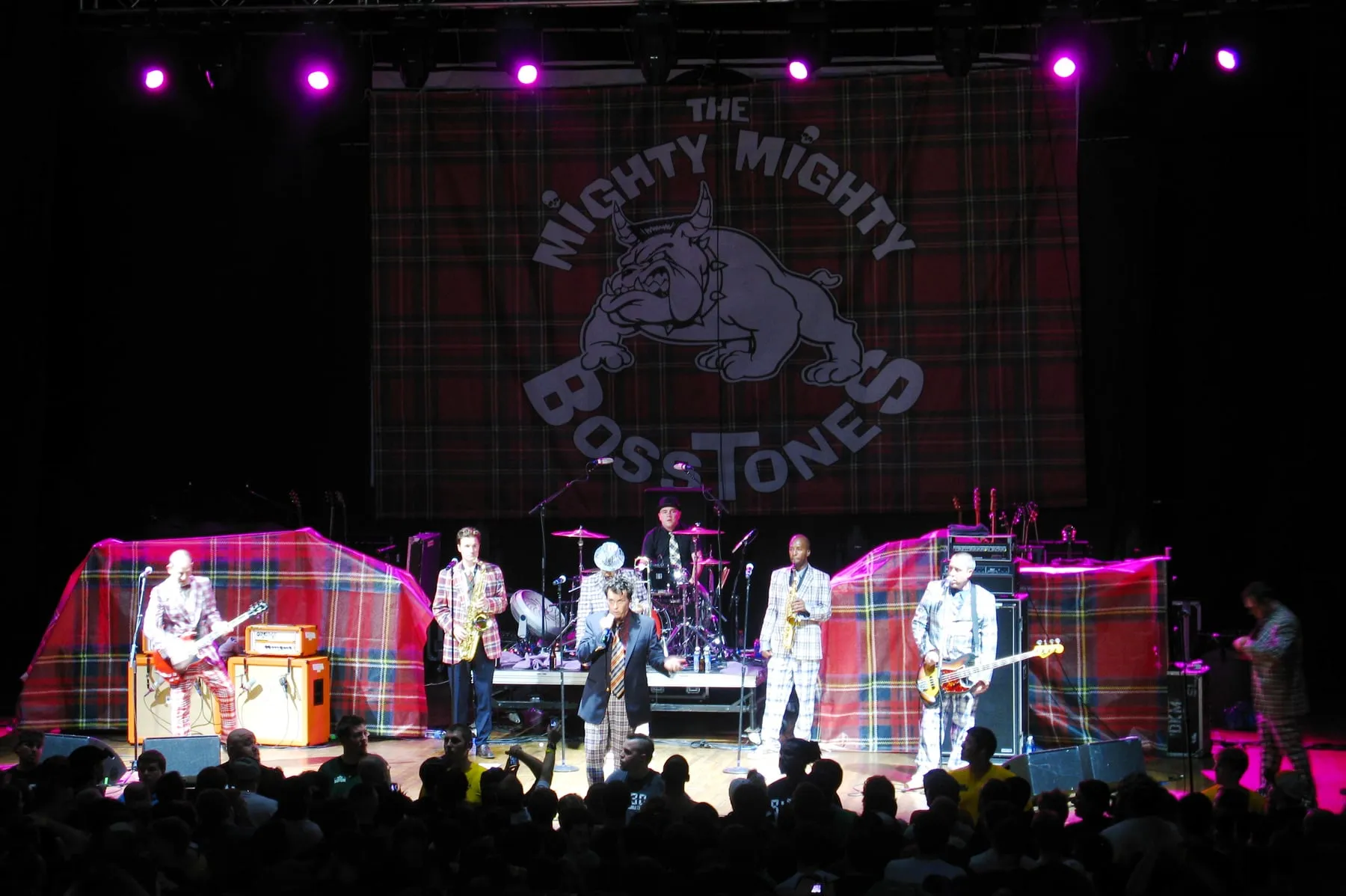
Photo by thisisbossi , licensed under CC BY-SA 2.0 · Wikimedia Commons
Rank #415
The Mighty Mighty Bosstones
Boston ska-core veterans behind 'The Impression That I Get'.
From Wikipedia
The Mighty Mighty Bosstones were an American ska punk band from Boston, Massachusetts, formed in 1983. From the band's inception, lead vocalist Dicky Barrett, bassist Joe Gittleman, tenor saxophonist Tim "Johnny Vegas" Burton and dancer ("Bosstone") Ben Carr remained constant members. The band's final lineup also included drummer Joe Sirois, saxophonist Leon Silva, guitarist Lawrence Katz, keyboardist John Goetchius, and trombonist Chris Rhodes.
Members
- Chris Rhodes
- Dicky Barrett
- Joe Gittleman
- Joe Sirois
- Tim Burton
Studio Albums
- 1989 Devil’s Night Out
- 1992 More Noise and Other Disturbances
- 1993 Don’t Know How to Party
- 1994 Question the Answers
- 1997 Let’s Face It
- 2000 Pay Attention
- 2002 A Jackknife to a Swan
- 2009 Pin Points and Gin Joints
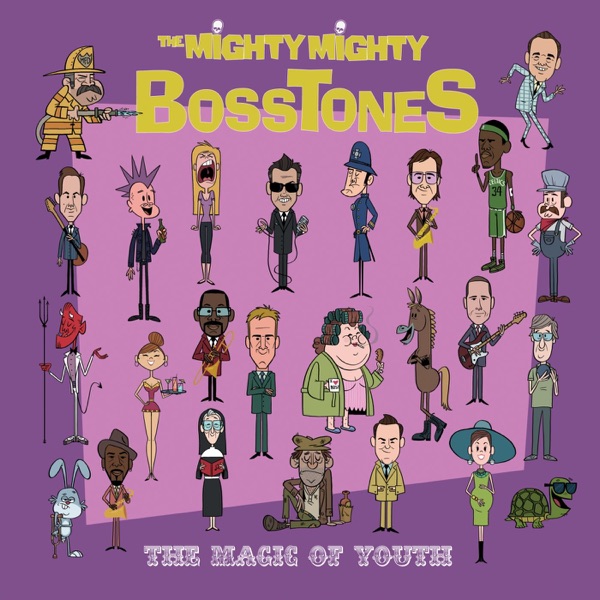
- 2011 The Magic of Youth
- 2018 While We’re at It
- 2021 When God Was Great
Source: MusicBrainz
Deep Dive
Overview
The Mighty Mighty Bosstones were an American ska punk band from Boston, Massachusetts, that operated from 1983 until their final performance in 2022. Emerging from a lineage that merged hardcore punk aggression with the horn-driven energy of ska, the Bosstones became one of the most recognizable ska-core acts of the 1990s and early 2000s. Their signature sound combined driving basslines, layered horn arrangements, high-velocity guitar work, and the distinctive vocal delivery of lead vocalist Dicky Barrett, anchored by the rhythmic and performative presence of dancer Ben Carr.
The band’s longevity and consistent touring presence made them central figures in keeping ska and ska punk alive through multiple decades, even as mainstream attention to the genre waxed and waned. Their most commercially successful moment arrived in 1997 with the album Let’s Face It, which yielded a top-10 radio hit and solidified their place in American rock culture.
Formation Story
The Mighty Mighty Bosstones coalesced in Boston in 1983, drawing members from the city’s thriving hardcore and alternative music scenes. From the band’s inception, four core members remained constant throughout much of their career: lead vocalist Dicky Barrett, bassist Joe Gittleman, tenor saxophonist Tim “Johnny Vegas” Burton, and dancer Ben Carr. This stability of founding personnel was exceptional for a punk or ska ensemble and allowed the band to develop a coherent identity even as other lineups shifted around them.
Boston in the early 1980s was a city with a deep tradition of punk and hardcore. The Bosstones grafted horns onto that foundation, creating a hybrid that was immediate and accessible yet maintained punk’s edge and DIY ethos. Ben Carr’s role as a dancer—not a traditional musician but a visual and kinetic force—was itself unusual and became a defining element of their live presentation.
Breakthrough Moment
The Bosstones’ recorded output began in 1989 with Devil’s Night Out, released on Taang! Records, a Boston-based independent label. However, their wider breakthrough came in the mid-1990s as ska punk gained mainstream traction. The 1994 album Question the Answers established them as a steady draw and touring act within ska and punk circles, but it was 1997’s Let’s Face It that propelled them into national prominence. The album spawned “The Impression That I Get,” which became a top-10 radio staple and music video mainstay, introducing the Bosstones to audiences far beyond the underground.
Let’s Face It marked a moment when the band’s songwriting, horn arrangements, and Barrett’s vocal charisma aligned with mainstream radio’s appetite for upbeat, energetic alternative rock with ska inflections. The success of that album and single cemented their status as the face of 1990s ska-core.
Peak Era
The Bosstones’ most creatively productive and commercially successful period spanned the late 1990s through the early 2000s. Following the breakthrough of Let’s Face It in 1997, they released Pay Attention in 2000 and A Jackknife to a Swan in 2002. These albums maintained their signature sound while expanding their production quality and songwriting reach. The band toured extensively during this era, building a devoted fanbase that extended beyond the initial ska-punk core audience.
Their live shows became legendary within punk and alternative circles for their energy and interplay among the horn section, the rhythm section, and Carr’s dancing. The consistency of their core lineup allowed them to refine their presentation night after night. By the early 2000s, the Bosstones had become elder statesmen of American ska, respected for their authenticity and staying power in a genre that had cycled through periods of underground obscurity and mainstream novelty.
Musical Style
The Mighty Mighty Bosstones’ sound fused the driving, distorted guitars and rapid-fire drumming of hardcore punk with the brass instrumentation of ska. Specifically, their lineup featured tenor saxophone and trombone—instruments that gave them a fuller, more horn-driven texture than many punk bands. The interplay between Tim Burton’s tenor saxophone and the band’s other horn players created melodic lines that often competed with or complemented the vocals rather than simply punctuating them. Joe Gittleman’s basslines were assertive and melodic, sitting high in the mix and often functioning as a lead instrument.
Dicky Barrett’s vocals ranged from shouted exhortation to sung melody, with an accent and phrasing that was distinctly Boston and distinctly his own. The band’s songwriting typically favored upbeat tempos and singable choruses that could work equally well in packed clubs or on rock radio. While the genre label “ska” typically evokes Jamaican musical influences, the Bosstones’ application was firmly rooted in American punk and hardcore, with ska serving as a tonal and rhythmic garnish rather than the primary skeleton.
Major Albums
Devil’s Night Out (1989)
The Bosstones’ debut established the template for their sound: punchy horn arrangements, melodic basslines, and Barrett’s commanding vocals over chiming guitars and tight drumming.
Don’t Know How to Party (1993)
Released during ska’s underground resurgence, this album refined the band’s approach and began building a stronger regional and national following.
Let’s Face It (1997)
The album that broke the band to mainstream audiences, anchored by “The Impression That I Get” and demonstrating a stronger songwriting maturity and production sophistication.
Pay Attention (2000)
Following up their breakthrough, this album solidified their status and proved that Let’s Face It was not a one-album phenomenon.
A Jackknife to a Swan (2002)
Released at the band’s peak touring visibility, this album showcased the full capabilities of their expanded horn section and Gittleman’s bass work.
Signature Songs
- “The Impression That I Get” — The band’s crossover hit from Let’s Face It, a top-10 radio staple that defined their mainstream identity.
- “Ringing in My Ears” — A testament to their ability to craft memorable melodic choruses within a high-energy punk framework.
- “The Roof Is on Fire” — A live staple that showcased the band’s energetic presentation and audience participation.
- “Numerology” — Demonstrates their songwriting depth and the interplay between vocals and horn arrangements.
Influence on Rock
The Mighty Mighty Bosstones were instrumental in keeping ska punk alive and visible during the late 1980s and 1990s when the genre repeatedly cycled between underground credibility and mainstream novelty. Their success with Let’s Face It and “The Impression That I Get” proved that ska-influenced rock could achieve genuine radio success without sacrificing its punk roots or underground credibility. They provided a model for how a horn-based rock band could maintain artistic integrity while embracing commercial viability.
Their influence extended to other ska and ska-punk acts who saw in the Bosstones a roadmap for longevity and respect. The band’s emphasis on live performance and touring created a template that became central to ska-punk culture: the ska show as a high-energy, participatory event rather than a passive concert experience. Their example—four constant members from inception through decades of change—also stood as a counterpoint to the revolving-door lineups common in punk and alternative rock.
Legacy
The Mighty Mighty Bosstones ceased active operations in 2022 after nearly four decades of continuous recording and touring. In that span, they released eleven studio albums and became one of the longest-active punk or ska bands in American history. Their 2021 album When God Was Great represented a final statement from the band, arriving after a nearly seven-year gap from While We’re at It in 2018.
The band’s legacy rests on their role as custodians of ska-core during an era when the genre was often dismissed or trivialized. They demonstrated that ska punk could be taken seriously without abandoning its inherent energy and humor, and that a rock band could sustain a career for decades by building a loyal touring audience and refusing to chase trends. For generations of fans who came of age in the 1990s and 2000s, the Bosstones remain synonymous with Boston punk and with the possibility that underdogs and regional acts could make a lasting mark on American rock.
Fun Facts
- Ben Carr’s role as a designated dancer was unusual for punk and ska bands, making the Bosstones a visually distinctive live act and establishing the “Bosstone” as an integral part of the band’s identity.
- The band recorded for multiple independent labels throughout their career, including Taang! Records and Golf Records, never signing to a major label despite achieving mainstream radio success.
- The Bosstones’ 1997 breakthrough arrived during the peak of American ska-punk’s mainstream visibility, allowing them to capture a moment that many ska bands either missed or could not sustain.
- The band maintained their core four members—Dicky Barrett, Joe Gittleman, Tim Burton, and Ben Carr—from 1983 onward, an extraordinarily rare achievement in punk and alternative rock.
Discography & Previews
Click any album to expand its track list. Each track plays a 30-second preview streamed from Apple Music. Tap the link icon next to a track to open it in Apple Music for full playback.


- 1 Our Only Weapon ↗ 3:08
- 2 Last Dead Mouse ↗ 3:37
- 3 Don't Know How to Party ↗ 3:15
- 4 Someday I Suppose ↗ 3:28
- 5 A Man Without ↗ 2:47
- 6 Holy Smoke ↗ 2:53
- 7 Illegal Left ↗ 3:12
- 8 Tin Soldiers ↗ 3:24
- 9 Almost Anything Goes ↗ 4:11
- 10 Issachar ↗ 3:47
- 11 What Was Was Over ↗ 2:59
- 12 Seven Thirty Seven/Shoe Glue ↗ 4:32

- 1 Kinder Words ↗ 3:07
- 2 A Sad Silence ↗ 3:57
- 3 Hell of a Hat ↗ 3:55
- 4 Pictures to Prove It ↗ 3:16
- 5 We Should Talk ↗ 3:12
- 6 Dollar and a Dream ↗ 3:18
- 7 Stand Off ↗ 3:22
- 8 365 Days ↗ 3:11
- 9 Toxic Toast ↗ 3:47
- 10 Bronzing the Garbage ↗ 2:28
- 11 Dogs and Chaplains ↗ 3:02
- 12 Jump through the Hoops ↗ 4:11


- 1 Let Me Be ↗ 3:52
- 2 The Skeleton Song ↗ 3:00
- 3 All Things Considered ↗ 4:02
- 4 So Sad to Say ↗ 3:10
- 5 Allow Them ↗ 3:28
- 6 High School Dance ↗ 2:52
- 7 Over the Eggshells ↗ 2:30
- 8 She Just Happened ↗ 2:52
- 9 Finally ↗ 3:47
- 10 I Know More ↗ 3:09
- 11 Riot on Broad Street ↗ 3:16
- 12 One Million Reasons ↗ 3:01
- 13 Bad News and Bad Breaks ↗ 3:34
- 14 Temporary Trip ↗ 2:27
- 15 Where You Come From ↗ 2:46
- 16 The Day He Didn't Die ↗ 3:25

- 1 A Jackknife to a Swan ↗ 2:48
- 2 Mr. Moran ↗ 3:05
- 3 You Gotta Go! ↗ 2:43
- 4 Everybody's Better ↗ 3:42
- 5 Sugar Free ↗ 2:45
- 6 I Want My City Back ↗ 3:16
- 7 Chasing the Sun Away ↗ 3:29
- 8 You Can't Win ↗ 3:19
- 9 The Old School Off the Bright ↗ 2:26
- 10 The Punch Line ↗ 3:16
- 11 Go Big ↗ 2:52
- 12 Shit Outta Luck ↗ 2:57
- 13 7 Ways to Sunday ↗ 3:59
- 1 The Daylights ↗ 2:21
- 2 Like a Shotgun ↗ 3:16
- 3 Disappearing ↗ 3:27
- 4 Sunday Afternoons on Wisdom Ave ↗ 3:36
- 5 They Will Need Music ↗ 3:46
- 6 The Package Store Petition ↗ 3:13
- 7 The Horse Shoe and the Rabbits Foot ↗ 3:58
- 8 The Magic of Youth ↗ 3:11
- 9 The Upper Hand ↗ 3:16
- 10 The Ballad of Candlepin Paul ↗ 3:25
- 11 Open and Honest ↗ 2:52

- 1 Green Bay, Wisconsin ↗ 3:11
- 2 The Constant ↗ 3:38
- 3 Wonderful Day for the Race ↗ 3:16
- 4 Unified ↗ 3:26
- 5 Divide ↗ 2:00
- 6 Closer to Nowhere ↗ 3:00
- 7 Walked Like a Ghost ↗ 3:14
- 8 The West Ends ↗ 2:51
- 9 Here We Are ↗ 3:48
- 10 The Mad Dash ↗ 2:46
- 11 Absolutely Wrong ↗ 3:21
- 12 In Honor Of ↗ 4:16
- 13 Hugo's Wife ↗ 3:53
- 14 After the Music Is Over ↗ 5:24

- 1 Decide ↗ 2:44
- 2 M O V E ↗ 3:17
- 3 I Don't Believe in Anything ↗ 3:47
- 4 Certain Things ↗ 3:43
- 5 Bruised ↗ 3:12
- 6 Lonely Boy ↗ 3:34
- 7 The Killing of Georgie (Pt. III) ↗ 4:25
- 8 You Had to Be There ↗ 3:43
- 9 When God Was Great ↗ 3:41
- 10 What It Takes ↗ 3:41
- 11 Long as I Can See the Light ↗ 2:51
- 12 The Truth Hurts ↗ 3:36
- 13 It Went Well ↗ 4:33
- 14 I Don't Want to Be You ↗ 3:56
- 15 The Final Parade (feat. Aimee Interrupter, Tim Timebomb, Angelo Moore & Stranger Cole) ↗ 7:58