
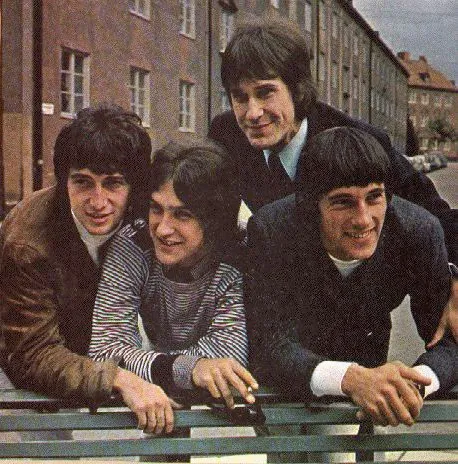
Photo by Unknown photographer , licensed under Public domain · Wikimedia Commons
Rank #76
The Kinks
Ray Davies' London band whose riff-rock prefigured punk and metal.
From Wikipedia
The Kinks were an English rock band formed in London in 1962. The band's original line-up comprised brothers Ray Davies and Dave Davies, Pete Quaife (bass), and Mick Avory. Emerging during the height of British rhythm and blues and Merseybeat, their breakthrough third single, the Ray Davies-penned "You Really Got Me" (1964), became an international hit, topping the charts in the United Kingdom and reaching the Top 10 in the United States. Other early hits included "All Day and All of the Night" (1964), "Tired of Waiting for You", "Set Me Free", "See My Friends", and "Till the End of the Day". They were part of the British Invasion of America until several problems during their 1965 American tour led to them being banned from touring there for a number of years.
Members
- Andy Pyle
- Bob Henrit
- Dave Davies
- Gordon John Edwards
- Ian Gibbons
- Jim Rodford
- John Dalton
- John Gosling
- Mick Avory
- Pete Quaife
- Ray Davies
Studio Albums
- 1964 Kinks
- 1965 Kinkdom
- 1965 The Kink Kontroversy
- 1965 Kinks‐Size
- 1965 Kinda Kinks
- 1966 Face to Face
- 1967 Something Else by The Kinks
- 1968 The Kinks Are the Village Green Preservation Society
- 1969 Arthur (or The Decline and Fall of the British Empire)
- 1970 Lola Versus Powerman and the Moneygoround, Part One
- 1971 Muswell Hillbillies
- 1972 Everybody’s in Show‐Biz
- 1973 Preservation Act 1
- 1974 Preservation Act 2
- 1975 Soap Opera
- 1975 Schoolboys in Disgrace
- 1977 Sleepwalker
- 1978 Misfits
- 1979 Low Budget
- 1981 Give the People What They Want
- 1983 State of Confusion
- 1984 Word of Mouth
- 1986 Think Visual
- 1989 UK Jive
- 1993 Phobia
Source: MusicBrainz
Deep Dive
Overview
The Kinks were an English rock band formed in London in 1964 that became one of the most innovative and influential acts of the British Invasion. Led by brothers Ray Davies and Dave Davies, the band synthesized rhythm and blues with raw, distorted guitar work and became architects of a sound that would prefigure both punk and heavy metal. Their breakthrough came swiftly with the Ray Davies-penned “You Really Got Me” in 1964, which topped the UK charts and reached the American Top 10, establishing the band as more than a passing trend.
Formation Story
The Kinks coalesced in London in 1964 around the songwriting partnership of brothers Ray Davies (vocals, rhythm guitar) and Dave Davies (lead guitar). The original rhythm section comprised Pete Quaife on bass and Mick Avory on drums. The band emerged during the height of British rhythm and blues and the Merseybeat phenomenon, drawing on American blues and R&B sources while adding their own raw, guitar-driven edge. This lineup would define the band’s classic period and establish the musical DNA that would sustain them through decades of evolution.
Breakthrough Moment
The Kinks’ third single, “You Really Got Me,” released in 1964, catapulted the band from London session musicians to international stars. The track’s defining feature—Dave Davies’ heavily distorted, fuzz-toned lead guitar riff—became iconic and proved that crude, aggressive guitar tone could be as compelling as technical mastery. The song’s success in both the United Kingdom and the United States opened doors that remained partially closed after 1965, when problems during an American tour led to a touring ban in the United States that lasted several years. Despite this setback, a string of early singles—“All Day and All of the Night” (1964), “Tired of Waiting for You,” “Set Me Free,” “See My Friends,” and “Till the End of the Day”—cemented their status as central figures in the British Invasion.
Peak Era
The Kinks’ creative zenith spanned the late 1960s and early 1970s, a period marked by Ray Davies’ increasing sophistication as a songwriter and conceptualist. Albums like The Kinks Are the Village Green Preservation Society (1968), Arthur (or The Decline and Fall of the British Empire) (1969), and Lola Versus Powerman and the Moneygoround, Part One (1970) showcased a band no longer confined to three-minute singles but expanding into narrative-driven rock that anticipated the prog-rock and punk movements. Ray Davies’ observational lyrics, steeped in working-class London imagery and social commentary, gave the band’s music intellectual weight alongside its visceral power. Muswell Hillbillies (1971) continued this trajectory, exploring British working-class life through a country-rock lens that broadened the band’s musical palette without sacrificing their essential identity.
Musical Style
The Kinks’ sound evolved from straightforward garage-rock riff-craft into something far more ambitious. In their early years, the band’s appeal rested on Dave Davies’ fuzzy, power-chord-driven lead guitar—a crude but effective distortion that predated and influenced the heavy rock sound of Black Sabbath and other metal pioneers. Ray Davies’ vocals ranged from sneering, aggressive delivery on uptempo numbers to world-weary, narrative-focused performances on the band’s more elaborate compositions. By the late 1960s, the Kinks incorporated music-hall influences, country instrumentation, orchestral arrangements, and theatrical production into their work, demonstrating that a band born from blues-rock fundamentals could operate across multiple registers without losing coherence. The core remained: Dave Davies’ inventive, often unconventional guitar work and Ray Davies’ gift for melody and storytelling.
Major Albums
You Really Got Me / The Kinks (1964)
The debut established the template: bludgeoning blues-rock riffs, British swagger, and Ray Davies’ emerging craft as a songwriter. The title track became a worldwide hit and the band’s signature statement of intent.
The Kinks Are the Village Green Preservation Society (1968)
A concept album centered on nostalgia, community, and loss, it marked Ray Davies’ transition into art-rock ambition. Theatrical, emotionally complex, and richly arranged, it stands as one of the band’s most enduring achievements and a precursor to punk’s embrace of kitsch and working-class themes.
Arthur (or The Decline and Fall of the British Empire) (1969)
A rock opera following a working-class Englishman’s emigration to Australia, Arthur demonstrated that the Kinks could sustain narrative across an entire album without sacrificing melodic invention or emotional clarity. The album consolidated Ray Davies’ reputation as a composer and social observer.
Lola Versus Powerman and the Moneygoround, Part One (1970)
A return toward tighter song structures while maintaining conceptual ambition, this album featured the hit “Lola,” a Ray Davies composition about a transvestite encounter in London. It proved the band could deliver both chart success and artistic credibility simultaneously.
Muswell Hillbillies (1971)
Drawn from the band members’ north London neighborhood, this album integrated country-rock, music-hall, and R&B influences into a richly textured exploration of working-class life. It demonstrated the band’s genre flexibility and Ray Davies’ ability to draw emotional and historical weight from everyday subjects.
Signature Songs
- “You Really Got Me” (1964) — The debut hit and band signature, built on Dave Davies’ pioneering fuzz-guitar riff that influenced generations of rock and metal musicians.
- “All Day and All of the Night” (1964) — A harder, more aggressive follow-up that solidified the band’s reputation for power-chord-driven rock.
- “Lola” (1970) — Ray Davies’ most commercially successful composition, balancing pop melodicism with sophisticated lyrical content about gender and desire in mid-century London.
- “Sunny Afternoon” (1966) — A music-hall-inflected, acoustic-driven reflection on working-class leisure that showcased Ray Davies’ narrative gift and the band’s stylistic range.
- “Tired of Waiting for You” (1965) — A wistful, melodic pop-rock song that proved the band’s ability to move beyond heavy riffing toward more introspective material.
- “Victoria” (1969) — A chant-based, almost punk-rock song from the Arthur album, featuring a chorus structure and subject matter that anticipated punk’s revival of simple, direct rock songwriting.
Influence on Rock
The Kinks’ influence on rock music extends across multiple genres and generations. The band’s pioneering use of heavy distortion and raw guitar tone in “You Really Got Me” established a template for hard rock and metal; the song remains a direct ancestor to Black Sabbath, Led Zeppelin, and the entire trajectory of heavy music. Equally significant was their shift toward art-rock and concept albums in the late 1960s, which influenced progressive rock but also, paradoxically, punk. Ray Davies’ embrace of music-hall traditions, working-class storytelling, and deliberately crude or unconventional production choices anticipated punk’s aesthetic of anti-polish and social commentary. The Kinks demonstrated that a band could be simultaneously brutal and sophisticated, commercial and experimental, rooted in tradition and forward-looking. Punk and new-wave bands of the 1970s and 1980s, including The Clash and The Jam, traced their lineage directly to the Kinks’ model of intelligent, socially aware rock that refused polite convention.
Legacy
The Kinks’ career extended far beyond their peak: the band continued recording and touring through 1996, producing albums across multiple labels including Reprise, Arista, and others, and adapting to changing rock landscapes without abandoning their core identity. Their influence on alternative rock, post-punk, and indie rock in the late 20th century proved as significant as their immediate 1960s impact. Ray Davies’ songwriting—particularly his ability to narrate working-class life with humor, pathos, and social observation—became a touchstone for songwriters across rock’s spectrum. The band’s willingness to fail in public, to experiment with theatrical and musical styles that didn’t always succeed commercially, earned them respect for artistic integrity over predictability. Decades after their initial run, the Kinks remain culturally and musically central to how rock history understands the British Invasion not as a monolithic phenomenon but as a diverse movement that included everything from straightforward power-pop to rock opera to proto-punk.
Fun Facts
- Dave Davies’ fuzzy guitar tone on “You Really Got Me” was created by slashing the speaker cone of an amplifier with a razor blade, a crude technique that anticipated the synthesized distortion and fuzz-box effects that would become standard in rock.
- The band operated their own record label, Konk Records, and controlled aspects of their production and release schedule that most 1960s acts had no authority over.
- Ray Davies wrote the majority of the band’s material, establishing himself as one of rock’s most prolific and consistent songwriters across more than three decades of releases.
Discography & Previews
Click any album to expand its track list. Each track plays a 30-second preview streamed from Apple Music. Tap the link icon next to a track to open it in Apple Music for full playback.

- 1 Beautiful Delilah ↗ 2:08
- 2 So Mystifying ↗ 2:54
- 3 Just Can't Go to Sleep ↗ 2:00
- 4 Long Tall Shorty ↗ 2:51
- 5 I Took My Baby Home ↗ 1:50
- 6 I'm a Lover Not a Fighter ↗ 2:05
- 7 You Really Got Me ↗ 2:15
- 8 Cadillac ↗ 2:46
- 9 Bald Headed Woman ↗ 2:44
- 10 Revenge ↗ 1:31
- 11 Too Much Monkey Business ↗ 2:17
- 12 I've Been Driving on Bald Mountain ↗ 2:03
- 13 Stop Your Sobbing ↗ 2:08
- 14 Got Love If You Want It ↗ 3:45

- 1 Milk Cow Blues ↗ 3:42
- 2 Ring the Bells ↗ 2:20
- 3 Gotta Get the First Plane Home ↗ 1:49
- 4 When I See That Girl of Mine ↗ 2:12
- 5 I Am Free ↗ 2:30
- 6 Till the End of the Day ↗ 2:22
- 7 The World Keeps Going Round ↗ 2:37
- 8 I'm on an Island ↗ 2:17
- 9 Where Have All the Good Times Gone ↗ 2:52
- 10 It's Too Late ↗ 2:35
- 11 What's In Store for Me ↗ 2:06
- 12 You Can't Win ↗ 2:40

- 1 Look for Me Baby ↗ 2:16
- 2 Got My Feet on the Ground ↗ 2:16
- 3 Nothin' in the World Can Stop Me Worryin' 'Bout That Girl ↗ 2:46
- 4 Naggin' Woman ↗ 2:36
- 5 Wonder Where My Baby Is Tonight ↗ 2:02
- 6 Tired of Waiting for You ↗ 2:33
- 7 Dancing in the Street ↗ 2:21
- 8 Don't Ever Change ↗ 2:25
- 9 Come On Now ↗ 1:48
- 10 So Long ↗ 2:11
- 11 You Shouldn't Be Sad ↗ 2:01
- 12 Something Better Beginning ↗ 2:24

- 1 Party Line ↗ 2:35
- 2 Rosy Won't You Please Come Home ↗ 2:34
- 3 Dandy ↗ 2:13
- 4 Too Much on My Mind ↗ 2:30
- 5 Session Man ↗ 2:17
- 6 Rainy Day in June ↗ 3:11
- 7 House in the Country ↗ 3:02
- 8 Holiday in Waikiki ↗ 2:52
- 9 Most Exclusive Residence for Sale ↗ 2:50
- 10 Fancy ↗ 2:31
- 11 Little Miss Queen of Darkness ↗ 3:17
- 12 You're Looking Fine ↗ 2:47
- 13 Sunny Afternoon ↗ 3:36
- 14 I'll Remember ↗ 2:26

- 1 David Watts ↗ 2:42
- 2 Death of a Clown ↗ 3:17
- 3 Two Sisters ↗ 2:04
- 4 No Return ↗ 2:04
- 5 Harry Rag ↗ 2:19
- 6 Tin Soldier Man ↗ 2:54
- 7 Situation Vacant ↗ 3:14
- 8 Love Me Till the Sun Shines ↗ 3:25
- 9 Lazy Old Sun ↗ 2:49
- 10 Afternoon Tea ↗ 3:26
- 11 Funny Face ↗ 2:29
- 12 End of the Season ↗ 3:00
- 13 Waterloo Sunset ↗ 3:17

- 1 The Village Green Preservation Society ↗ 2:52
- 2 Do You Remember Walter? ↗ 2:30
- 3 Picture Book ↗ 2:39
- 4 Johnny Thunder ↗ 2:33
- 5 Last of the Steam-Powered Trains ↗ 4:13
- 6 Big Sky ↗ 2:53
- 7 Sitting By the Riverside ↗ 2:26
- 8 Animal Farm ↗ 3:02
- 9 Village Green ↗ 2:11
- 10 Starstruck ↗ 2:24
- 11 Phenomenal Cat ↗ 2:41
- 12 All of My Friends Were There ↗ 2:29
- 13 Wicked Annabella ↗ 2:45
- 14 Monica ↗ 2:19
- 15 People Take Pictures of Each Other ↗ 2:11


- 1 20th Century Man (2022 Remaster) ↗ 5:56
- 2 Acute Schizophrenia Paranoia Blues (2022 Remaster) ↗ 3:32
- 3 Holiday (2022 Remaster) ↗ 2:41
- 4 Skin and Bone (2022 Remaster) ↗ 3:40
- 5 Alcohol (2022 Remaster) ↗ 3:38
- 6 Complicated Life (2022 Remaster) ↗ 4:09
- 7 Here Come the People in Grey (2022 Remaster) ↗ 3:46
- 8 Have a Cuppa Tea (2022 Remaster) ↗ 3:45
- 9 Holloway Jail (2022 Remaster) ↗ 3:26
- 10 Oklahoma USA (2022 Remaster) ↗ 2:40
- 11 Uncle Son (2022 Remaster) ↗ 2:32
- 12 Muswell Hillbilly (2022 Remaster) ↗ 5:04

- 1 Here Comes Yet Another Day (2022 Remaster) ↗ 3:55
- 2 Maximum Consumption (2022 Remaster) ↗ 4:06
- 3 Unreal Reality (2022 Remaster) ↗ 3:34
- 4 Hot Potatoes (2022 Remaster) ↗ 3:28
- 5 Sitting in My Hotel (2022 Remaster) ↗ 3:24
- 6 Motorway (2022 Remaster) ↗ 3:32
- 7 You Don't Know My Name (2022 Remaster) ↗ 2:36
- 8 Supersonic Rocket Ship (2022 Remaster) ↗ 3:32
- 9 Look a Little on the Sunny Side (2022 Remaster) ↗ 2:51
- 10 Celluloid Heroes (2022 Remaster) ↗ 6:24
- 11 Top of the Pops (Live at Carnegie Hall, New York, 3rd March 1972) [2022 Remaster] ↗ 4:35
- 12 Brainwashed (Live at Carnegie Hall, New York, 3rd March 1972) [2022 Remaster] ↗ 2:58
- 13 Mr. Wonderful (Live at Carnegie Hall, New York, 3rd March 1972) [2022 Remaster] ↗ 0:43
- 14 Acute Schizophrenia Paranoia Blues (Live at Carnegie Hall, New York, 3rd March 1972) [2022 Remaster] ↗ 4:00
- 15 Holiday (Live at Carnegie Hall, New York, 3rd March 1972) [2022 Remaster] ↗ 3:55
- 16 Muswell Hillbilly (Live at Carnegie Hall, New York, 3rd March 1972) [2022 Remaster] ↗ 3:09
- 17 Alcohol (Live at Carnegie Hall, New York, 3rd March 1972) [2022 Remaster] ↗ 5:21
- 18 Banana Boat Song (Live at Carnegie Hall, New York, 3rd March 1972) [2022 Remaster] ↗ 1:41
- 19 Skin and Bone (Live at Carnegie Hall, New York, 3rd March 1972) [2022 Remaster] ↗ 3:55
- 20 Baby Face (Live at Carnegie Hall, New York, 3rd March 1972) [2022 Remaster] ↗ 1:56
- 21 Lola (Live at Carnegie Hall, New York, 3rd March 1972) [2022 Remaster] ↗ 1:44

- 1 Morning Song ↗ 2:01
- 2 Daylight ↗ 3:20
- 3 Sweet Lady Genevieve ↗ 3:27
- 4 There's a Change in the Weather ↗ 3:01
- 5 Where Are They Now? ↗ 3:29
- 6 One of the Survivors ↗ 4:31
- 7 Cricket ↗ 2:57
- 8 Money and Corruption / I Am Your Man ↗ 6:02
- 9 Here Comes Flash ↗ 2:42
- 10 Sitting in the Midday Sun ↗ 3:48
- 11 Demolition ↗ 4:09
- 12 Preservation ↗ 3:39

- 1 Announcement 1 ↗ 0:41
- 2 Introduction to a Solution ↗ 2:43
- 3 When a Solution Comes ↗ 3:40
- 4 Money Talks ↗ 3:44
- 5 Announcement 2 ↗ 0:55
- 6 Shepherds of the Nation ↗ 4:18
- 7 Scum of the Earth ↗ 2:45
- 8 Second Hand Car Spiv ↗ 4:01
- 9 He's Evil ↗ 4:25
- 10 Mirror of Love ↗ 3:26
- 11 Announcement 3 ↗ 0:36
- 12 Nobody Gives ↗ 6:33
- 13 Oh Where Oh Where Is Love? ↗ 3:40
- 14 Flash's Dream (The Final Elbow) ↗ 3:55
- 15 Flash's Confession ↗ 4:30
- 16 Nothing Lasts Forever ↗ 3:42
- 17 Announcement 4 ↗ 0:20
- 18 Artificial Man ↗ 5:30
- 19 Scrapheap City ↗ 3:16
- 20 Announcement 5 ↗ 1:06
- 21 Salvation Road ↗ 3:19

- 1 Everybody's a Star (Starmaker) ↗ 2:57
- 2 Ordinary People ↗ 3:50
- 3 Rush Hour Blues ↗ 4:29
- 4 Nine to Five ↗ 1:48
- 5 When Work Is Over ↗ 2:06
- 6 Have Another Drink ↗ 2:43
- 7 Underneath the Neon Sign ↗ 3:56
- 8 Holiday Romance ↗ 3:12
- 9 You Make It All Worthwhile ↗ 3:50
- 10 Ducks on the Wall ↗ 3:23
- 11 (A) Face in the Crowd ↗ 2:18
- 12 You Can't Stop the Music ↗ 3:13




- 1 Opening ↗ 0:38
- 2 Wall of Fire ↗ 4:59
- 3 Drift Away ↗ 5:02
- 4 Still Searching ↗ 4:52
- 5 Phobia ↗ 5:16
- 6 Only a Dream ↗ 5:03
- 7 Don't ↗ 4:36
- 8 Babies ↗ 4:46
- 9 Over the Edge ↗ 4:19
- 10 Surviving ↗ 5:59
- 11 It's Alright (Don't Think About It) ↗ 3:31
- 12 The Informer ↗ 4:01
- 13 Hatred (A Duet) ↗ 6:06
- 14 Somebody Stole My Car ↗ 4:03
- 15 Close to the Wire ↗ 4:01
- 16 Scattered ↗ 4:11