
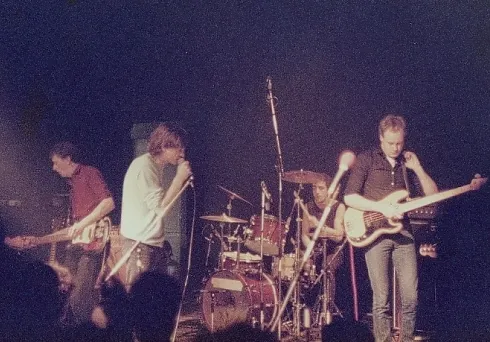
Photo by Gabi Hütköper The original uploader was Kekslover at English Wikipedia . , licensed under CC BY-SA 3.0 · Wikimedia Commons
Rank #212
The Fall
Mark E. Smith's prolific Manchester institution of acerbic post-punk.
From Wikipedia
The Fall were an English post-punk band, formed in 1976 in Prestwich, Greater Manchester. They had many line-up changes, with vocalist and founder member Mark E. Smith being the only constant member. The Fall's long-term musicians included drummers Paul Hanley, Simon Wolstencroft and Karl Burns; guitarists Craig Scanlon, Marc Riley, and Brix Smith; and bassist Steve Hanley, whose melodic, circular bass lines are widely credited with shaping the band's sound from early 1980s albums such as Hex Enduction Hour to the late 1990s.
Members
- Mark E. Smith
Deep Dive
Overview
The Fall were an English post-punk band that emerged from Prestwich, Greater Manchester in 1976 and remained active until 2018. Fronted and founded by Mark E. Smith, whose caustic vocal delivery and unrelenting creative vision defined their entire 42-year existence, The Fall became one of rock’s most prolific and uncompromising acts. They occupied a space between post-punk’s raw urgency and art rock’s structural experimentation, producing a catalog of 32 studio albums that prioritized conceptual restlessness and sardonic lyricism over commercial calculation.
Formation Story
The Fall coalesced in 1976 in the working-class Manchester suburb of Prestwich, with Mark E. Smith as the sole founding and permanent member throughout their four-decade run. From the outset, Smith established a creative dictatorship that would define the band’s ethos: constant line-up rotation became a deliberate artistic strategy rather than a sign of instability. Early members rotated with frequency, but by the early 1980s, a core of long-term collaborators emerged who would anchor the band’s sound: drummer Karl Burns, guitarist Craig Scanlon, and crucially, bassist Steve Hanley. This fluid membership structure meant that The Fall rarely cohered into a stable ensemble, yet Smith’s presence remained the constant through which all iterations were filtered.
Breakthrough Moment
The Fall’s emergence into wider attention coincided with the post-punk boom of the late 1970s and early 1980s. Their first two albums, Live at the Witch Trials (1979) and Dragnet (1979), introduced their stark, repetitive approach to post-punk: minimal arrangements, angular rhythms, and Smith’s spoken-sung vocals delivered with contemptuous precision. By 1982, the band had solidified its artistic identity with Hex Enduction Hour, an album that stands as a landmark statement of post-punk possibility. Steve Hanley’s melodic, circular bass lines—a foundational element that would define The Fall’s sound across three decades—became the engine around which the band’s arrangements coalesced. The album’s release marked their transition from post-punk novelty to a sustained artistic force with a genuinely distinct voice within rock music.
Peak Era
The Fall’s most creatively vital and commercially successful period ran roughly from 1982 to 1990. Albums including Grotesque (After the Gramme) (1980), Perverted by Language (1983), The Wonderful and Frightening World of… The Fall (1984), This Nation’s Saving Grace (1985), and Bend Sinister (1986) established them as prolific masters of post-punk abstraction. Each release twisted their foundational formula—repetitive bass patterns, oblique lyrical commentary, and Smith’s distinctive deadpan delivery—into new configurations. The late 1980s saw further experimentation with I Am Kurious Oranj (1988) and The Frenz Experiment (1988), albums that pushed against post-punk orthodoxy while maintaining Smith’s sardonic worldview. By Extricate (1990), The Fall had become an institution unto themselves: a band that had never compromised their artistic vision for mainstream acceptance, yet maintained a devoted following across three continents.
Musical Style
The Fall’s sound was built on a foundation of repetition and abstraction. Rather than moving toward conventional song structures, Smith and his collaborators favored circular bass patterns—Steve Hanley’s contribution was essential here—layered with angular, often discordant guitar work from Craig Scanlon and later Marc Riley. Rhythmically, they favored off-kilter, repetitive grooves that created propulsive unease rather than dancing momentum. Smith’s vocals eschewed traditional rock frontman histrionics; instead, he spoke-sang in a thick Mancunian accent, treating lyrics as barbed observations about working-class life, bureaucratic absurdity, and cultural decline. This approach situated them within post-punk but set them apart from punk’s three-chord directness and art rock’s excessive virtuosity. The band’s evolution across four decades saw them incorporate elements of industrial music, electronic production, and even dance rhythms, yet Smith’s core aesthetic—repetitive, sardonic, architecturally minded—remained constant. Their records rarely featured traditional verses and choruses; instead, songs spiraled through variations on a single motif, building tension through accretion rather than dynamic arc.
Major Albums
Hex Enduction Hour (1982)
A landmark post-punk statement where Steve Hanley’s bass work crystallized as the band’s foundational element. Established the template that would define The Fall’s sound across the coming decades: repetitive, hypnotic, and acerbic.
This Nation’s Saving Grace (1985)
An album that balanced experimental post-punk abstraction with surprisingly direct lyrical commentary on contemporary Britain. Demonstrated Smith’s capacity to evolve within his established aesthetic without abandoning core principles.
Bend Sinister (1986)
Among the band’s most accomplished works, showcasing tighter arrangements and a greater emphasis on melodic undercurrents beneath the surface abstraction. Proved The Fall could refine their sound without diluting its power.
Extricate (1990)
Captured The Fall at a peak of creative maturity, balancing their experimental impulses with songs that possessed genuine emotional weight beneath the deadpan delivery. Represented the culmination of their 1980s trajectory.
The Unutterable (2000)
A late-period album that demonstrated The Fall’s refusal to retreat into nostalgia or self-parody. Maintained their commitment to conceptual restlessness and acerbic observation into their third decade.
Fall Heads Roll (2005)
Released when The Fall was entering their fourth decade, this album proved the band could still generate surprising new directions while retaining their fundamental identity and Mark E. Smith’s uncompromising vision.
Signature Songs
- “Repetition” — An early statement of the band’s core aesthetic: a song structured entirely around repetitive, hypnotic guitar and bass work that builds toward a sense of controlled dread.
- “How I Wrote Elastic Man” — A rare moment of narrative clarity from Smith, delivered with his characteristic sardonic detachment and rhythmic precision.
- “The Sparta” — Showcases the band’s ability to create tension through minimal means, with Steve Hanley’s bass work at the center of a sparse but propulsive arrangement.
- “English Scheme” — Demonstrates Smith’s gift for observational commentary, presented through spoken-sung vocals over a characteristically off-kilter groove.
Influence on Rock
The Fall’s influence on post-punk and alternative rock proved substantial despite their refusal to chase commercial success. Their insistence on artistic autonomy and conceptual restlessness provided a model for countless bands uninterested in mainstream compromise. By maintaining constant line-up rotation and album-to-album stylistic shifts, they demonstrated that a rock band need not calcify into a nostalgia act or dissolve entirely; instead, an artist could remain the constant while everything around them transformed. Bands working in industrial rock, post-punk revival, and art rock all drew lessons from The Fall’s commitment to abstraction and repetition as tools for emotional and intellectual expression. Mark E. Smith’s role as a solo visionary within a collaborative medium—similar to figures like Robert Quine or Richard Hell—established a template for the uncompromising post-punk frontman that echoed through decades of alternative rock.
Legacy
The Fall disbanded in 2018 with Mark E. Smith’s death, ending one of rock music’s most consistent and prolific careers. Their 32 studio albums across four decades represent one of the largest and most uneven bodies of work in rock history—a fact that Smith seemed to embrace rather than resist. The band never achieved mainstream commercial success comparable to their cultural influence, a distinction that only strengthened their credibility within alternative and post-punk circles. In the decades since their formation, The Fall have been recognized as a foundational post-punk institution whose approach to repetition, abstraction, and working-class observation influenced both contemporary acts and retrospective reevaluation of post-punk’s possibilities. Streaming platforms and retrospective box sets have made their catalog more accessible to younger listeners unfamiliar with their original releases, ensuring their relevance to successive generations of rock musicians and listeners interested in the margins where abstraction and passion converge.
Fun Facts
- The Fall’s line-up changed so frequently that Mark E. Smith once joked about being the only permanent member, a structural quirk that became celebrated as an artistic principle rather than a weakness.
- Steve Hanley’s bass work, spanning from Hex Enduction Hour through the late 1990s, is widely credited by critics and musicians as a primary architect of The Fall’s distinctive sound.
- The band’s discography spans 32 studio albums, an astonishing output that places them among rock’s most prolific acts and reflects Smith’s refusal to slow creative output or repeat commercial formulas.
- Throughout their career, The Fall maintained their Manchester base and working-class identity, resisting the cosmopolitan pretensions that often accompany alternative rock success.