
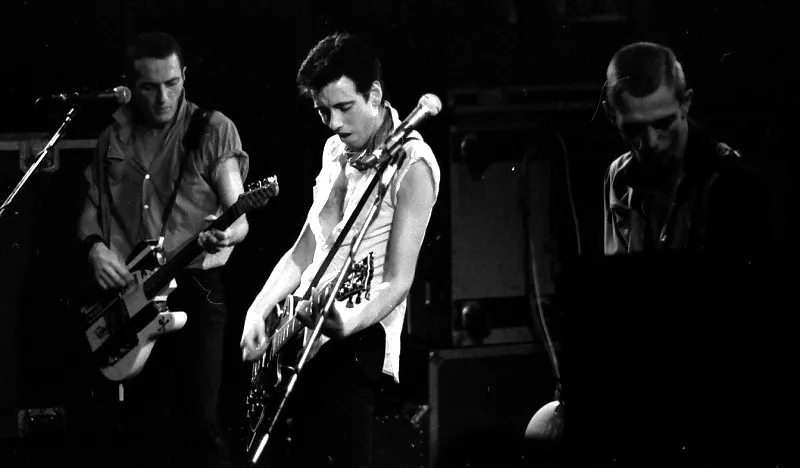
Photo by Helge Øverås , licensed under CC BY-SA 4.0 · Wikimedia Commons
Rank #17
The Clash
Punk's most musically expansive band, fusing reggae, dub, and rockabilly.
From Wikipedia
The Clash were an English rock band formed in London in 1976. Billed as "The Only Band That Matters", they are considered one of the most influential acts in the original wave of British punk rock, with their music fusing elements of reggae, dub, funk, ska and rockabilly. The band also contributed to the post-punk and new wave movements that followed. For most of their recording career, the Clash consisted of lead vocalist and rhythm guitarist Joe Strummer, lead guitarist and vocalist Mick Jones, bassist Paul Simonon and drummer Nicky "Topper" Headon.
Members
- Joe Strummer
- Keith Levene
- Mick Jones
- Paul Simonon
- Terry Chimes
- Topper Headon
Deep Dive
Overview
The Clash were an English rock band formed in London in 1976 who fundamentally expanded the musical vocabulary of punk rock. Billed as “The Only Band That Matters,” they stand as one of the most influential acts of the original British punk wave, not through raw simplicity but through relentless genre-crossing ambition. While their contemporaries in the Sex Pistols and The Ramones mined the primal power of three-chord rock, The Clash layered reggae, dub, funk, ska, and rockabilly into a sound that proved punk need not be stylistically narrow. They were equally architects of the post-punk and new wave movements that displaced punk’s initial dominance in the early 1980s.
Formation Story
The Clash crystallized around Joe Strummer and Mick Jones, both guitarists and vocalists, in London’s volatile mid-1976 punk scene. Strummer, having played in earlier outfits, and Jones brought complementary songwriting sensibilities and a shared vision of punk as a vehicle for social commentary and sonic experimentation. Paul Simonon joined as bassist and Nicky “Topper” Headon as drummer, solidifying the classic four-piece lineup that would define the band’s recorded legacy. The band’s name and stated mission—articulated through relentless touring, provocative album artwork, and interview rhetoric—positioned them as the punk movement’s intellectual and moral conscience, intent on using the genre’s speed and anger as a template for something far more expansive.
Breakthrough Moment
The Clash’s self-titled debut in 1977 announced their arrival with urgent, tightly wound songs that fused punk’s aggression with reggae’s offbeat rhythms and dub’s textural depth. The album established their sound as fundamentally different from punk orthodoxy, and their live reputation—built through constant gigging—began to extend their influence beyond London. Give ‘Em Enough Rope arrived in 1978, deepening their fusion of styles and expanding their reach. However, it was London Calling in 1979 that cemented their status as the decade’s most vital rock band. A double album recorded as punk’s cultural moment was already fading, London Calling ranged across reggae (“Police and Thieves”), rockabilly-influenced rockouts, stark political songs, and intricate studio experimentation. The album’s breadth and consistent quality proved that punk’s fundamental energy could fuel endless formal variation. London Calling became a touchstone for how rock music could be both commercially ambitious and artistically uncompromising.
Peak Era
The period from 1979 through 1980 represented The Clash at their creative and commercial apex. London Calling’s success was followed almost immediately by Sandinista!, a sprawling triple album released in 1980 that pushed their genre-blending further into funk, dub reggae, and even calypso-inflected material. The band’s willingness to occupy double and triple album formats—forms typically reserved for stadium rock—demonstrated how fully they had escaped punk’s implicit constraint that “more” necessarily meant “less interesting.” Sandinista! divided critics and fans, its ambitious scope and uneven track list a departure from London Calling’s focused mastery, yet it represented a band operating at maximum creative confidence, uninterested in repeating a formula. This era also saw them become one of rock’s most visible political voices, with Strummer’s lyrics engaging directly with Nicaraguan politics, racism, and working-class struggle, topics punk had raised but The Clash pursued with intellectual rigor.
Musical Style
The Clash’s sonic identity rested on the fundamental punk toolkit—loud, fast guitars, driving rhythm section, Strummer’s ragged vocal delivery—but deployed in service of unexpected arrangements and non-Western rhythm sources. Topper Headon’s drumming moved fluidly between punk’s relentless kick-snare attack and reggae’s syncopated swing; Simonon’s bass lines pushed from punk’s anchor function into reggae’s melodic and rhythmic foregrounding; Mick Jones’s lead guitar work combined punk’s buzz and feedback with cleaner, more structured melodic passages and rockabilly twang. Producer influence, particularly in London Calling and Sandinista!, brought studio sophistication that ran counter to punk’s supposed authenticity cult—multitrack recording, layering, echo and reverb effects, and careful mixing that allowed reggae and dub elements to breathe. The band’s songwriting evolved from Strummer and Jones’s collaboration, oscillating between visceral, three-minute political statements and seven-plus minute explorations of rhythm and texture. Their willingness to slow down, to accent reggae’s space and echo, and to incorporate non-rock instrumentation made them sound constantly contemporary even as punk itself hardened into historical artifact.
Major Albums
The Clash (1977)
Their raw, confident debut established the template for punk-reggae fusion with tracks that combined punk’s velocity and lyrical directness with reggae’s offbeat rhythms and spaces, proving the two forms were not incompatible but symbiotic.
Give ‘Em Enough Rope (1978)
The follow-up deepened their sonic palette and songwriting maturity, showing the band consolidating their vision and expanding it incrementally rather than through revolution.
London Calling (1979)
A double album and the definitive statement of their artistic ambition, ranging across reggae, rockabilly, dub, and straight-ahead rock with no loss of intensity, it stands as perhaps the finest rock album of its decade and the album most responsible for their legendary status.
Sandinista! (1980)
A triple album reflecting their peak confidence and scope, blending funk, dub reggae, calypso, and political urgency into a sprawling, sometimes unfocused but always adventurous artistic statement.
Combat Rock (1982)
Their final charting album and last to achieve broad commercial success, it refined rather than reinvented their sound, marking the beginning of the band’s commercial and critical decline.
Signature Songs
- “White Riot” — An early statement of political urgency and punk aggression that established Strummer as the genre’s most socially conscious lyricist.
- “I Fought the Law” — A cover originally by the Bobby Fuller Four that became a punk anthem in their hands, its simple defiance becoming the band’s most recognizable refrain.
- “London Calling” — The opening track of their masterpiece, a reggae-inflected alarm call that balanced rock dynamics with apocalyptic imagery.
- “Rock the Casbah” — A funkier, more pop-oriented track from Combat Rock that broadened their radio presence while maintaining compositional sophistication.
- “Police and Thieves” — A reggae interpretation that displayed their ability to inhabit and reinterpret non-punk genres with respect and intensity.
Influence on Rock
The Clash’s impact on rock music extended far beyond punk itself. Their demonstration that punk could accommodate reggae, funk, and dub without dilution opened stylistic pathways that postpunk and new wave acts traveled throughout the 1980s. Bands from Joy Division to Gang of Four to The Police drew from The Clash’s template of punk energy deployed through non-punk genres. The Clash also shifted punk’s self-image from a movement opposed to musicianship and production sophistication to one that could encompass both, influencing how subsequent generations thought about punk’s ideological and sonic scope. Their explicit political engagement, particularly Strummer’s visibility as a lyricist concerned with global justice and class struggle, established punk (or post-punk) as a vehicle for sustained political thought rather than adolescent rebellion alone. The Clash’s influence extended across genres: rock acts, reggae interpreters, and hip-hop producers all drew from their fusion approach.
Legacy
The Clash disbanded in 1986, a decade after their formation, leaving behind a recorded catalog whose standing has only grown in the decades since. London Calling endures as a reference point in rock music conversations, regularly appearing on “greatest albums” lists and serving as a touchstone for musicians across genres. The band’s embrace of reggae and dub at a time when British rock remained largely segregated from Black musical forms lent their music a prophetic quality, and their interracial composition (particularly Simonon’s Black British identity) reflected an anti-racist stance that distinguished them within punk’s fractious scene. Subsequent reissues, including expanded versions of their studio work and The Interviews compilations from 2010, have kept the band’s catalog in circulation and available to new audiences. The Clash’s placement in rock’s institutional memory remains secure: they represent punk at its most ambitious and achieved its greatest integration of commercial success with artistic expansion. Their music continues to influence rock musicians and to serve as a reference for how a band rooted in a specific moment could transcend its immediate historical context through sheer musical and intellectual range.
Fun Facts
- The band’s 1976 formation came just as the Sex Pistols were breaking into public consciousness, yet The Clash quickly differentiated themselves through reggae study and wider musical ambition.
- Joe Strummer had been playing in pub rock outfits before punk, bringing live experience and songwriting maturity that informed The Clash’s more expansive approach to composition.
- London Calling was a double album released at standard single-album price, a commercial gamble that paid off and signaled the band’s confidence in their material’s strength.
- Topper Headon’s drumming on tracks like “Rock the Casbah” drew from funk and reggae drum patterns, displacing punk’s typically rigid kick-snare lockstep and introducing swing and syncopation.