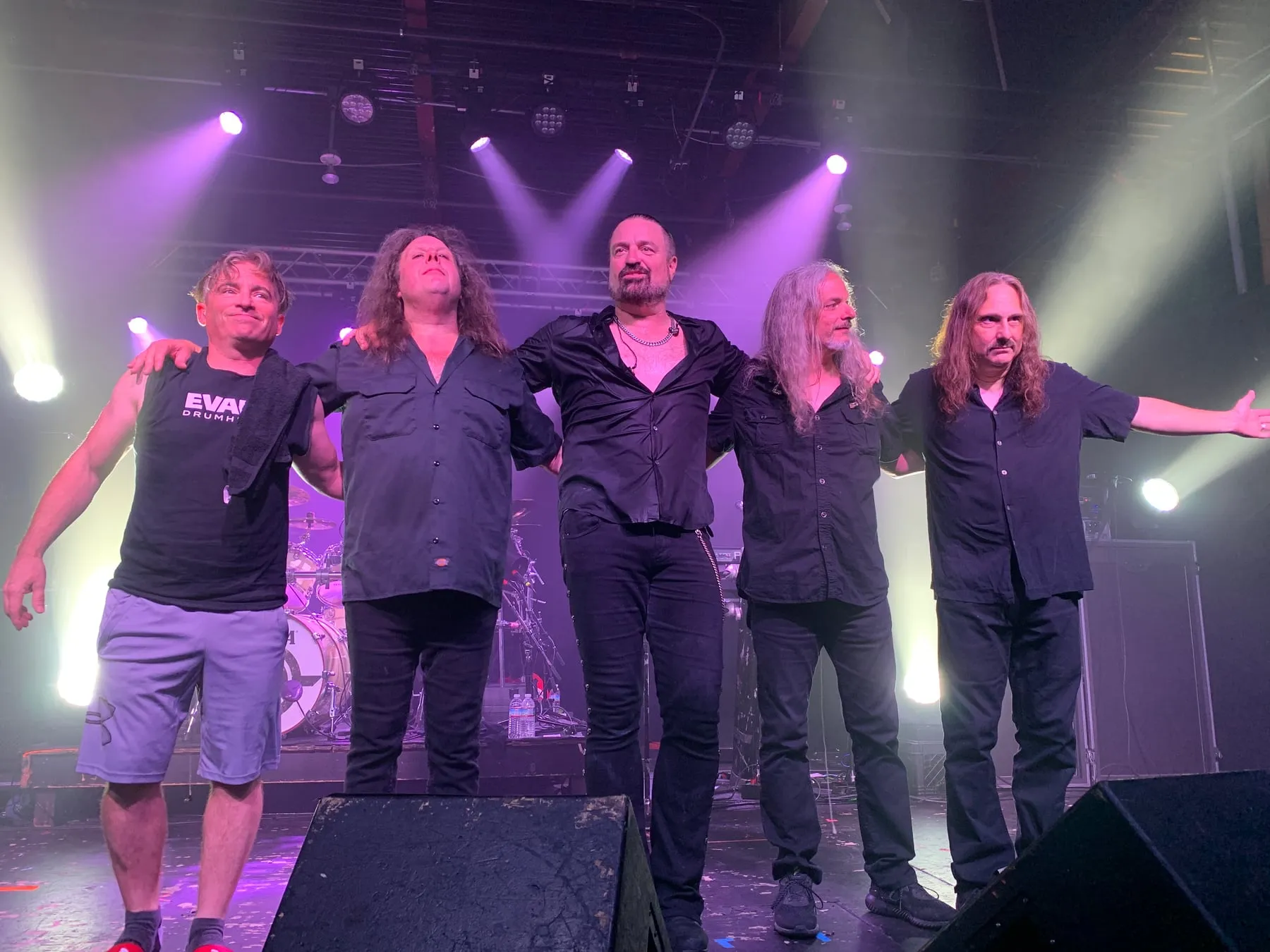
Photo by Austin Kokel , licensed under CC BY-SA 4.0 · Wikimedia Commons
Rank #292
Symphony X
New Jersey neoclassical prog-metal stalwarts.
From Wikipedia
Symphony X is an American progressive metal band from Middletown, New Jersey. Founded in 1994, the band consists of guitarist Michael Romeo, keyboardist Michael Pinnella, drummer Jason Rullo, lead vocalist Russell Allen and bassist Michael LePond.
Members
- Jason Rullo
- Michael LePond
- Michael Pinnella
- Michael Romeo
- Russell Allen
- Thomas Miller
- Tom Walling
Studio Albums
- 1994 Symphony X
- 1995 The Damnation Game
- 1996 The Divine Wings of Tragedy
- 1998 Twilight in Olympus
- 2000 V: The New Mythology Suite
- 2002 The Odyssey
- 2007 Paradise Lost
- 2011 Iconoclast
- 2015 Underworld
Source: MusicBrainz
Deep Dive
Overview
Symphony X is an American progressive metal band that emerged from Middletown, New Jersey in 1994 and has sustained a recording and touring presence into the present day. The band synthesizes neoclassical metal technique with progressive rock ambition, layering intricate instrumental passages, operatic and theatrical vocal delivery, and extended compositional frameworks that typically exceed five minutes per song. Formed during the mid-1990s rise of progressive metal as a commercially viable subgenre, Symphony X established themselves as one of the decade’s most technically accomplished acts, eventually achieving their widest recognition in the 2000s through concept albums and festival appearances.
Formation Story
Symphony X coalesced in Middletown, New Jersey in 1994, drawing from the region’s proximity to New York City’s thriving metal and progressive rock scenes. The founding lineup included guitarist Michael Romeo, keyboardist Michael Pinnella, drummer Jason Rullo, lead vocalist Russell Allen, and bassist Michael LePond, alongside early member Tom Walling. This core combination of instruments—with Romeo and Pinnella as the primary creative voice—established the band’s foundational sound: a fusion of neoclassical guitar technique, symphonic keyboard arrangements, and metal rhythm sections. The band’s immediate self-titled debut, released in 1994, announced their arrival with a fully formed aesthetic that would remain consistent across three decades.
Breakthrough Moment
Symphony X’s early albums established their reputation within progressive and metal circles but remained confined to dedicated fanbases. The release of V: The New Mythology Suite in 2000 marked a turning point in the band’s career trajectory and visibility. The album’s ambitious scope—a concept work that drew from classical mythology and progressive rock tradition—and Romeo’s increasingly sophisticated compositional approach elevated the band’s profile considerably. V demonstrated that Symphony X could sustain interest across a full album-length narrative, combining technical display with accessible melodic hooks. The following album, The Odyssey in 2002, solidified their position as one of the leading acts in progressive metal, earning widespread critical attention and cementing their status as festival mainstays at European and North American progressive rock events.
Peak Era
The period spanning 2000 to 2007, anchored by V: The New Mythology Suite, The Odyssey, and Paradise Lost, represented Symphony X’s most creatively vital and commercially successful window. These three albums showcased the band’s matured compositional vocabulary: extended instrumental passages that gave Romeo and Pinnella room for extended dialogue, Russell Allen’s vocals shifting between operatic grandeur and aggressive metal delivery, and rhythm section work from Rullo and LePond that balanced precision with dynamic range. Paradise Lost in 2007 continued the trajectory of concept-driven works, further establishing Symphony X as one of progressive metal’s most consistent creators. The band’s touring schedule expanded during this era, making them fixtures at festivals and headlining substantial venue tours across Europe and North America.
Musical Style
Symphony X’s sound rests on the collision between neoclassical metal technique and symphonic progressive rock ambition. Michael Romeo’s guitar approach draws from classical music theory and execution—rapid arpeggios, harmonic minor scales, and contrapuntal phrasing—deployed within metal contexts where distortion and power chords coexist with acoustic passages and complex time signatures. Michael Pinnella’s keyboards serve a quasi-orchestral function, layering strings, organs, and synthetic textures beneath Romeo’s leads and underneath Allen’s vocals. The rhythm section provides both the foundational heaviness of metal—drop-tuned basses, kick drum patterns rooted in double-bass technique—and the flexibility to shift between meters and tempos within single songs, accommodating the band’s 6-minute-plus average song lengths. Russell Allen’s vocal delivery occupies a wide range, from clean and operatic singing to aggressive shouts and growls, reflecting the band’s genre positioning between power metal theatricality and progressive rock’s experimental impulses. This combination of technical proficiency, orchestral ambition, and metal aggression distinguishes Symphony X from both straightforward metal bands and contemporary progressive rock acts.
Major Albums
V: The New Mythology Suite (2000)
The album that established Symphony X as more than a technically skilled regional act, V introduced concept-driven songwriting and elevated the band’s songwriting maturity with extended compositional arrangements that justified the progressive metal label.
The Odyssey (2002)
Continuing the concept album trajectory, The Odyssey became Symphony X’s most celebrated work, balancing technical display with memorable melodies and solidifying the band’s reputation among progressive rock and metal audiences worldwide.
Paradise Lost (2007)
This album sustained the band’s creative momentum through another concept narrative, demonstrating that Symphony X could sustain interest across multiple album cycles without formulaic repetition.
Iconoclast (2011)
Released nearly a decade into their peak era, Iconoclast showed the band adapting their approach while maintaining their fundamental stylistic commitments to complex arrangements and virtuosic performance.
The Damnation Game (1995)
The band’s early second album showcased their foundational neoclassical and progressive metal approach, establishing templates that would be refined throughout the following two decades.
Signature Songs
- “The Divine Wings of Tragedy” — The title track from the 1996 album, a nine-minute composition that crystallized the band’s neoclassical ambitions and showcased Romeo’s lead guitar work within extended progressive structures.
- “The Odyssey” — The closing epic from the 2002 album, demonstrating Symphony X’s ability to sustain interest across extended single compositions that incorporate multiple thematic and stylistic sections.
- “Paradise Lost” — A representative track that balances operatic vocal delivery, symphonic keyboard arrangement, and neoclassical guitar technique within the progressive metal framework.
- “King of Thieves” — A composition that exemplifies the band’s approach to balancing accessibility with technical complexity, featuring memorable vocal melodies above intricate instrumental interplay.
Influence on Rock
Symphony X’s sustained presence in progressive metal has influenced the subgenre’s continued viability and the direction of contemporary metal acts pursuing technical sophistication and classical music influences. The band demonstrated that neoclassical metal could sustain a full-length career and achieve festival prominence without compromising technical ambition for commercial accessibility. Their synthesis of operatic vocals, symphonic keyboards, and classical-influenced guitar technique has become a recognizable subgenre marker, with subsequent progressive metal bands citing Symphony X’s approach as a template. The band’s consistent touring and album release schedule maintained progressive metal’s presence during the 2000s and 2010s, when metalcore and djent movements dominated mainstream metal attention, preserving instrumental virtuosity and extended composition as viable metal aesthetics.
Legacy
Symphony X’s four-decade presence in progressive metal—from their 1994 formation through continuous activity to the present—has established them as one of the subgenre’s most reliable and technically accomplished acts. While achieving less mainstream cultural penetration than early progressive metal pioneers like Dream Theater, the band has secured a dedicated international fanbase and consistent festival presence at European progressive rock events. Their sustained output across a stable lineup demonstrates the viability of a career built on technical proficiency, concept albums, and touring rather than mainstream radio success. The band’s recording relationships with Inside Out Music and Nuclear Blast positioned them within the infrastructure of progressive metal’s most established labels, maintaining their visibility within specialist music communities. Symphony X’s presence on streaming platforms and continued touring ensure their catalog remains accessible to new listeners discovering progressive metal, solidifying their status as stalwarts of a subgenre that has maintained cultural significance despite broader metal trends.
Fun Facts
- Symphony X’s hometown of Middletown, New Jersey positioned them near New York City’s metal scene while maintaining relative geographic isolation from the major music industry centers, allowing the band to develop their distinctive approach without immediate commercial pressure.
- The band’s consistent core lineup—with Michael Romeo, Russell Allen, Michael Pinnella, Jason Rullo, and Michael LePond remaining stable across multiple decades—has been unusual in progressive metal, where membership turnover is common.
- Symphony X’s concept albums draw from classical literature and mythology, positioning them within progressive rock tradition rather than contemporary metal aesthetics, reflecting the band’s equal allegiance to both genres.
Discography & Previews
Click any album to expand its track list. Each track plays a 30-second preview streamed from Apple Music. Tap the link icon next to a track to open it in Apple Music for full playback.


- 1 Prelude ↗ 1:08
- 2 Evolution (The Grand Design) ↗ 5:21
- 3 Fallen ↗ 5:51
- 4 Transcendence (Segue) ↗ 0:38
- 5 Communion and the Oracle ↗ 7:46
- 6 The Bird Serpent War / Cataclysm ↗ 4:02
- 7 On the Breath of Poseidon (Segue) ↗ 3:02
- 8 Egypt ↗ 7:05
- 9 The Death of Balance / Lacrymosa ↗ 3:42
- 10 Absence of Light ↗ 4:59
- 11 A Fool's Paradise ↗ 5:48
- 12 Rediscovery (Segue) ↗ 1:25
- 13 Rediscovery, Pt. II (The New Mythology) ↗ 12:01


- 1 Iconoclast ↗ 10:51
- 2 The End of Innocence ↗ 5:27
- 3 Dehumanized ↗ 6:48
- 4 Bastards of the Machine ↗ 4:56
- 5 Heretic ↗ 6:25
- 6 Children of a Faceless God ↗ 6:21
- 7 When All Is Lost ↗ 9:10
- 8 Electric Messiah ↗ 6:14
- 9 Prometheus (I Am Alive) ↗ 6:47
- 10 Light up the Night ↗ 5:04
- 11 The Lords of Chaos ↗ 6:10
- 12 Reign in Madness ↗ 8:38
