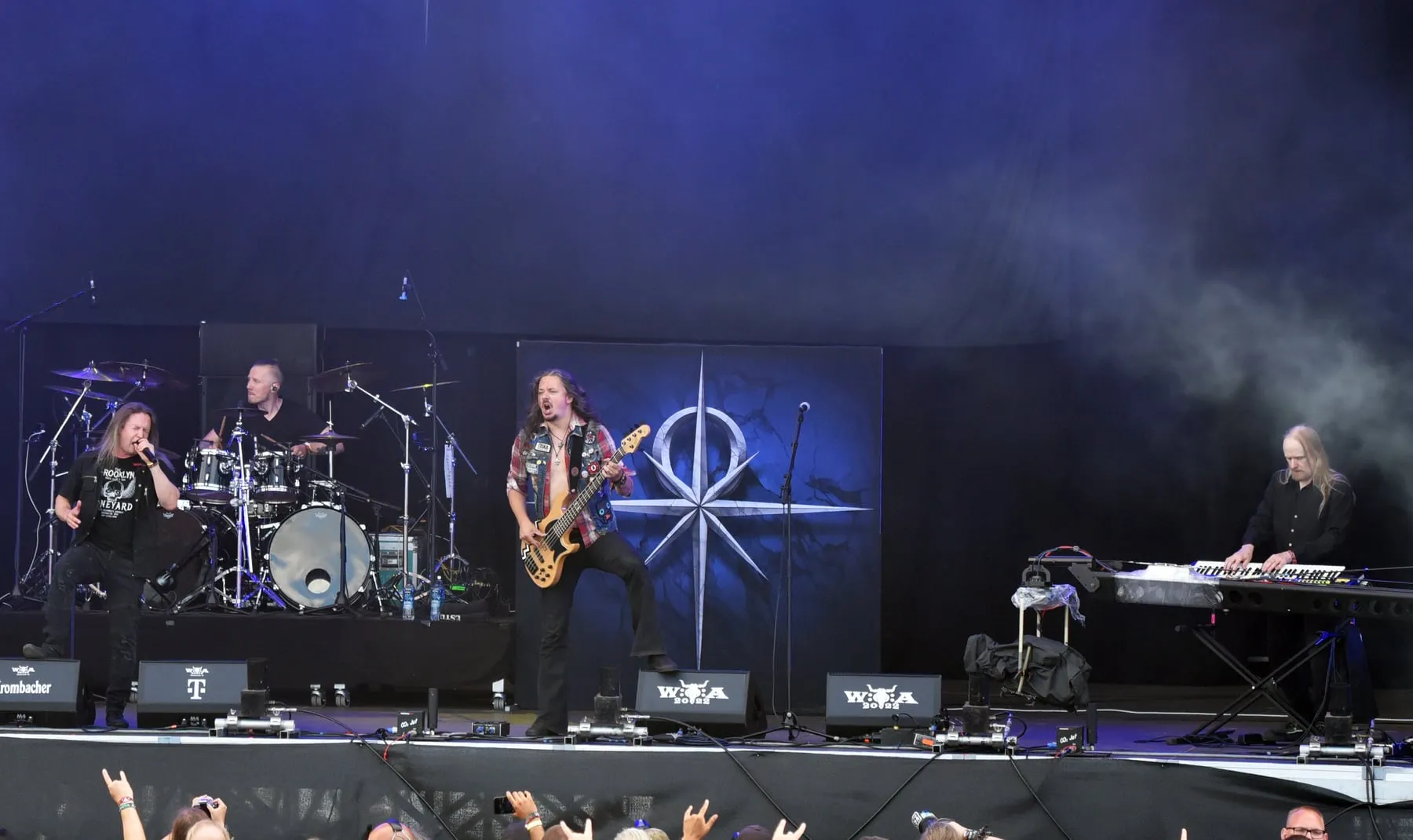
Photo by Frank Schwichtenberg , licensed under CC BY-SA 4.0 · Wikimedia Commons
Rank #184
Stratovarius
Finnish melodic power-metal stalwarts of operatic neoclassical scale.
From Wikipedia
Stratovarius is a Finnish power metal band formed in 1984. They have released sixteen studio albums, six DVDs, and six live albums. The band's line-up has changed many times, with no founding member left since the departure of drummer Tuomo Lassila in 1995, and no member from their early recording days left following guitarist Timo Tolkki's departure in 2008. Currently, the longest standing member is singer Timo Kotipelto, who joined in 1994.
Members
- Antti Ikonen
- Jari Behm
- Jari Kainulainen
- Jens Johansson
- John Vihervä
- Jörg Michael
- Jyrki Lentonen
- Lauri Porra
- Matias Kupiainen
- Mika Ervaskari
- Rolf Pilve
- Staffan Stråhlman
- Timo Kotipelto
- Timo Tolkki
- Tuomo Lassila
Deep Dive
Overview
Stratovarius is a Finnish power metal band that emerged from Helsinki in 1984 and has spent nearly four decades refining a distinctly melodic, neoclassical approach to heavy metal. Operating across the intersection of classical composition, operatic ambition, and the driving rhythmic intensity of power metal, they have anchored one of the defining regional sounds of heavy metal—the Finnish melodic-metal tradition that would influence European and international metal scenes throughout the 1990s and beyond. With sixteen studio albums and a touring presence that has extended into the 2020s, Stratovarius stands as one of continental Europe’s most prolific and enduring metal acts.
Formation Story
Stratovarius was formed in 1984 in Helsinki, Finland, during an era when the country was beginning to establish itself as a hotbed of innovative metal music. The band’s early years saw significant lineup turnover, a characteristic that would persist throughout their history. The founding membership would largely dissolve by the mid-1990s; drummer Tuomo Lassila’s departure in 1995 marked the exit of the last original member from that initial phase. Singer Timo Kotipelto joined the band in 1994 and became the longest-standing member in the band’s roster, providing vocal continuity through successive lineup changes that would reshape the group’s composition multiple times over the following decades.
Breakthrough Moment
Stratovarius released their debut album, Fright Night, in 1989, establishing the technical and melodic foundations that would define their approach. However, the band’s critical and commercial breakthrough came with successive releases throughout the mid-to-late 1990s. The albums Dreamspace (1994), Fourth Dimension (1995), and Episode (1996) showcased an increasingly refined blend of neoclassical guitar work, keyboard-driven arrangements, and Kotipelto’s operatic vocal range. By the time Visions arrived in 1997 and Destiny in 1998, Stratovarius had established themselves as leading figures in the European power-metal resurgence, gaining recognition beyond Finland and solidifying a dedicated international fanbase.
Peak Era
The years spanning 1997 to 2003 represent Stratovarius’s most creatively expansive and commercially successful period. Visions (1997) and Destiny (1998) cemented their status within the power-metal pantheon, while Infinite (2000) demonstrated the band’s continued growth in compositional ambition and production sophistication. The paired releases Elements, Pt. 1 and Elements, Pt. 2 (both 2003) represented a conceptual ambition unusual even for a band known for theatrical scope, with the two records exploring thematic and musical continuity across their combined runtime. This era established Stratovarius as one of the few Scandinavian metal bands capable of sustaining both critical respect and a sizeable touring audience across Europe and beyond.
Musical Style
Stratovarius’s sound draws from the neoclassical metal tradition established by guitarists like Yngwie Malmsteen in the 1980s, but filtered through a distinctly melodic and symphonic sensibility. Keyboards occupy a prominent role in their arrangements—functioning not merely as accompaniment but as compositional equal to the guitar, with synthesizers often carrying melodic and harmonic passages that might otherwise fall to horns or strings in a classical context. Timo Kotipelto’s vocals are characterized by an operatic range and vibrato, allowing the band to sustain extended, soaring vocal lines that emphasize emotion and technical display in equal measure. The rhythm section provides the propulsive drive essential to power metal while accommodating the complex time signatures and dynamic shifts that the band’s keyboard and guitar lines demand. Over time, their production grew larger and more polished, moving from the raw energy of their earliest records toward a more orchestral and studio-refined approach by the 2000s.
Major Albums
Dreamspace (1994)
Stratovarius’s third album marked a turning point in their artistic maturation, introducing Timo Kotipelto’s vocals and establishing the core melodic-neoclassical formula that would define their subsequent decades.
Visions (1997)
This landmark album showcased the band at the height of their mid-career creative powers, balancing technical virtuosity with deeply melodic songwriting and crystallizing their status as European power-metal leaders.
Destiny (1998)
Following directly on Visions’ success, Destiny deepened their symphonic ambitions and further expanded their international audience through sustained touring and radio play across European metal markets.
Infinite (2000)
With this album, Stratovarius achieved a fuller, more expansive production sound while maintaining the architectural complexity and emotional directness that distinguished their work from more bombastic power-metal competitors.
Elements, Pt. 1 & Pt. 2 (2003)
A conceptually ambitious paired release that demonstrated the band’s willingness to undertake extended compositional projects, with the two records functioning as a thematic and musical cycle across their combined length.
Signature Songs
- Visions — A showcase for the band’s ability to blend operatic vocal delivery with neoclassical guitar and keyboard interplay across an extended compositional framework.
- Destiny — Demonstrates the band’s gift for balancing technical complexity with immediate melodic hooks and Kotipelto’s soaring vocal performance.
- Infinite — A title track that captures the band’s embrace of larger production scales and symphonic arrangement while maintaining the core power-metal energy.
- Diamonds — Exemplifies their skill at constructing emotionally direct, accessible songs without sacrificing the technical and melodic sophistication that distinguishes their catalogue.
Influence on Rock
Stratovarius’s consistent output and touring presence across three decades established them as ambassadors of melodic European power metal to global audiences. Their demonstration that technical complexity and emotional accessibility were not mutually exclusive—a quality that extended to their live performances—influenced a generation of European metal musicians who sought to balance virtuosity with songcraft. The band’s emphasis on keyboard composition as an equal partner to guitar riffing provided a template that many subsequent symphonic and progressive metal acts would adopt and adapt. Their status as one of Finland’s most successful heavy metal exports contributed to the broader international recognition of Finnish metal as a distinctive regional tradition alongside the better-known Swedish and German scenes.
Legacy
Stratovarius has maintained an active touring and recording schedule well into the 2020s, with the album Survive arriving in 2022 and demonstrating their continued relevance after nearly four decades of activity. The band’s personnel transitions—including the 2008 departure of founding guitarist Timo Tolkki after two decades with the group—marked significant inflection points, yet Stratovarius has endured through successive lineups, a testament to the strength of the melodic and structural foundations established in their formative period. Their extensive discography, spanning sixteen studio albums and multiple live and compilation releases, provides a comprehensive documentation of the evolution of Finnish power metal from the late 1980s through the contemporary era. The band remains a consistent fixture in European festival lineups and touring circuits, maintaining a dedicated international fanbase that has sustained their career across changing musical trends.
Fun Facts
- Stratovarius was formed in Helsinki in 1984, making the band one of the earliest power-metal acts to emerge from the Scandinavian region during the genre’s initial development.
- The band released paired concept albums, Elements, Pt. 1 and Elements, Pt. 2, both in 2003, representing one of their most ambitious compositional undertakings.
- Timo Kotipelto, who joined as vocalist in 1994, remains the longest-standing current member of the band, having provided vocal continuity through multiple lineup transformations.
- The band has recorded across multiple major European record labels including Noise Records, Nuclear Blast, and earMUSIC, reflecting both their commercial significance and the shifting landscape of metal-music distribution across their career span.