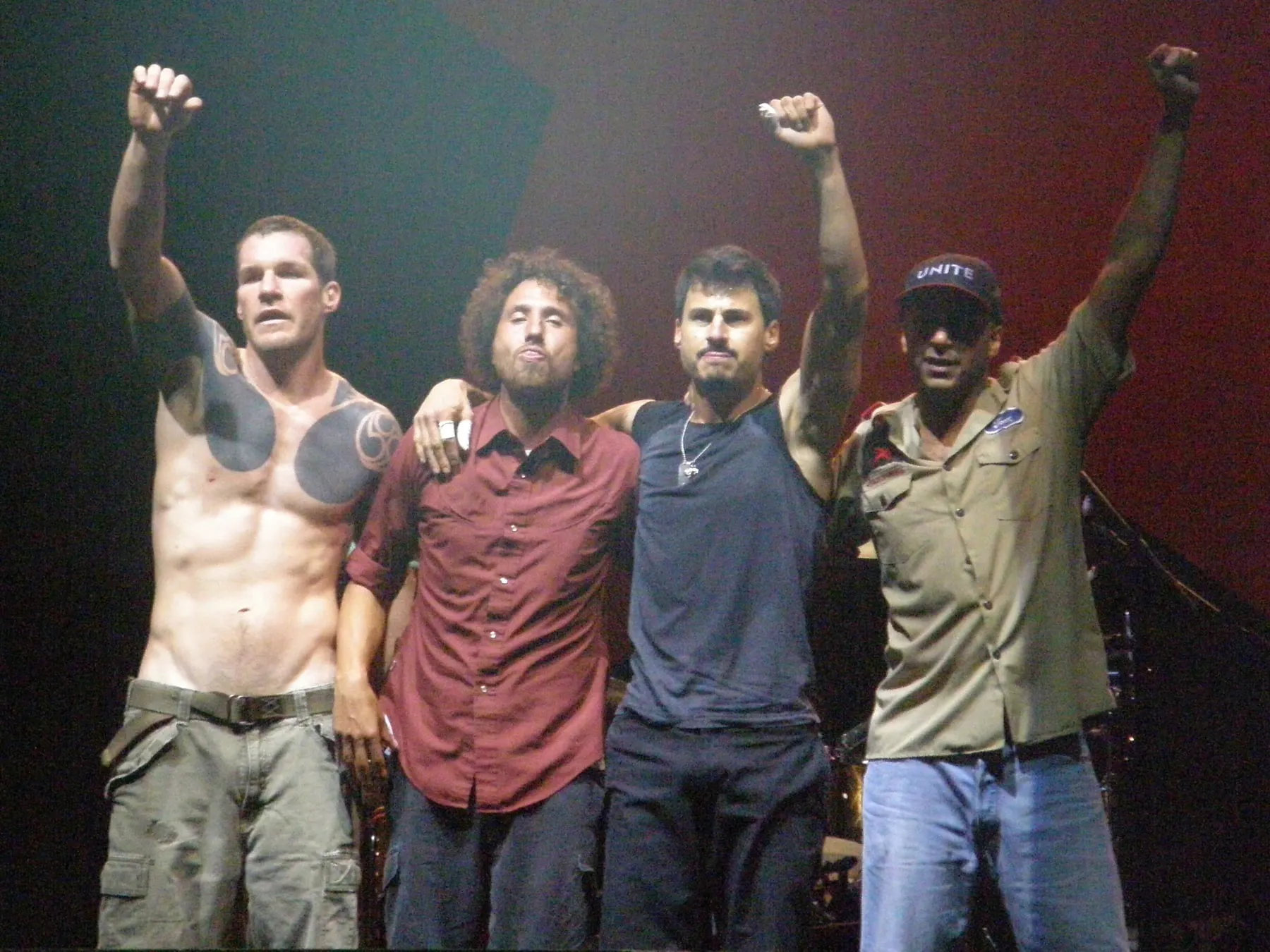
Photo by Penner , licensed under CC BY-SA 4.0 · Wikimedia Commons
Rank #187
Rage
Long-running German power-metal trio of relentless output.
From Wikipedia
Rage Against the Machine was an American rock band formed in Los Angeles, California, in 1991. It consisted of vocalist Zack de la Rocha, bassist and backing vocalist Tim Commerford, guitarist Tom Morello, and drummer Brad Wilk. They melded heavy metal, rap, punk rock, and funk with anti-authoritarian, anti-capitalist, and revolutionary lyrics. As of 2010, they had sold over 16 million records worldwide. They were inducted into the Rock and Roll Hall of Fame in 2023.
Members
- Brad Wilk
- Tim Commerford
- Tom Morello
- Zack de la Rocha
Deep Dive
Overview
Rage Against the Machine was an American rock band formed in Los Angeles, California, in 1991. The group melded heavy metal, rap, punk rock, and funk into a high-octane fusion that carried anti-authoritarian, anti-capitalist, and revolutionary lyrics as its thematic core. Operating from the West Coast at the intersection of multiple rock and hip-hop traditions, they became one of the defining acts of 1990s alternative metal, establishing a template for politically charged music that merged street-level aggression with complex compositional arrangements.
Formation Story
Rage Against the Machine coalesced in Los Angeles in 1991 through the convergence of four musicians: vocalist Zack de la Rocha, guitarist Tom Morello, bassist and backing vocalist Tim Commerford, and drummer Brad Wilk. The band emerged during a moment when Los Angeles was already home to thriving parallel scenes—heavy metal, funk, hip-hop, and punk rock each with their own infrastructure. Rather than adhering to a single tradition, the four members drew equally from all of them, creating something that rejected easy categorization. De la Rocha brought a confrontational vocal delivery rooted in punk and hardcore sensibilities, while Morello’s guitar work combined metal technicality with the rhythmic precision of funk and rap production. Commerford and Wilk provided a rhythm section that was equally at home in a metal riff as in a funky groove, giving the band a foundation that could shift between genres without losing momentum.
Breakthrough Moment
Rage Against the Machine’s self-titled debut, released in 1992, announced their arrival with immediate force. The album showcased the band’s core sound: heavy, distorted guitars layered over funk-inflected bass lines and programmed-drum-like precision, with de la Rocha’s vocals shifting between rapped verses and melodic choruses. The combination resonated beyond traditional metal audiences, drawing listeners from rap, punk, and alternative rock camps. The album’s commercial trajectory was steady rather than explosive, but it established the band as a significant presence within alternative metal and set the stage for deeper industry and radio penetration. By pairing genre hybridization with explicitly political content, they had created a space that few acts occupied in the early 1990s.
Peak Era
The mid-to-late 1990s represented Rage Against the Machine’s period of maximum cultural and commercial impact. Following their 1992 debut, the band maintained a relentless touring schedule and steady album release cycle, building a devoted fanbase. Albums such as Evil Empire and The Battle of Los Angeles (both released in the mid-to-late 1990s) deepened their sonic identity and expanded their audience. The band’s live shows became legendary for their intensity and political directness, with de la Rocha’s activism off-stage matched by the musical commitment onstage. During this period, they sold millions of records globally and established themselves as one of the defining voices of 1990s rock and metal, influencing everything from nu-metal to politically conscious hip-hop.
Musical Style
Rage Against the Machine’s sound was built on the collision of metal and rap traditions. Morello’s guitar work combined heavy distortion and metal riff structures with the syncopated rhythmic sensibilities of funk and hip-hop production—he often layered multiple effects and textural elements across a single song, creating space for de la Rocha’s vocals to occupy multiple registers without loss of clarity. Commerford’s bass lines were thick and funky, often locking into polyrhythmic patterns with Wilk’s drumming that refused to sit neatly within traditional rock time signatures. De la Rocha’s vocal approach was perhaps the band’s most distinctive feature: he could deliver rapid-fire rapped verses with a hardcore punk inflection, then shift into a more melodic, almost soulful tone on choruses, sometimes within the same song. This stylistic fluidity—metal without being limited to metal, rap without submitting to hip-hop convention, punk without sacrificing musicianship—defined their approach. The production was typically clean and detailed, allowing each instrument to be heard clearly even in moments of maximum chaos, and the songwriting often centered on political and social critique delivered with the same intensity as the music itself.
Major Albums
Rage Against the Machine (1992)
The self-titled debut introduced the band’s fusion of metal, rap, funk, and punk to a wide audience and established them as a significant force in alternative metal.
Evil Empire (1996)
The second full-length deepened their sonic template and political messaging, solidifying their fanbase and expanding their commercial reach across radio and MTV.
The Battle of Los Angeles (1999)
Released near the end of the decade, this album represented the band at their creative and commercial peak, combining maximum sonic intensity with their most explicit political content.
Renegades (2000)
A covers album that saw the band reinterpreting songs from punk, funk, and other traditions through their signature lens, demonstrating their musical range and deepening appreciation for their influences.
Signature Songs
- Killing in the Name — A relentless attack combining a stripped-down metal riff with de la Rocha’s escalating vocal intensity, becoming one of the band’s most recognizable tracks.
- Bulls on Parade — A showcase for Morello’s rhythmic guitar innovation layered over a driving funk-metal groove that became a live staple.
- Wake Up — A politically charged anthem that grew larger and more complex as it developed, exemplifying the band’s ability to build from minimal elements.
- Testify — A display of the band’s precision and their ability to lock into tightly constructed grooves without sacrificing heaviness.
- Vietnow — A demonstration of de la Rocha’s ability to deliver rapid, intricate vocal patterns over complex instrumental arrangements.
Influence on Rock
Rage Against the Machine fundamentally altered how rock and metal bands could engage with political content and genre hybridization in the 1990s. By treating rap and metal as equally valid starting points rather than treating either as secondary, they opened space for a generation of bands to move fluidly between genres. Nu-metal, which dominated the late 1990s and 2000s, owed a substantial debt to their template of heavy guitars combined with non-traditional vocal approaches and funk-influenced rhythms. Beyond metal, they demonstrated that politically engaged lyrics and anti-establishment messaging could coexist with mainstream commercial success, influencing countless alternative and independent rock acts to take political stances without self-consciousness. Their integration of hip-hop elements into rock and metal also helped erode the genre barriers that had kept those traditions somewhat separate, paving the way for later collaborations and cross-pollinations.
Legacy
By 2010, Rage Against the Machine had sold over 16 million records worldwide, a figure that testifies to their sustained commercial presence and cultural relevance. In 2023, the band was inducted into the Rock and Roll Hall of Fame, an institutional recognition of their influence on multiple genres and their role in defining 1990s alternative music. Their albums remain widely available on streaming platforms, and their influence appears in metal, hip-hop, alternative rock, and politically conscious music of subsequent decades. The band’s ability to sustain relevance without compromising their core identity—combining musical sophistication with explicit political content—remains rare in mainstream rock, cementing their status as one of the most significant acts of their era.
Fun Facts
- The band’s official website, established at https://www.ratm.com/, remains active and serves as a hub for fans seeking information and tour dates.
- Rage Against the Machine recorded for multiple major labels throughout their career, including Revelation Records and Epic Records, reflecting their evolution from independent to mainstream distribution.
- Their covers album, Renegades, included reinterpretations of songs from artists across funk, punk, and soul traditions, demonstrating their deep engagement with musical history beyond their own work.