
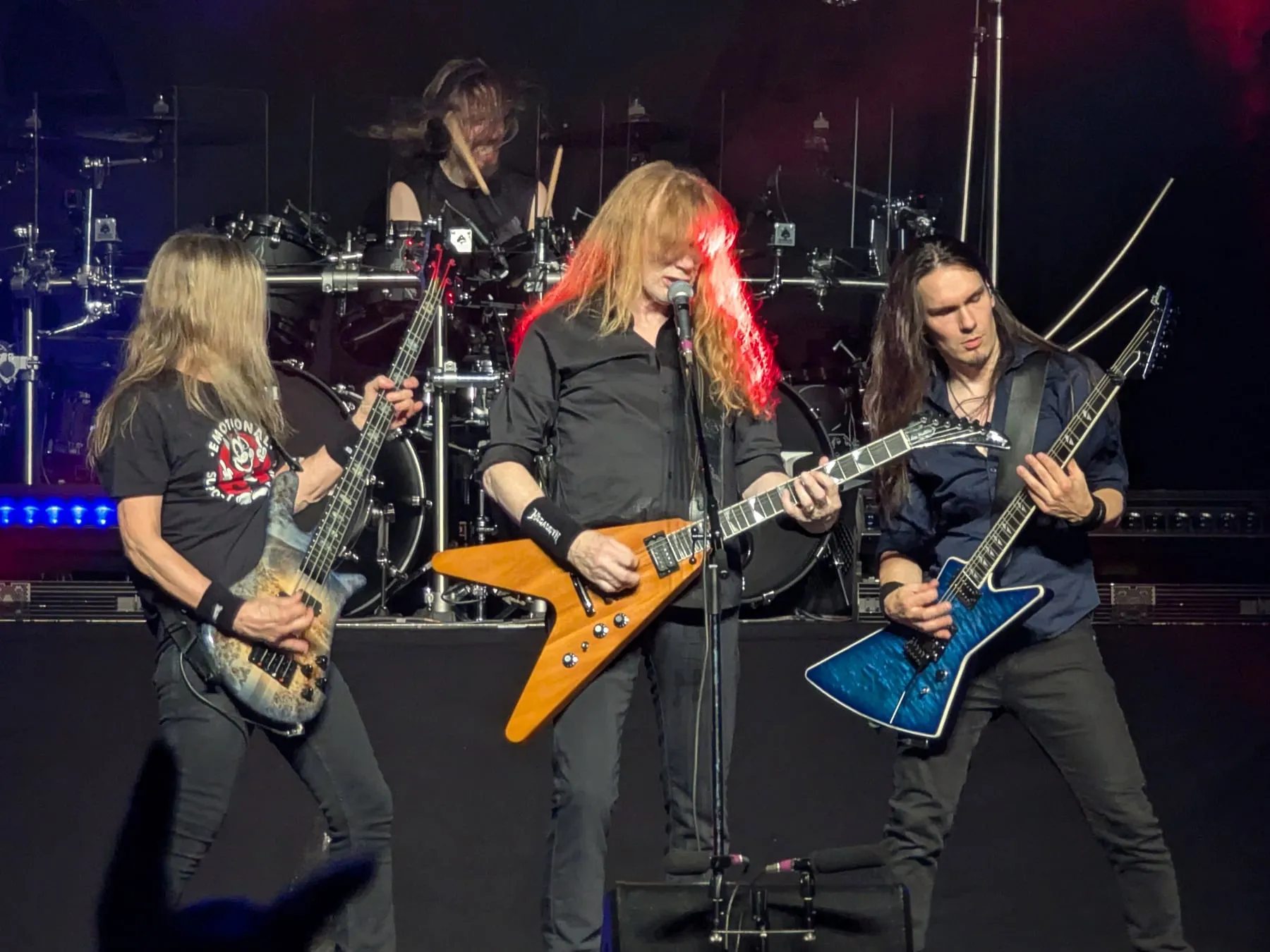
Photo by Justice for the Beholder of the Harvester of Blackened Straw , licensed under CC BY-SA 4.0 · Wikimedia Commons
Rank #61
Megadeth
Technical thrash titans led by Dave Mustaine after his Metallica exit.
From Wikipedia
Megadeth is an American heavy metal band formed in Los Angeles in 1983 by vocalist and guitarist Dave Mustaine. Known for their technically complex guitar work and musicianship, Megadeth is one of the "big four" of American thrash metal—along with Slayer, Anthrax, and Metallica—and is credited with helping to develop and popularize the genre. Their music features intricate arrangements, fast rhythm sections, dual lead guitars, and lyrical themes such as war, conflicts, politics, religion, death, and personal relationships.
Members
- David Ellefson (1983–2002)
- Gar Samuelson (1984–1987)
- Chuck Behler (1987–1989)
- Jeff Young (1987–1989)
- Nick Menza (1989–1998)
- Marty Friedman (1990–2000)
- Jimmy DeGrasso (1998–2002)
- Al Pitrelli (2000–2002)
- Glen Drover (2004–2008)
- James MacDonough (2004–2006)
- Shawn Drover (2004–2014)
- Chris Broderick (2008–2014)
- Chris Adler (2015–2016)
- Kiko Loureiro (2015–2023)
- Dirk Verbeuren (2016–present)
- Teemu Mäntysaari (2023–present)
- Chris Poland
- Dave Mustaine
- Greg Handevidt
- James LoMenzo
- Lee Rauch
Studio Albums
- 1985 Killing Is My Business… and Business Is Good!
- 1986 Peace Sells… but Who’s Buying?
- 1988 So Far, So Good… So What!
- 1990 Rust in Peace
- 1992 Countdown to Extinction
- 1994 Youthanasia
- 1997 Cryptic Writings
- 1999 Risk
- 2000 The World Needs a Hero
- 2004 The System Has Failed
- 2007 United Abominations
- 2009 Endgame
- 2011 Th1rt3en
- 2013 Super Collider
- 2016 Dystopia
- 2022 The Sick, the Dying… and the Dead!
- 2026 Megadeth
Source: MusicBrainz
Deep Dive
Overview
Megadeth is an American heavy metal band formed in Los Angeles in 1983 by vocalist and guitarist Dave Mustaine. Emerging from Mustaine’s departure from Metallica, the band became one of the four defining acts of American thrash metal, alongside Slayer, Anthrax, and Metallica itself. Megadeth distinguished itself through technically complex guitar work, intricate arrangements, dual lead guitar voices, and lyrical examinations of war, politics, religion, death, and personal conflict. Over four decades, the band evolved from speed metal’s raw energy into a more diversified heavy metal sound while maintaining its core identity as a vehicle for Mustaine’s restless compositional voice and virtuosic guitar playing.
Formation Story
Dave Mustaine formed Megadeth in Los Angeles in 1983 immediately after his exit from Metallica, the band that had recruited him as lead guitarist before replacing him with Kirk Hammett. Determined to prove his musical worth, Mustaine assembled an initial lineup to record his vision of speed and thrash metal. The earliest lineup featured David Ellefson on bass, a partnership that would define the band’s core sound through the 1980s and 1990s. Chris Poland handled lead guitar duties on the debut, and Gar Samuelson provided drumming for the band’s first recordings. This founding configuration gave Megadeth its technical foundation: Mustaine’s sharp, economical riffing and solowork paired with a rhythm section built for speed and precision.
Breakthrough Moment
Megadeth’s breakthrough came with the release of their second album, Peace Sells… but Who’s Buying? in 1986. Following their debut Killing Is My Business… and Business Is Good! the previous year, Peace Sells established the band as more than a side project for a former Metallica member. The album’s title track became the band’s signature song and a thrash metal standard, featuring one of Mustaine’s most recognizable riffs and a sharp critique of consumerism and conflict. The album’s success—driven by MTV exposure despite the band’s aggressive sound—proved that technically demanding thrash metal could achieve mainstream visibility. Peace Sells positioned Megadeth as a creative force in their own right, separating them from the shadow of Mustaine’s past and launching them into the upper tier of the thrash metal hierarchy.
Peak Era
Megadeth reached their commercial and critical zenith between 1990 and 1994, anchored by two albums that defined their legacy: Rust in Peace (1990) and Countdown to Extinction (1992). Rust in Peace is widely considered the band’s masterwork—a showcase of technical precision, ambitious songwriting, and thematic coherence that rivals any thrash metal album of the era. The album featured Marty Friedman on lead guitar, whose melodic sensibilities complemented Mustaine’s riff-oriented approach and created a dual-guitar dynamic that became central to the band’s identity. Countdown to Extinction continued this momentum, achieving higher chart positions and broader mainstream reach while maintaining the technical standards established on its predecessor. Nick Menza’s drumming provided the foundation for both records, his fluid technical command matching the guitars’ complexity. This period represented Megadeth at maximum creative confidence and commercial viability, before lineup changes and shifting industry trends would reshape their trajectory.
Musical Style
Megadeth’s sound synthesized speed metal’s accelerated tempos and technical ambition with thrash metal’s aggressive riffing and dark subject matter. Mustaine’s guitar playing emphasized economical, jagged riffs that prioritized clarity over the chromatic saturation favored by some peers; his solos mixed rapid scalar passages with bent notes and dynamic phrasing that suggested classical training. The band’s rhythm sections—particularly the Ellefson-era bass work—distinguished themselves through melodic counter-playing rather than pure bottom-end heaviness; Ellefson’s bass lines often carried musical weight equal to the guitars, a trait inherited from Metallica’s Cliff Burton. Vocally, Mustaine deployed a sharp, often nasal delivery that conveyed urgency rather than power, aligning with thrash metal’s emphasis on articulation over operatic range. As the band evolved through the 1990s and 2000s, production values became more polished and song structures more conventional, but the core elements—dual lead guitars, intricate arrangements, and Mustaine’s distinctive voice—remained constant. The addition of Marty Friedman (1990–2000) introduced a melodic, almost neoclassical lead guitar voice that expanded the band’s harmonic palette and influenced their songwriting toward greater emotional range.
Major Albums
Peace Sells… but Who’s Buying? (1986)
The album that established Megadeth as thrash metal architects in their own right. The title track’s iconic riff became a metal standard, and the record’s balance of technical proficiency and song accessibility proved thrash metal could achieve mainstream exposure.
Rust in Peace (1990)
Widely regarded as the band’s creative peak, this album showcased Marty Friedman’s arrival as co-lead guitarist and marked the highest point of Megadeth’s technical ambition and thematic coherence. A masterwork of the thrash metal genre.
Countdown to Extinction (1992)
The band’s most commercially successful album, combining the technical standards of Rust in Peace with broader mainstream appeal. It achieved the band’s strongest chart performance while preserving the instrumental complexity that defined their identity.
So Far, So Good… So What! (1988)
The band’s third album, recorded during peak touring years and showcasing growing production sophistication. It represented Megadeth’s transition from underground speed metal originators to widely recognized thrash metal figures.
Dystopia (2016)
A return to heavier, more aggressive material after years of stylistic experimentation, marking a reunification with longtime bassist David Ellefson and signaling renewed focus on the band’s thrash metal roots.
Signature Songs
- “Peace Sells” — The defining Megadeth anthem, featuring Mustaine’s most iconic riff and establishing the band’s identity beyond Metallica nostalgia.
- “Symphony of Destruction” — A politically charged mid-tempo track that showcased the band’s ability to write memorable melodies within a heavy framework.
- “Hangar 18” — An instrumental-heavy showcase of dual-guitar interplay and technical precision, becoming a concert staple.
- “A Tout Le Monde” — Demonstrating the band’s range beyond speed and aggression with a melancholic approach and extended melodic passages.
- “Sweating Bullets” — A rare acoustic-driven piece that revealed the songwriting depth beneath the band’s technical exterior.
- “Rust in Peace… Polaris” — An instrumental that defined the Rust in Peace album’s ambitious approach to song structure and composition.
Influence on Rock
Megadeth’s position within the “big four” of American thrash metal ensured their influence on the genre’s development and global reach. The band’s emphasis on technical guitar work and complex arrangements raised the baseline for musicianship expectations within heavy metal, influencing generations of musicians to pursue classical training and compositional sophistication. Marty Friedman’s neoclassical lead guitar approach, particularly during his tenure from 1990 to 2000, influenced the intersection of metal and progressive music that emerged in subsequent decades. Their willingness to explore diverse subject matter—from Cold War politics to psychological introspection—demonstrated that thrash metal could accommodate intellectual and thematic ambition alongside raw aggression. Bands across metal subgenres, from progressive metal to modern thrash revival acts, cite Megadeth’s technical standards and songwriting approach as formative influences.
Legacy
Megadeth remains active into the 2020s, having released The Sick, the Dying… and the Dead! in 2022 and with a new album announced for 2026. The band’s four-decade tenure across shifting industry conditions—from vinyl to streaming—has secured their position as a durable force in heavy metal. Their induction into the metal canon reflects both their early role in defining thrash metal and their sustained creative output across changing tastes. Dave Mustaine’s continued leadership and evolving lineup (featuring guitarists Marty Friedman, Chris Broderick, and Kiko Loureiro across different eras, and drummer Dirk Verbeuren since 2016) has allowed the band to renew itself without losing identity. The streaming era has introduced their catalog to audiences who may discover Rust in Peace or Peace Sells as entry points to thrash metal, ensuring that their most acclaimed work maintains cultural currency alongside newer material.
Fun Facts
- Dave Mustaine founded Megadeth to prove his musical worth after being fired from Metallica, transforming personal rejection into creative vindication.
- The band has featured numerous notable guitarists across their tenure, including Chris Poland, Marty Friedman, Chris Broderick, and Kiko Loureiro, each bringing distinct styles while maintaining Megadeth’s core identity.
- David Ellefson’s bass work—particularly his melodic counter-playing in the 1990s—set Megadeth apart from contemporaries by giving bass lines equal musical weight to the guitar parts.
- The band’s commercial peak in the early 1990s saw Countdown to Extinction become their highest-charting album, demonstrating that technical thrash metal could achieve mainstream success without sacrificing instrumental complexity.
Discography & Previews
Click any album to expand its track list. Each track plays a 30-second preview streamed from Apple Music. Tap the link icon next to a track to open it in Apple Music for full playback.

- 1 Last Rites / Loved to Deth ↗ 4:42
- 2 Killing Is My Business... And Business Is Good! ↗ 3:08
- 3 The Skull Beneath the Skin ↗ 3:48
- 4 Rattlehead ↗ 3:43
- 5 Chosen Ones ↗ 2:56
- 6 Looking Down the Cross ↗ 5:03
- 7 Mechanix ↗ 4:25
- 8 These Boots ↗ 3:36
- 9 Last Rites / Loved to Deth (Demo) ↗ 4:17
- 10 Mechanix (Demo) ↗ 4:00
- 11 The Skull Beneath the Skin (Demo) ↗ 3:12

- 1 Wake Up Dead ↗ 3:40
- 2 The Conjuring ↗ 5:04
- 3 Peace Sells ↗ 4:04
- 4 Devil's Island ↗ 5:06
- 5 Good Mourning / Black Friday ↗ 6:42
- 6 Bad Omen ↗ 4:05
- 7 I Ain't Superstitious ↗ 2:46
- 8 My Last Words ↗ 4:49
- 9 Wake Up Dead (Randy Burns Mix) ↗ 3:38
- 10 The Conjuring (Randy Burns Mix) ↗ 5:01
- 11 Peace Sells (Randy Burns Mix) ↗ 3:59
- 12 Good Mourning / Black Friday (Randy Burns Mix) ↗ 6:40


- 1 Skin O' My Teeth (1992 Mix Remaster) ↗ 3:14
- 2 Symphony Of Destruction (1992 Mix Remaster) ↗ 4:03
- 3 Architecture Of Aggression (1992 Mix Remaster) ↗ 3:35
- 4 Foreclosure Of A Dream (1992 Mix Remaster) ↗ 4:17
- 5 Sweating Bullets (1992 Mix Remaster) ↗ 5:03
- 6 This Was My Life (1992 Mix Remaster) ↗ 3:42
- 7 Countdown To Extinction (1992 Mix Remaster) ↗ 4:17
- 8 High Speed Dirt (1992 Mix Remaster) ↗ 4:12
- 9 Psychotron (1992 Mix Remaster) ↗ 4:42
- 10 Captive Honour (1992 Mix Remaster) ↗ 4:15
- 11 Ashes In Your Mouth (1992 Mix Remaster) ↗ 6:11


- 1 Trust ↗ 5:12
- 2 Almost Honest ↗ 4:09
- 3 Use the Man ↗ 4:04
- 4 Mastermind ↗ 3:48
- 5 The Disintegrators ↗ 3:05
- 6 I'll Get Even ↗ 4:19
- 7 Sin ↗ 3:06
- 8 A Secret Place ↗ 5:25
- 9 Have Cool, Will Travel ↗ 3:40
- 10 She-Wolf ↗ 3:38
- 11 Vortex ↗ 3:23
- 12 FFF ↗ 2:47
- 13 Trust (Spanish Version) ↗ 5:12
- 14 Evil That's Within (Alternate Version of "Sin") ↗ 3:22
- 15 Vortex (Alternate Version) ↗ 3:31
- 16 Bullprick (Alternate Version of "FFF") ↗ 2:47

- 1 Insomnia ↗ 4:16
- 2 Prince of Darkness ↗ 6:27
- 3 Enter the Arena ↗ 0:44
- 4 Crush 'Em ↗ 4:54
- 5 Breadline ↗ 4:32
- 6 The Doctor Is Calling ↗ 5:44
- 7 I'll Be There ↗ 5:13
- 8 Wanderlust ↗ 5:48
- 9 Ecstasy ↗ 4:31
- 10 Seven ↗ 4:46
- 11 Time: The Beginning ↗ 3:11
- 12 Time: The End ↗ 2:41
- 13 Insomnia (Jeff Balding Mix) ↗ 4:20
- 14 Breadline (Jack Joseph Puig Mix) ↗ 4:29
- 15 Crush 'Em (Jock Mix) ↗ 5:10

- 1 Disconnect ↗ 5:20
- 2 The World Needs a Hero ↗ 3:52
- 3 Moto Psycho ↗ 3:06
- 4 1000 Times Goodbye ↗ 6:26
- 5 Burning Bridges ↗ 5:20
- 6 Promises ↗ 4:29
- 7 Recipe for Hate... Warhorse ↗ 5:19
- 8 Losing My Senses ↗ 4:41
- 9 Dread and the Fugitive Mind ↗ 4:25
- 10 Silent Scorn ↗ 1:43
- 11 Return to Hangar ↗ 3:59
- 12 When ↗ 9:14

- 1 Blackmail The Universe ↗ 4:33
- 2 Die Dead Enough ↗ 4:19
- 3 Kick The Chair ↗ 3:57
- 4 The Scorpion ↗ 5:59
- 5 Tears In A Vial ↗ 5:22
- 6 I Know Jack ↗ 0:41
- 7 Back In The Day ↗ 3:27
- 8 Something That I'm Not ↗ 5:07
- 9 Truth Be Told ↗ 5:40
- 10 Of Mice And Men ↗ 4:05
- 11 Shadow Of Deth ↗ 2:15
- 12 My Kingdom ↗ 3:04


- 1 Sudden Death ↗ 5:09
- 2 Public Enemy No. 1 ↗ 4:15
- 3 Whose Life (Is It Anyways?) ↗ 3:50
- 4 We the People ↗ 4:33
- 5 Guns, Drugs, & Money ↗ 4:20
- 6 Never Dead ↗ 4:33
- 7 New World Order ↗ 3:56
- 8 Fast Lane ↗ 4:04
- 9 Black Swan ↗ 4:10
- 10 Wrecker ↗ 3:52
- 11 Millennium of the Blind ↗ 4:15
- 12 Deadly Nightshade ↗ 4:55
- 13 13 ↗ 5:50


- 1 The Threat Is Real ↗ 4:22
- 2 Dystopia ↗ 4:59
- 3 Fatal Illusion ↗ 4:16
- 4 Death from Within ↗ 4:47
- 5 Bullet to the Brain ↗ 4:29
- 6 Post American World ↗ 4:26
- 7 Poisonous Shadows ↗ 6:03
- 8 Look Who's Talking (Bonus Track) ↗ 4:14
- 9 Conquer or Die! ↗ 3:33
- 10 Lying In State ↗ 3:34
- 11 The Emperor ↗ 3:52
- 12 Last Dying Wish (Bonus Track) ↗ 3:49
- 13 Foreign Policy ↗ 2:28

- 1 The Sick, The Dying… And The Dead! ↗ 5:04
- 2 Life In Hell ↗ 4:12
- 3 Night Stalkers (feat. Ice-T) ↗ 6:38
- 4 Dogs Of Chernobyl ↗ 6:14
- 5 Sacrifice ↗ 4:08
- 6 Junkie ↗ 3:39
- 7 Psychopathy ↗ 1:20
- 8 Killing Time ↗ 5:13
- 9 Soldier On! ↗ 4:54
- 10 Célebutante ↗ 3:51
- 11 Mission To Mars ↗ 5:24
- 12 We’ll Be Back ↗ 4:29
- 13 Police Truck ↗ 2:29
- 14 This Planet’s On Fire (Burn In Hell) [feat. Sammy Hagar] ↗ 5:04
