
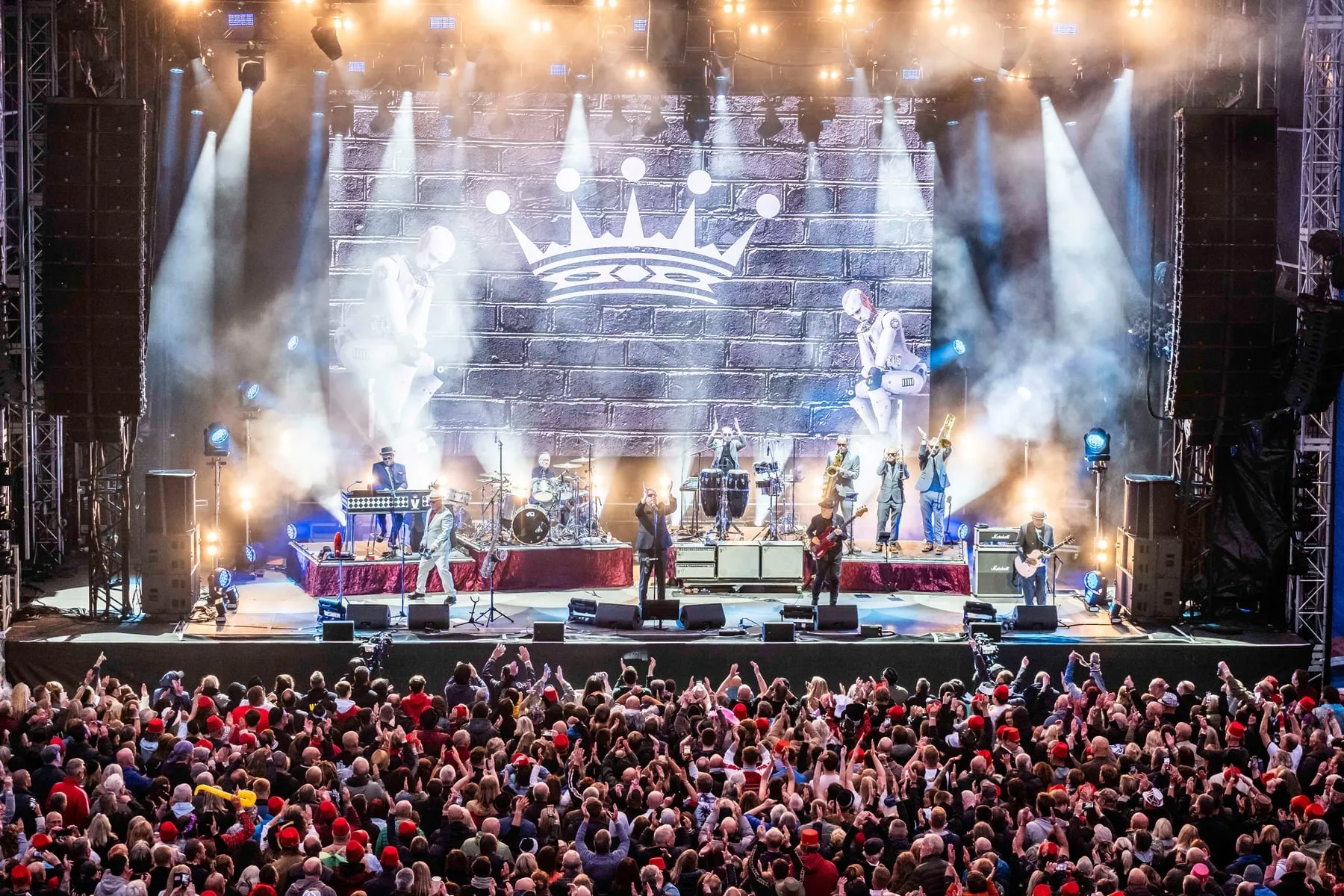
Photo by Ash Youd , licensed under CC0 · Wikimedia Commons
Rank #222
Madness
London 'nutty boys' whose ska-pop charm defined a slice of 80s UK pop.
From Wikipedia
Madness are an English ska and pop band from Camden Town, north west London, who formed in 1976. One of the most prominent bands of the late-1970s/early-1980s two-tone ska revival, they continue to perform with six of the seven members of their original line-up. Madness's most successful period was from 1980 to 1986, when the band's songs spent a total of 214 weeks on the UK Singles Chart, jointly holding the record with English reggae group UB40 for most weeks spent by a group in the UK singles chart during the 1980s.
Members
- Suggs
Studio Albums
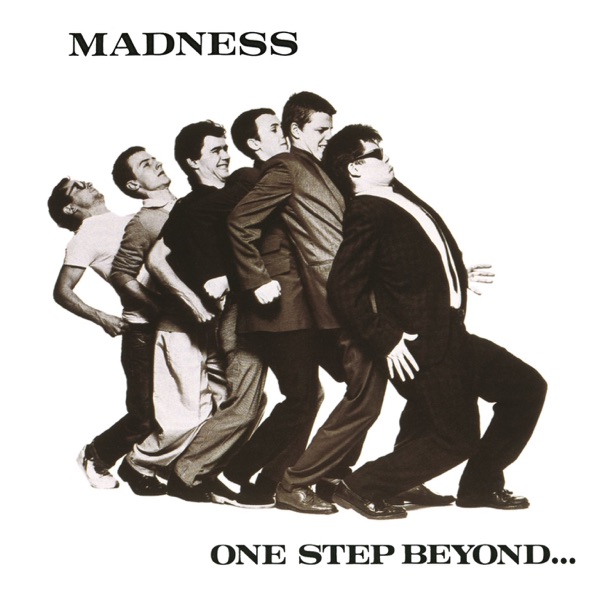
- 1979 One Step Beyond…
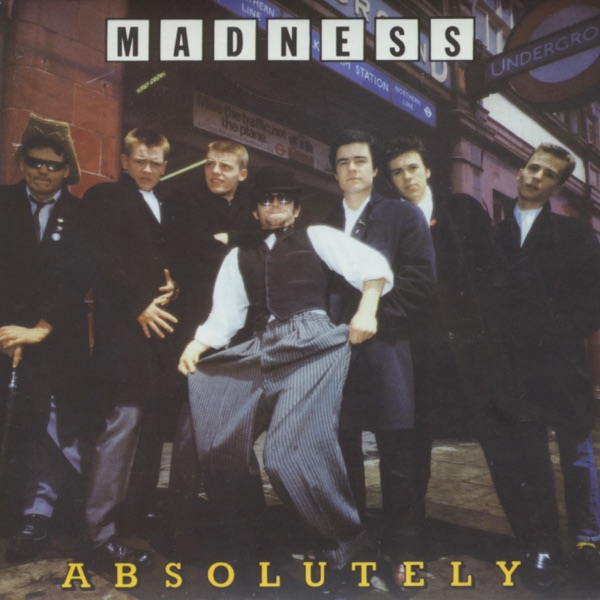
- 1980 Absolutely
- 1981 7
- 1982 The Rise & Fall
- 1984 Keep Moving
- 1985 Mad Not Mad
- 1999 Wonderful
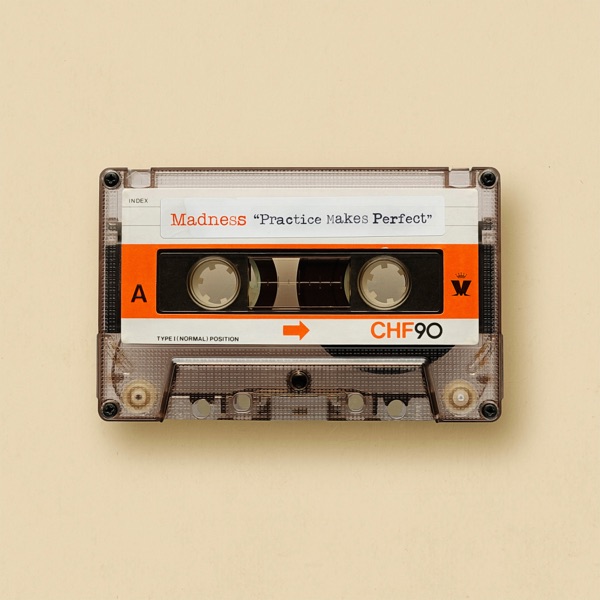
- 2005 The Dangermen Sessions, Volume One
- 2009 The Liberty of Norton Folgate
- 2012 Oui Oui, Si Si, Ja Ja, Da Da
- 2016 Can’t Touch Us Now
- 2023 Theatre of the Absurd Presents C’est La Vie
Source: MusicBrainz
Deep Dive
Overview
Madness are an English ska and pop band from Camden Town in north west London, formed in 1976. They emerged as one of the most prominent forces of the late-1970s and early-1980s two-tone ska revival, a movement that fused the off-beat rhythms of Jamaican ska with punk’s energy and attitude. Between 1980 and 1986, Madness’s songs spent 214 weeks on the UK Singles Chart, jointly holding the record for most weeks spent by a group in the UK singles chart during that decade alongside reggae outfit UB40. Their particular gift was translating ska’s infectious bounce and reggae’s rhythmic cool into something entirely suited to mass-market pop radio, without sacrificing the roughness or humor that made the music feel alive.
Formation Story
Madness coalesced in North London during the mid-to-late 1970s, drawing on the reggae, soul, and ska sounds that circulated through the city’s immigrant communities and youth clubs. The original seven-member lineup drew heavily on the musical lineage of Jamaican ska—a style that preceded reggae and emphasized the offbeat guitar skank—but filtered it through punk’s rawness and British new wave’s theatrical sensibility. By 1979, when they released their debut, the band had tightened into the unit that would define their early sound: lean, percussive, propulsive, and built as much for live performance and dancefloor energy as for radio play.
Breakthrough Moment
Madness’s breakthrough came swiftly. Their debut album, One Step Beyond…, released in 1979, introduced the blueprint that would dominate their early years: bouncy, horn-driven ska-pop with lyrics that mixed social observation with absurdist humor. The title track and its surrounding material found an immediate audience in the UK, establishing the band’s signature style before their truly commercial peak. Their second album, Absolutely, released in 1980, solidified their position, arriving at the precise moment when two-tone ska was accelerating from subcultural phenomenon to mainstream pop force. From that point forward, Madness maintained an almost unbroken string of UK hits throughout the early 1980s.
Peak Era
Madness’s most successful and creatively productive period spanned 1980 to 1986, the years bracketed by Absolutely and the final album of that initial run. During this window, they released 7 (1981), The Rise & Fall (1982), Keep Moving (1984), and Mad Not Mad (1985). These records showcased a band growing in confidence and sonic ambition: the skittering horns and reggae undertow remained constant, but production grew sleeker, songwriting deepened, and Suggs’s vocal delivery—playful yet precise—became more assured. The band’s ability to alternate between novelty-tinged pop confections and songs with genuine emotional weight, all wrapped in the ska template, kept listeners and critics engaged for a sustained run unusual for a pop group of the era.
Musical Style
Madness’s sound was built on the syncopated guitar strums and horn-section drive of Jamaican ska, combined with the irreverent attitude and fast tempos of punk and the synthesizer sheen of 1980s new wave. The bass lines carried reggae’s deep bottom end; the rhythm guitars chopped on the offbeat in classical ska fashion; and a trumpet, trombone, and saxophone section gave the records a jumping, almost carnival atmosphere. Suggs delivered lead vocals with a speaking-singing clarity that matched the lyrics’ often comic or observational bent, while backing harmonies added harmonic shimmer. The production aesthetic evolved from the rawer One Step Beyond… toward something more polished and pop-oriented by Keep Moving and Mad Not Mad, where synthesizers and drum machines gained prominence without displacing the organic horn arrangements that remained central to their identity. The band straddled multiple genres—ska, two-tone, new wave, synth-pop, reggae—without fully committing to any one, which was precisely their commercial and artistic strength.
Major Albums
One Step Beyond… (1979)
Madness’s debut announced their style fully formed: bouncy, horn-led ska-pop with a reggae undercurrent and punk’s lean energy. The album established the template that would sustain them through the 1980s and introduced “One Step Beyond,” the track that became their first signature song.
Absolutely (1980)
Their second album refined and expanded the formula, arriving at the crest of the two-tone wave’s commercial moment. Absolutely delivered more nuanced songwriting and tighter production than its predecessor while maintaining the infectious ska drive and humor that defined the band’s appeal.
7 (1981)
With a single-digit title suggesting both conceptual ambition and playful irreverence, 7 continued their run of UK success, balancing pop craftsmanship with the energetic horn arrangements and reggae-influenced rhythms that fans had come to expect.
The Rise & Fall (1982)
Madness’s most thematically cohesive effort, The Rise & Fall showcased the band’s ability to tackle more serious lyrical territory without abandoning their signature style. The album reaffirmed their status as the UK’s leading two-tone interpreters.
Keep Moving (1984)
Reflecting the synthetic production trends of mid-1980s pop while retaining ska’s rhythmic foundation, Keep Moving proved that the band could adapt to shifting production values and tastes without losing their identity.
Signature Songs
- “One Step Beyond” — The track that introduced Madness to mainstream audiences and became their defining first statement, built on a galloping ska rhythm and infectious horn section.
- “My Girl” — A reggae-influenced love song that showcased Suggs’s ability to balance humor and genuine sentiment, built on a rolling bass line and tight horn arrangement.
- “House of Fun” — A cheeky, upbeat pop-ska number that exemplified the band’s lighter side and mass-market appeal during their peak chart years.
- “Our Lips Are Sealed” — A late-80s collaboration that demonstrated how the ska template could stretch into pure pop without losing its rhythmic character.
Influence on Rock
Madness were instrumental in translating the two-tone ska revival from subcultural moment into mainstream pop currency. Their seven-year run of continuous UK success proved that ska could dominate radio and chart-top positions without compromising its rhythmic character or heritage. They arrived at the exact historical moment when British pop needed an infusion of reggae-influenced groove and Caribbean rhythm; their success both reflected and accelerated the growing integration of reggae and world music elements into the mainstream UK pop landscape. The band’s longevity and commercial dominance during the two-tone moment meant that subsequent ska and reggae-influenced pop acts looked to their template for evidence that the style could sustain a major career.
Legacy
Madness never truly disbanded, continuing to tour and record across subsequent decades. The fact that six of the original seven members have remained active with the band speaks to both the durability of their concept and their ongoing connection to their audience. Albums like Wonderful (1999), The Liberty of Norton Folgate (2009), Can’t Touch Us Now (2016), and Theatre of the Absurd Presents C’est La Vie (2023) demonstrate a band that has continued to document its era and creative evolution rather than simply recycling past glories. Though the chart dominance of the early 1980s never returned, Madness maintained a presence in UK popular culture and in the touring circuit, ensuring that subsequent generations encountered their music through live performance, streaming availability, and cultural reference. They remain cultural ambassadors for the two-tone moment and living proof that a pop band rooted in a specific time and place can transcend its era without abandoning its core identity.
Fun Facts
- Madness are one of only two groups to hold the record for most weeks spent on the UK Singles Chart during the 1980s, sharing this achievement with reggae band UB40—an fitting parallel given the reggae influences central to both acts’ sound.
- The band’s name was taken from a 1963 album by Prince Buster, the pioneering Jamaican ska and reggae musician whose work directly influenced the two-tone movement.
- Throughout their initial run and beyond, Madness maintained strong ties to Camden Town and North London, remaining rooted in the geographic and cultural location where they formed rather than relocating to pursue greater commercial convenience.
- Six of the seven original members have continued to perform and record together across multiple decades, making Madness one of the most stable and enduring lineups in British pop history.
Discography & Previews
Click any album to expand its track list. Each track plays a 30-second preview streamed from Apple Music. Tap the link icon next to a track to open it in Apple Music for full playback.
- 1 One Step Beyond ↗ 2:18
- 2 My Girl ↗ 2:45
- 3 Night Boat to Cairo ↗ 3:31
- 4 Believe Me ↗ 2:29
- 5 Land of Hope and Glory ↗ 2:58
- 6 The Prince ↗ 3:19
- 7 Tarzan's Nuts ↗ 2:25
- 8 In the Middle of the Night ↗ 3:01
- 9 Bed & Breakfast Man ↗ 2:33
- 10 Razor Blade Alley ↗ 2:42
- 11 Swan Lake ↗ 2:36
- 12 Rockin' In A Flat ↗ 2:29
- 13 Mummy's Boy ↗ 2:24
- 14 Madness ↗ 2:38
- 15 Chipmunks Are Go! ↗ 0:54
- 1 Baggy Trousers ↗ 2:47
- 2 Embarrassment ↗ 3:11
- 3 E.R.N.I.E. ↗ 2:10
- 4 Close Escape ↗ 3:33
- 5 Not Home Today ↗ 2:44
- 6 On the Beat Pete ↗ 3:05
- 7 Solid Gone ↗ 2:19
- 8 Take It or Leave It ↗ 3:27
- 9 Shadow of Fear ↗ 1:59
- 10 Disappear ↗ 2:58
- 11 Overdone ↗ 3:45
- 12 In the Rain ↗ 2:44
- 13 You Said ↗ 2:35
- 14 Return of the Los Palmas 7 ↗ 2:04

- 1 Cardiac Arrest (2010 Remaster) ↗ 2:52
- 2 Shut Up (2010 Remaster) ↗ 4:06
- 3 Sign of the Times (2010 Remaster) ↗ 2:43
- 4 Missing You (2010 Remaster) ↗ 2:33
- 5 Mrs. Hutchinson (2010 Remaster) ↗ 2:18
- 6 Tomorrow's Dream (2010 Remaster) ↗ 3:55
- 7 Grey Day (2010 Remaster) ↗ 3:39
- 8 Pac-a-Mac (2010 Remaster) ↗ 2:37
- 9 Promises Promises (2010 Remaster) ↗ 2:52
- 10 Benny Bullfrog (2010 Remaster) ↗ 1:51
- 11 When Dawn Arrives (2010 Remaster) ↗ 2:43
- 12 The Opium Eaters (2010 Remaster) ↗ 3:02
- 13 Day on the Town (2010 Remaster) ↗ 3:23
- 14 It Must Be Love ↗ 3:26

- 1 Keep Moving ↗ 3:32
- 2 Wings of a Dove (A Celebratory Song) ↗ 3:03
- 3 The Sun and the Rain ↗ 3:19
- 4 Brand New Beat ↗ 3:16
- 5 March of the Gherkins ↗ 3:29
- 6 Michael Caine ↗ 3:37
- 7 Prospects ↗ 4:14
- 8 Victoria Gardens ↗ 4:31
- 9 Samantha ↗ 3:13
- 10 One Better Day ↗ 4:06
- 11 Give Me a Reason ↗ 3:24
- 12 Turning Blue ↗ 3:08
- 13 Time For Tea ↗ 3:06
- 14 Waltz Into Mischief ↗ 3:35


- 1 Lovestruck (2010 Remaster) ↗ 3:51
- 2 Johnny the Horse (2010 Remaster) ↗ 3:21
- 3 The Communicator (2010 Remaster) ↗ 3:21
- 4 4.A.M. (2010 Remaster) ↗ 3:51
- 5 The Wizard (2010 Remaster) ↗ 3:28
- 6 Drip Fed Fred (feat. Ian Dury) [2010 Remaster] ↗ 4:31
- 7 Going to the Top (2010 Remaster) ↗ 3:57
- 8 Elysium (2010 Remaster) ↗ 3:57
- 9 Saturday Night, Sunday Morning (2010 Remaster) ↗ 4:16
- 10 If I Didn’t Care (2010 Remaster) ↗ 4:25
- 11 No Money (2010 Remaster) ↗ 3:13

- 1 My Girl 2 ↗ 2:51
- 2 Never Knew Your Name ↗ 3:28
- 3 La Luna ↗ 3:38
- 4 How Can I Tell You ↗ 3:19
- 5 Kitchen Floor ↗ 3:21
- 6 Misery ↗ 3:17
- 7 Leon ↗ 3:48
- 8 Circus Freaks ↗ 3:15
- 9 So Alive ↗ 2:59
- 10 Small World ↗ 3:46
- 11 Death of a Rude Boy ↗ 3:58
- 12 Powder Blue ↗ 3:47
- 13 Black and Blue ↗ 3:02
- 14 My Girl 2 (Clive Langer and Charlie Andrew Mix) ↗ 3:01

- 1 Grandslam (Instrumental Demo) ↗ 2:04
- 2 Mumbo Jumbo (Demo) ↗ 3:10
- 3 Good Times (Demo) ↗ 3:04
- 4 You Are My Everything (Demo) ↗ 4:45
- 5 Another Version of Me (Demo) ↗ 3:58
- 6 Blackbird (Instrumental Demo) ↗ 3:04
- 7 Herbert (Demo) ↗ 3:50
- 8 I Believe (Demo) ↗ 3:33
- 9 (Don't Let Them) Catch You Crying (Demo) ↗ 3:27
- 10 Pam the Hawk (Demo) ↗ 3:51
- 11 Soul Denying (Demo) ↗ 5:33
- 12 Whistle In the Dark (Demo) ↗ 3:11
- 13 The Last Rag and Bone Man (Demo) ↗ 3:34

- 1 Prologue: “Mr Beckett Sir…” ↗ 0:12
- 2 Theatre of the Absurd ↗ 4:14
- 3 If I Go Mad ↗ 4:37
- 4 Baby Burglar ↗ 4:06
- 5 Act One: "Surrounded on all sides..” ↗ 0:10
- 6 C’est La Vie ↗ 3:11
- 7 What On Earth Is It (You Take Me For?) ↗ 3:07
- 8 Hour of Need ↗ 4:07
- 9 Act Two "the damsel in distress..” ↗ 0:13
- 10 Round We Go ↗ 4:18
- 11 Act Three: "The situation deteriorates..” ↗ 0:20
- 12 Lockdown and Frack Off ↗ 3:12
- 13 Beginners 101 ↗ 4:22
- 14 Is There Anybody Out There? ↗ 3:22
- 15 The Law According to Dr. Kippah ↗ 5:36
- 16 Epilogue: “And so Ladies and Gentlemen..” ↗ 0:17
- 17 Run For Your Life ↗ 4:00
- 18 Set Me Free (Let Me Be) ↗ 3:39
- 19 In My Street ↗ 3:38
- 20 Fin.: “Ladies and Gentlemen..” ↗ 0:13