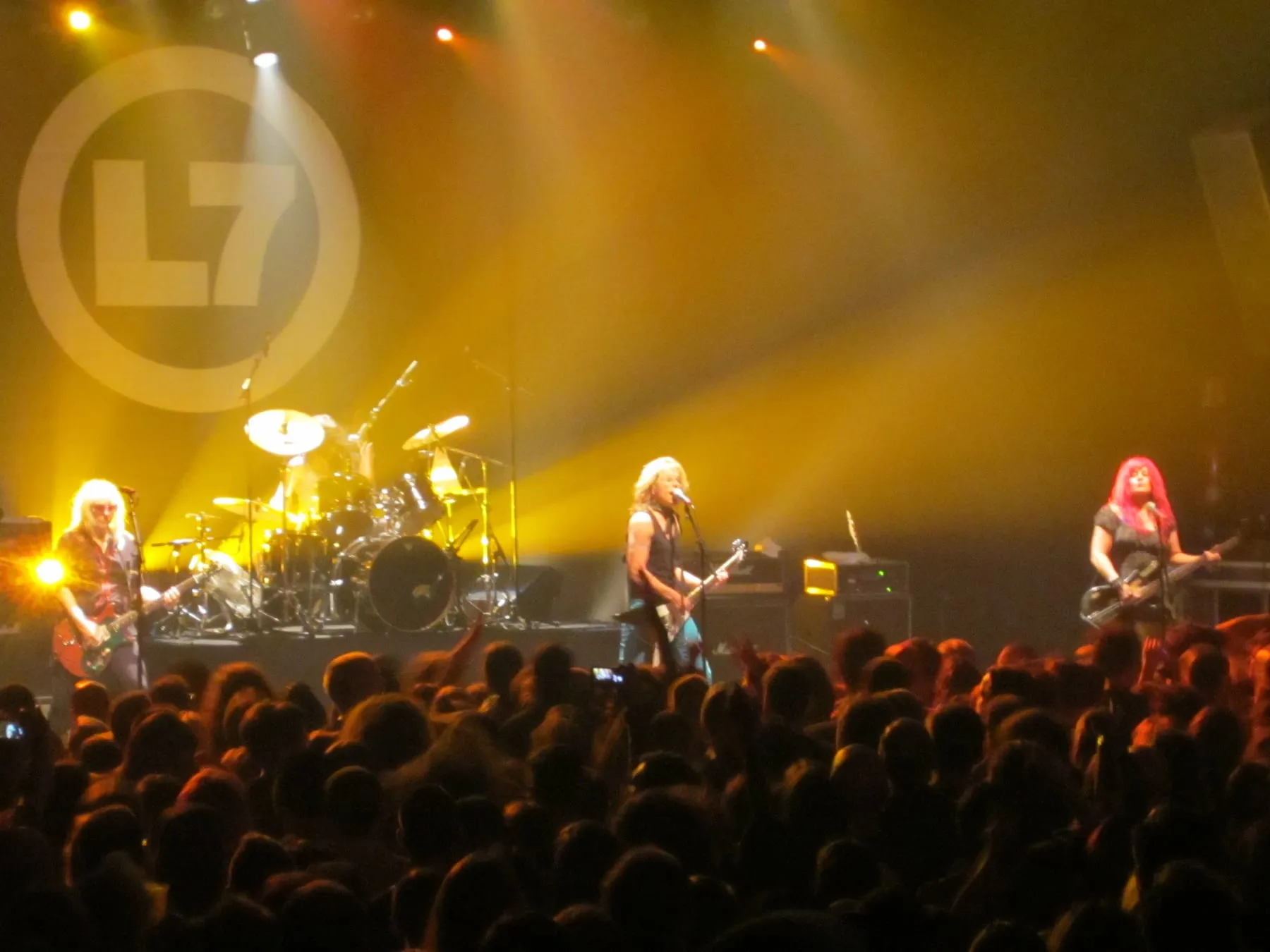
Photo by Joecuba , licensed under CC BY-SA 4.0 · Wikimedia Commons
Rank #407
L7
L.A. all-women punk-grunge band whose 'Bricks Are Heavy' is a 90s classic.
From Wikipedia
L7 is an American rock band founded in Los Angeles, California, first active from 1985 to 2001 and re-formed in 2014. Their longest standing lineup consists of Suzi Gardner, Donita Sparks, Jennifer Finch, and Dee Plakas. L7 has released seven studio albums and has toured widely in the US, Europe, Japan, Australia, and South America. "Pretend We're Dead" was heavily played on US alternative radio and entered the top 10 on the Billboard Modern Rock chart in 1992.
Members
- Demetra Plakas
- Donita Sparks
- Gail Greenwood
- Greta Brinkman
- Janis Tanaka
- Jennifer Finch
- Suzi Gardner
Studio Albums
- 1988 L7
- 1990 Smell the Magic
- 1992 Bricks Are Heavy
- 1992 Maneater
- 1992 Fast And Frightening
- 1993 Skeleton Songs
- 1993 Fast and Frightening
- 1994 Hungry for Stink
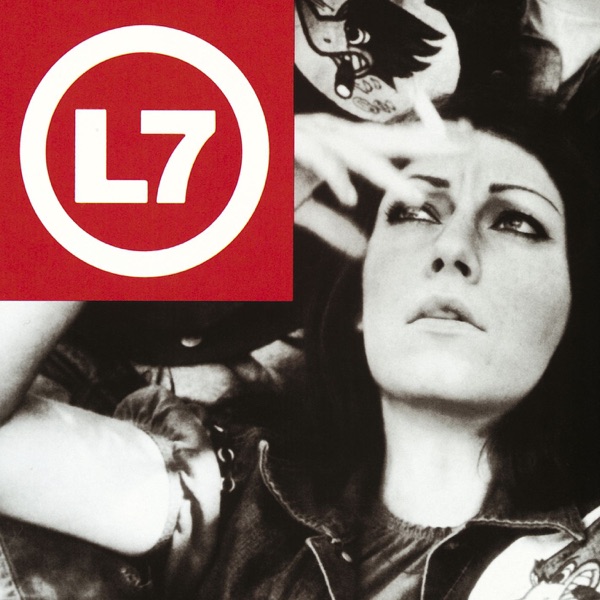
- 1997 The Beauty Process: Triple Platinum
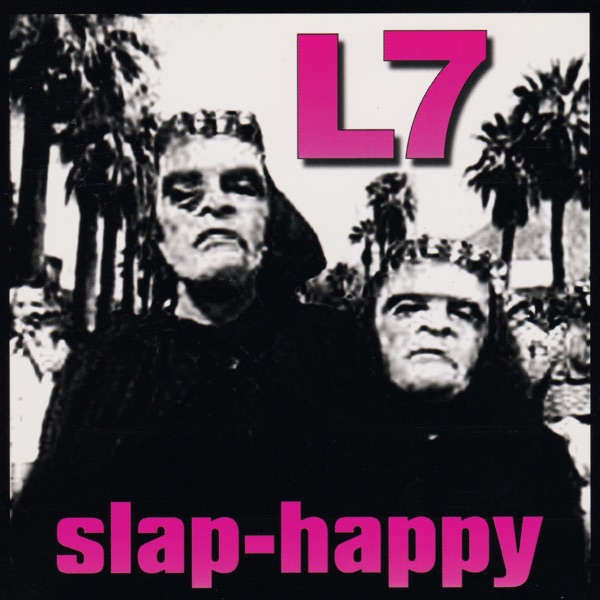
- 1999 Slap-Happy
- 2019 Scatter the Rats
Source: MusicBrainz
Deep Dive
Overview
L7 emerged from Los Angeles in 1985 as an all-women punk and grunge outfit during a decade when the rock mainstream remained heavily male-dominated. Their commercial and artistic peak arrived in the early 1990s, when the alternative rock boom created space for their abrasive, guitar-driven sound. The band’s 1992 album Bricks Are Heavy and its lead single “Pretend We’re Dead” anchored L7 as one of the decade’s defining acts, bridging punk’s DIY ethos with grunge’s heavier, angst-ridden aesthetic. Though they disbanded in 2001, their reformation in 2014 confirmed their enduring place in rock history.
Formation Story
L7 coalesced in Los Angeles in 1985, a time when the city’s underground rock scene was fragmenting between hardcore punk and emergent metal influences. The longest-standing and best-known lineup consisted of Donita Sparks and Suzi Gardner on guitars and vocals, Jennifer Finch on bass, and Demetra Plakas on drums. The band drew its name from a slang term for an unhip person—a choice reflecting punk rock’s irreverent attitude toward mainstream acceptance. Los Angeles, though associated with glam metal and hair rock in the 1980s, contained a vital underground punk community from which L7 drew both stylistic and ethical grounding. Over their first years, the group solidified their lineup and began performing in the city’s club circuit, building a local following through energetic, no-compromise live shows.
Breakthrough Moment
L7’s transition from regional act to national alternative radio staple occurred in 1992 with the release of Bricks Are Heavy and its lead single “Pretend We’re Dead.” The song’s driving guitar riff, blunt lyrics, and Sparks’ commanding vocal delivery made it a fixture on US alternative radio, where it climbed into the top 10 on the Billboard Modern Rock chart. Bricks Are Heavy itself became a landmark album of the early 1990s alternative explosion, reaching audiences far beyond L.A.’s club scene. The album’s commercial success positioned L7 alongside other female-fronted and all-female acts gaining traction during the grunge boom, yet the band maintained their punk-derived aggression and refusal of commercial compromise. This moment crystallized L7’s identity as serious musicians working in a hard rock idiom, not as a novelty or marketing category.
Peak Era
L7’s most commercially successful and creatively confident period spanned 1992 to 1994, encompassing Bricks Are Heavy, the 1994 album Hungry for Stink, and supporting tours across the United States, Europe, Japan, Australia, and South America. During this window, the band achieved consistent MTV exposure, toured major festivals, and accumulated a devoted fanbase that extended well beyond alternative radio listeners. Bricks Are Heavy established their template: heavily distorted guitars, propulsive rhythm section work, and vocals that ranged from melodic to raw depending on song context. Hungry for Stink extended these themes while deepening the band’s exploration of harder, more metal-influenced textures. By the mid-1990s, L7 had proven themselves as working touring musicians and studio professionals, not a one-album phenomenon. Their commercial momentum slowed after the mid-1990s, though they remained creatively active until their 2001 dissolution.
Musical Style
L7’s sound synthesized punk rock’s energy and attitude with the heavier, downtuned guitar work emerging from grunge and 1980s metal. The band’s primary instrumental palette featured two electric guitars played with distortion and heavy compression, creating a thick, wall-of-sound production style that differentiated them from the more ethereal female-fronted alternative acts of the era. Sparks and Gardner’s guitar work emphasized riff-based song structures over technical showmanship; their solos were brief and functional, prioritizing groove and impact. Finch’s bass lines often drove the harmonic content, anchoring songs with melodic runs that prevented the heavy guitars from becoming one-dimensional. Plakas’ drumming was forceful and precise, avoiding the jazz-influenced timekeeping of punk’s earlier generation in favor of a harder-hitting, more metal-adjacent approach. Lyrically, L7 addressed themes of alienation, anger, social observation, and female experience with a directness that eschewed both punk’s often-jokey irreverence and grunge’s more oblique symbolism. The overall effect was of a band playing hard rock that happened to be fronted and entirely composed of women, rather than a gender-specific subcategory of rock music.
Major Albums
Bricks Are Heavy (1992)
Bricks Are Heavy stands as L7’s finest and most commercially successful studio statement. The album’s muscular production, straightforward song structures, and the ubiquitous radio hit “Pretend We’re Dead” established L7 as major alternative rock players and demonstrated that all-female rock acts could achieve mainstream alternative radio success without compromise.
Hungry for Stink (1994)
Hungry for Stink continued and deepened Bricks Are Heavy’s approach, incorporating heavier, more metal-influenced tones and more intricate compositional arrangements. The album showcased L7’s expanded ambitions and continued willingness to push their sound toward harder territory.
Smell the Magic (1990)
This pre-breakthrough album captured L7 in their early form, blending punk rawness with proto-grunge heaviness. Though less refined than later work, it established the core elements of their sonic identity.
The Beauty Process: Triple Platinum (1997)
Released five years after Hungry for Stink, The Beauty Process: Triple Platinum represented L7’s attempt to sustain relevance during a period when the mainstream alternative rock market had shifted. The album demonstrated creative ambition even as commercial momentum waned.
Signature Songs
- “Pretend We’re Dead” — The 1992 chart-climbing single that defined L7’s mainstream breakthrough and remains their most recognizable song.
- “Shitlist” — A furious, rhythmically propulsive track exemplifying the band’s ability to channel anger into compelling hard rock.
- “Wargod” — A showcase for Gardner and Sparks’ guitar interplay and Plakas’ driving rhythm section work.
- “Lame” — A mid-tempo track demonstrating L7’s range beyond pure aggression.
Influence on Rock
L7 occupied a crucial position in 1990s rock as a all-women band that played with genuine heaviness and refused novelty positioning. Their commercial success in alternative rock radio and MTV validated the market for female-fronted hard rock acts and influenced subsequent generations of female musicians working in punk, grunge, and heavy genres. The band demonstrated that women could command the guitars and rhythm section in aggressive rock music without apology or special marketing. Their touring presence—wide, sustained international touring throughout the 1990s—reinforced the viability of all-female touring rock bands at a time when such acts remained relatively rare in headlining roles. While L7 did not fundamentally alter rock music’s structural or sonic foundations, they proved through sustained commercial and critical success that gender-balanced band rosters and women’s visibility in heavy rock could coexist with mainstream alternative radio success.
Legacy
L7’s 2014 reformation marked a symbolic reversal of their 2001 dissolution and signaled the band’s enduring cultural significance within 1990s rock history. The reunion allowed the core lineup of Sparks, Gardner, Finch, and Plakas to reconnect with audiences that had sustained interest in 1990s alternative rock through streaming services, documentary programming, and retrospective critical reassessment. The 2019 album Scatter the Rats confirmed the reunion as artistically serious, not merely a nostalgia tour. L7’s catalog remains widely available on streaming platforms, and Bricks Are Heavy in particular continues to be cited in discussions of 1990s alternative rock classics. The band’s example—an all-women hard rock outfit that achieved substantial commercial success during a major mainstream moment—remains culturally resonant for musicians and audiences seeking historical evidence of women’s participation in heavy rock music.
Fun Facts
- L7 recorded and released multiple albums in 1992 and 1993, including the EPs Maneater, Fast and Frightening, and Skeleton Songs, alongside the full-length Bricks Are Heavy, demonstrating the band’s prolific output during their peak commercial period.
- The band’s willingness to tour extensively across six continents—US, Europe, Japan, Australia, South America—during the 1990s established them as serious international touring musicians rather than a domestic alternative radio novelty.
- L7’s reformation in 2014, thirteen years after their 2001 breakup, placed them within a broader wave of 1990s alternative rock bands revisiting their catalogs, including bands like Hole, The Melvins, and Sonic Youth.
Discography & Previews
Click any album to expand its track list. Each track plays a 30-second preview streamed from Apple Music. Tap the link icon next to a track to open it in Apple Music for full playback.

- 1 Shove (Remastered) ↗ 3:13
- 2 Fast and Frightening (Remastered) ↗ 2:40
- 3 (Right On) Thru (Remastered) ↗ 3:15
- 4 Deathwish (Remastered) ↗ 3:49
- 5 Till the Wheels Fall Off (Remastered) ↗ 3:46
- 6 Broomstick (Remastered) ↗ 3:51
- 7 Packin' a Rod (Remastered) ↗ 2:10
- 8 Just Like Me (Remastered) ↗ 3:32
- 9 American Society (Remastered) ↗ 3:55