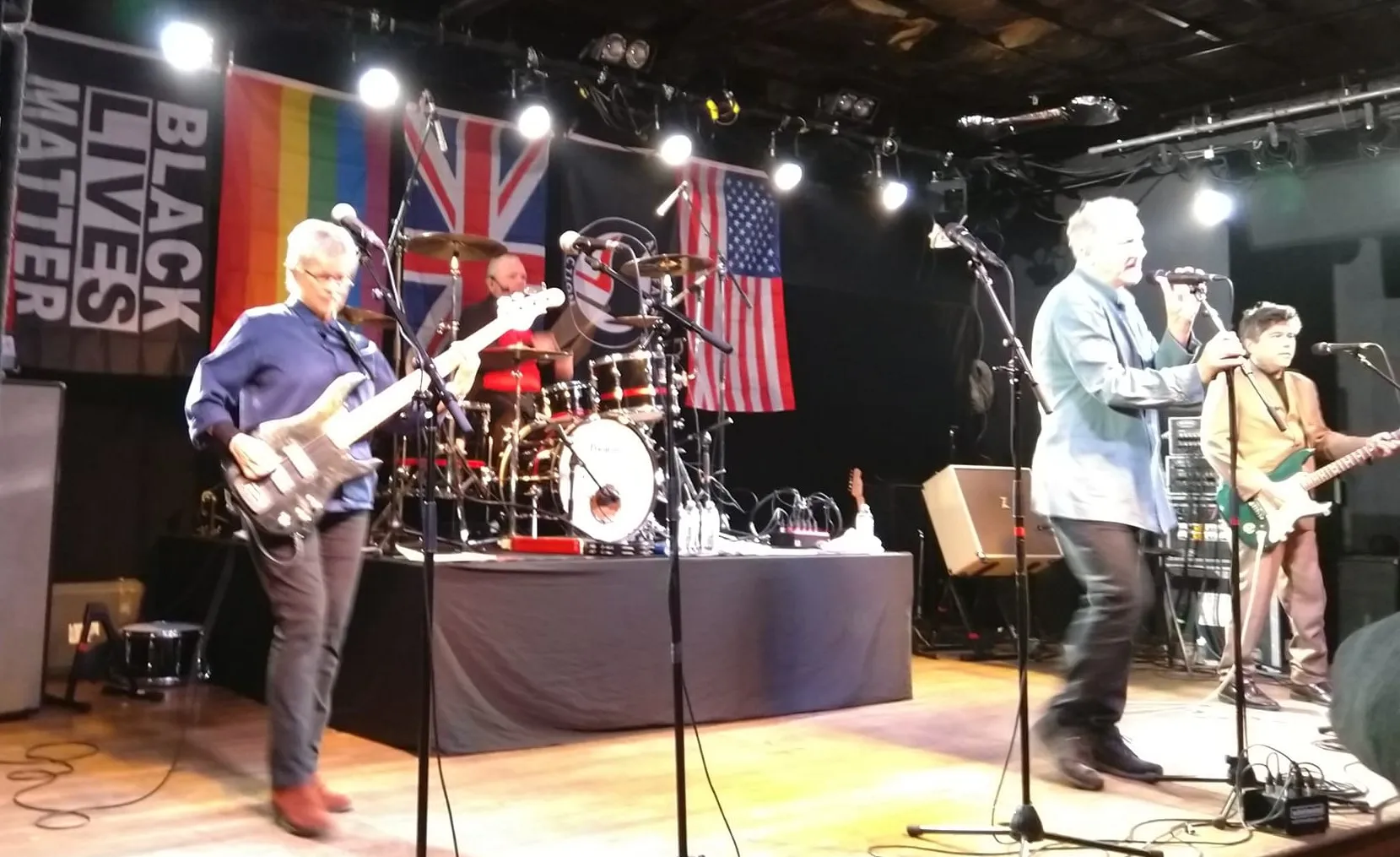
Photo by Robman94 , licensed under CC BY-SA 4.0 · Wikimedia Commons
Rank #219
Gang of Four
Leeds post-punks who fused political theory with funk-inflected rhythm.
From Wikipedia
Gang of Four are an English post-punk band, formed in 1976 in Leeds. The original members were singer Jon King, guitarist Andy Gill, bass guitarist Dave Allen and drummer Hugo Burnham. There have been many different line-ups including, among other notable musicians, Sara Lee, Gail Ann Dorsey, Mark Heaney and David Pajo. After a brief lull in the 1980s, different constellations of the band recorded two studio albums in the 1990s. Between 2004 and 2006 the original line-up was reunited; Gill toured using the name between 2012 and his death in 2020. In 2021, the band announced that King, Burnham, and Lee would be reuniting for a US tour in 2022 with David Pajo on guitar and Sara Lee returning to the band. They continued to perform live, including at the Cruel World Festival in Pasadena, California; headlining Luna Fest in Coimbra, Portugal, and a UK Tour in October 2023. They then announced that their "Long Goodbye" tour in 2025 would be their last headlining tour of the US and Europe. For this tour, King and Burnham were joined by Ted Leo on guitar and Gail Greenwood on bass.
Members
- Dave Allen
Studio Albums
- 1979 Entertainment!
- 1981 Solid Gold
- 1982 Songs of the Free
- 1983 Hard
- 1991 Mall
- 1995 Shrinkwrapped
- 2005 Return the Gift
- 2011 Content
- 2015 What Happens Next
- 2019 Happy Now
Source: MusicBrainz
Deep Dive
Overview
Gang of Four emerged from Leeds in 1977 as one of the defining post-punk acts of the late 1970s and early 1980s. The band synthesized the angular, atonal guitars of post-punk with syncopated funk rhythms and lyrics grounded in Marxist analysis and social critique. They occupied a unique position: politically uncompromising yet rhythmically dance-oriented, making intellectual rock that moved bodies as much as minds. Their influence extended far beyond their initial recording period, establishing templates for post-punk revival and politically engaged rock that endured into subsequent decades.
Formation Story
Gang of Four coalesced in Leeds in 1977 around the core partnership of singer Jon King and guitarist Andy Gill. Joined by bassist Dave Allen and drummer Hugo Burnham, the lineup captured the energy and ideological fervor of the post-punk moment. Leeds, a city with its own strong artistic tradition, provided the band with a base distinct from London’s overcrowded punk scene. The four members brought complementary skills: King’s vocal delivery combined spoken-word clarity with rhythmic precision, Gill’s guitar work eschewed conventional chord structures in favor of percussive, almost atonal textures, and the rhythm section of Allen and Burnham locked into syncopated patterns that owed as much to funk and Motown as to punk’s raw energy.
Breakthrough Moment
Gang of Four’s debut album Entertainment!, released in 1979, immediately signaled their arrival as a major artistic force. The record synthesized post-punk’s aesthetic of musical restraint with funk’s emphasis on groove, creating a sound that was simultaneously cerebral and physically compelling. Entertainment! established the band’s signature approach: abrasive, minimalist guitar work paired with hypnotic bass and drums, all serving lyrics that interrogated consumer culture, sexuality, and ideology. The album’s success placed them at the forefront of the post-punk movement and brought them an international audience. Their momentum accelerated through the early 1980s, with subsequent releases reinforcing their status as one of the era’s most vital bands.
Peak Era
The band’s creative and commercial peak spanned 1979 to 1983, encompassing the albums Entertainment!, Solid Gold (1981), Songs of the Free (1982), and Hard (1983). During this four-year window, Gang of Four refined and expanded their sound while maintaining their core identity. Solid Gold deepened their exploration of funk-inflected post-punk, integrating more complex rhythmic arrangements and tightening the relationship between Gill’s guitar and the rhythm section. Songs of the Free and Hard saw the band experimenting with production textures and sonic density without sacrificing the intellectual rigor that defined their work. These albums confirmed that Gang of Four’s approach was not a novelty but a sustainable artistic vision capable of evolution and growth.
Musical Style
Gang of Four’s sound rested on a fundamental paradox: music designed to be intellectually challenging yet physically irresistible. Andy Gill’s guitar work was the crucial distinguishing element—rather than playing chords or melodic lines in traditional fashion, he produced dissonant, percussive textures that functioned almost as another rhythm instrument. His approach deconstructed rock guitar vocabulary, stripping away sustain and harmonic warmth in favor of attack and abstraction. Beneath this, Dave Allen’s bass lines were melodically inventive and deeply funky, often driving the groove forward with the kind of syncopation found in Motown and James Brown rather than in punk or new wave. Hugo Burnham’s drumming was equally sophisticated, mixing punk’s directness with funk’s rhythmic complexity. Jon King’s vocals ranged from declamatory spoken passages to sung melodic phrases, all delivered with an emotional restraint that matched the music’s intellectual ambitions. The overall effect was music that sounded nothing like mainstream rock—it was too funky to be purely post-punk, too angular and atonal to be funk, too lyrically engaged to be purely dance music.
Major Albums
Entertainment! (1979)
The debut established Gang of Four’s signature fusion of post-punk atonality and funk groove, introducing their syncopated rhythmic approach and politically engaged lyrics. It remains the most immediate entry point to the band’s catalog and the album most directly influenced post-punk revival decades later.
Solid Gold (1981)
The second album deepened their exploration of rhythm and production, refining the funk-post-punk synthesis while adding textural sophistication. Solid Gold is their most commercially successful work and demonstrates the band’s growing confidence in their artistic vision.
Songs of the Free (1982)
On their third album, Gang of Four expanded their sonic palette, incorporating more elaborate production and varied instrumental arrangements. The record shows the band experimenting with density and dynamics without losing their core identity.
Hard (1983)
The final album of their original peak period pushed further into experimental territory, with even more layered production and expanded arrangements. Hard represented the band at their most ambitious in terms of sonic scope.
Return the Gift (2005)
Recorded after the original members reunited between 2004 and 2006, this album marked the band’s return to recording. Return the Gift found them reasserting the core elements of their sound after decades apart.
What Happens Next (2015)
This album demonstrated that the reunited band remained creatively vital, updating their post-punk-funk fusion for a contemporary context while honoring their established aesthetic.
Signature Songs
- “Damaged Goods” — An early defining statement that combines funk groove with critique of consumer capitalism and heterosexual politics, establishing the band’s intellectual-physical balance.
- “At Home He’s a Tourist” — A showcase for the band’s rhythmic innovation and Gill’s distinctive guitar approach, demonstrating how their music could be both challenging and compulsively listenable.
- “Contract” — An exploration of labor and exploitation that exemplifies their ability to make political content integral to the music rather than superficial.
- “I Found That Essence Rare” — A later-period work showing the band’s continued investment in complex rhythm and lyrical sophistication across their career.
Influence on Rock
Gang of Four’s impact on rock and alternative music far exceeded their commercial reach. They proved that post-punk could absorb funk and dance elements without sacrificing intellectual rigor or artistic integrity. Their approach influenced generations of post-punk revival bands, from Liars to Protomartyr, who understood that politically engaged rock music need not be grimly austere. The band demonstrated that rhythm and groove could be as central to post-punk as dissonance and irony. Their insistence on synthesizing disparate influences—punk’s energy, funk’s physicality, post-punk’s restraint, and leftist theory’s ambition—created a template that numerous alternative rock and electronic musicians have drawn upon. The band’s refusal of conventional rock structures and their embrace of repetitive, syncopated patterns anticipated aspects of post-punk’s 21st-century revival, when bands sought models for music that combined danceability with conceptual weight.
Legacy
After a period of relative inactivity following Hard in 1983, Gang of Four’s influence only deepened in cultural memory. The band’s reunification beginning in 2004 and continuing through subsequent decades allowed them to reconnect with longtime supporters and introduce their music to new audiences. Their continued touring—including festival appearances and headline dates across North America and Europe through 2024 and their announced final “Long Goodbye” tour in 2025—has reinforced their status as essential figures in rock history. The band members’ different configurations and the involvement of musicians like Sara Lee, David Pajo, Ted Leo, and Gail Greenwood in later iterations ensured that Gang of Four remained a living entity rather than a museum piece. Their catalog from 1979 to 1983 remains central to any serious discussion of post-punk’s achievements, and their willingness to continue recording and performing into the 2010s and 2020s demonstrated the durability of their artistic vision.
Fun Facts
- Gang of Four formed in 1976 according to some sources but officially date their formation to 1977, reflecting the fluid nature of band genesis in the post-punk era.
- The band’s name was drawn from the Chinese political term referring to the faction associated with the Cultural Revolution, reflecting their engagement with political theory.
- Andy Gill continued to tour under the Gang of Four name between 2012 and his death in 2020, keeping the band’s presence alive even during periods when the original lineup was not fully reunited.
- Sara Lee, who joined the band in later incarnations, brought significant musical credentials and continued the band’s tradition of strong collaborative partnerships.
- The band’s “Long Goodbye” tour announcement in 2025 signals their intention to step back from regular touring and recording while preserving the possibility of occasional performances.
Discography & Previews
Click any album to expand its track list. Each track plays a 30-second preview streamed from Apple Music. Tap the link icon next to a track to open it in Apple Music for full playback.


- 1 Call Me Up ↗ 3:37
- 2 I Love a Man In a Uniform ↗ 4:07
- 3 We Live As We Dream, Alone ↗ 3:40
- 4 It Is Not Enough ↗ 3:29
- 5 Life! It's a Shame ↗ 4:09
- 6 I Will Be a Good Boy ↗ 3:56
- 7 The History of the World ↗ 4:41
- 8 Muscle for Brains ↗ 3:17
- 9 Of the Instant ↗ 5:03
- 10 The World at Fault ↗ 3:39
- 11 I Love a Man In a Uniform (Dub) ↗ 4:47


- 1 Cadillac ↗ 5:27
- 2 Motel ↗ 3:33
- 3 Satellite ↗ 3:57
- 4 F.M.U.S.A. ↗ 5:00
- 5 Don't Fix What Ain't Broke ↗ 4:00
- 6 Impossible ↗ 0:52
- 7 Money Talks ↗ 3:33
- 8 Soul Rebel ↗ 4:05
- 9 Hiromi & Stan Talk ↗ 0:42
- 10 Colour from the Tube ↗ 3:45
- 11 Hey Yeah ↗ 3:42
- 12 Everybody Wants to Come ↗ 4:01
- 13 World Falls Apart ↗ 6:08


- 1 She Said 'You Made a Thing of Me' ↗ 3:49
- 2 You Don't Have to Be Mad ↗ 3:15
- 3 Who Am I? ↗ 3:35
- 4 I Can't Forget Your Lonely Face ↗ 3:56
- 5 You'll Never Pay for the Farm ↗ 3:53
- 6 I Party All the Time ↗ 3:42
- 7 A Fruitfly In the Beehive ↗ 3:45
- 8 It Was Never Gonna Turn Out Too Good ↗ 2:48
- 9 Do As I Say ↗ 3:26
- 10 I Can See from Far Away ↗ 2:58

- 1 Where The Nightingale Sings ↗ 4:03
- 2 Broken Talk (feat. Alison Mosshart) ↗ 4:20
- 3 Isle Of Dogs ↗ 3:48
- 4 England's In My Bones (feat. Alison Mosshart) ↗ 3:11
- 5 The Dying Rays (feat. Herbert Grönemeyer) ↗ 3:28
- 6 Obey The Ghost ↗ 4:37
- 7 First World Citizen ↗ 4:04
- 8 Stranded ↗ 3:37
- 9 Graven Image (feat. Robbie Furze) ↗ 4:05
- 10 Dead Souls (feat. Hotei) ↗ 3:23
- 11 Staubkorn (feat. Herbert Grönemeyer) ↗ 3:32
