
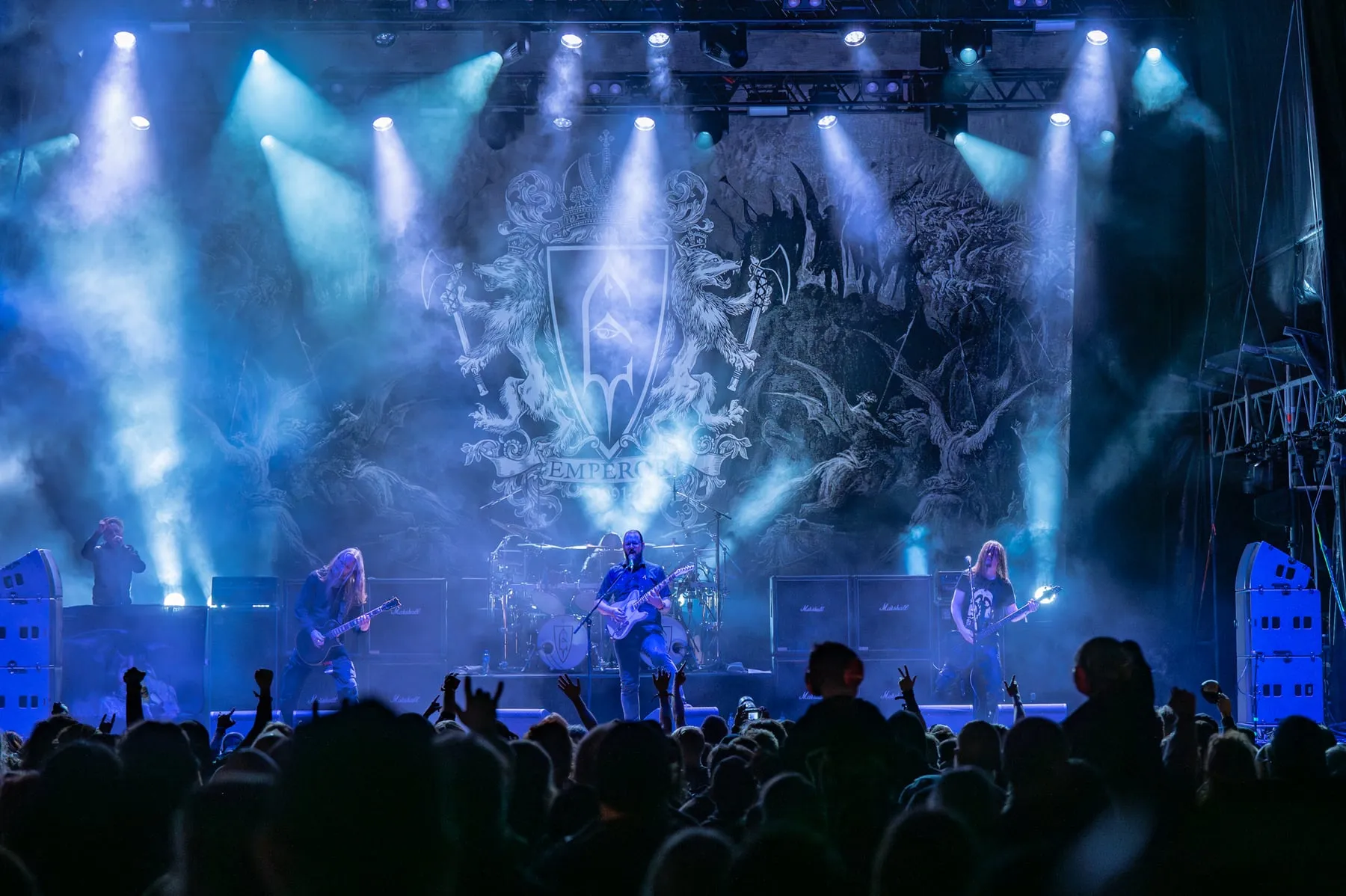
Photo by Birgit Fostervold , licensed under CC BY-SA 4.0 · Wikimedia Commons
Rank #245
Emperor
Norwegian black-metal innovators of orchestral grandeur.
From Wikipedia
Emperor is a Norwegian black metal band formed in 1991 by guitarist and vocalist Ihsahn and guitarist Samoth. The group split up in 2001, but reunited from 2005 to 2007 for a few festival dates and brief US tours, and again reunited from 2013 to 2014. Emperor reformed for the third time in 2016.
Members
- Alver
- Bård Faust
- Ihsahn
- Jan Axel Blomberg
- Mortiis
- Samoth
- Tchort
- Trym Torson
Studio Albums
- 1994 In the Nightside Eclipse
- 1997 Anthems to the Welkin at Dusk
- 1999 Thorns vs. Emperor
- 1999 IX Equilibrium
- 2001 Prometheus: The Discipline of Fire & Demise
Source: MusicBrainz
Deep Dive
Overview
Emperor stands as one of the most significant black-metal acts to emerge from Norway’s fertile underground scene of the early 1990s. Formed in 1991 by guitarist and vocalist Ihsahn and guitarist Samoth, the band pioneered a distinctive fusion of black metal’s raw aggression with elaborate orchestral arrangements and symphonic composition. Their work expanded the sonic and conceptual boundaries of a genre typically defined by minimalism and lo-fi aesthetics, proving that black metal could accommodate symphonic grandeur without sacrificing its essential darkness and intensity.
Formation Story
Emperor coalesced in Notodden Municipality, Norway, in 1991 around the partnership of Ihsahn and Samoth. The pair crystallized their vision at a moment when Norwegian black metal was solidifying into a coherent movement—a scene energized by bands like Mayhem, Darkthrone, and Burzum, yet hungry for stylistic innovation. The founding lineup expanded to include drummer Trym Torson, bassist Mortiis, keyboardist Jan Axel Blomberg, and guitarist Bård Faust, assembling a roster capable of executing the band’s increasingly intricate compositional ambitions. This expanded ensemble distinguished Emperor from the minimalist, stripped-down approach favored by many contemporaries, signaling from the outset that the band intended to pursue black metal as a vehicle for complex, multi-layered arrangement.
Breakthrough Moment
Emperor’s debut album, In the Nightside Eclipse, released in 1994, announced the band’s arrival as a major creative force. The record synthesized tremolo-picked guitar lines, blast-beat percussion, and synth-driven orchestration into a cohesive aesthetic that proved neither symphonic flourish nor blast-beat brutality need compromise the other. The album’s ambition and technical execution garnered attention across the international metal underground, establishing Emperor as architects of a new subgenre approach. In the Nightside Eclipse became a touchstone for bands seeking to expand black metal’s textural and compositional vocabulary, influencing how subsequent acts conceived of the genre’s potential.
Peak Era
Emperor’s creative zenith extended from the mid-1990s through the early 2000s. Their second album, Anthems to the Welkin at Dusk (1997), deepened and refined the orchestral-symphonic template established by its predecessor, demonstrating that the band’s initial vision was neither a one-off experiment nor an indulgence but a sustainable artistic direction. Two further releases followed in quick succession: a split collaboration with the band Thorns in 1999 and the full-length IX Equilibrium, also in 1999, which saw the band further integrate keyboard work and melodic sensibility into black metal’s conventional framework. The final album of their first run, Prometheus: The Discipline of Fire & Demise (2001), arrived as their swansong before an initial hiatus. Across this span, Emperor maintained creative momentum and commercial traction rare in a genre often defined by underground insularity.
Musical Style
Emperor’s signature sound fused the core elements of Norwegian black metal—high-velocity tremolo picking, blast-beat drumming, shrieked vocals, and a deliberately raw production aesthetic—with symphonic instrumentation, primarily keyboards and orchestral arrangements, that would normally be antithetical to the genre’s ethos. Keyboards did not supplant the guitar as the compositional and emotional anchor; instead, they functioned as a secondary harmonic and textural layer, weaving melodies and atmospheric depth around the black-metal skeleton. The band’s use of keyboards was deliberate and disciplined, avoiding the grandiosity that might overwhelm the genre’s essential character. Songwriting favored extended compositional development and dynamic range, moving between passages of pure, unadorned tremolo-picked mayhem and moments of synth-laden, almost progressive-metal restraint. This architecture made Emperor’s records rewarding across multiple listens and defined a template that influenced countless subsequent black-metal and symphonic-metal bands.
Major Albums
In the Nightside Eclipse (1994)
The debut established Emperor’s core approach: black metal fortified with symphonic ambition, tremolo-picked ferocity tempered by orchestral grandeur, and compositional sophistication rare in the early-1990s underground.
Anthems to the Welkin at Dusk (1997)
The second album consolidated and refined the orchestral-symphonic direction, deepening keyboard integration and melodic development while maintaining black metal’s raw emotional core and instrumental intensity.
IX Equilibrium (1999)
Released the same year as the Thorns collaboration, IX Equilibrium showcased the band continuing to explore the intersection of progressive composition and extreme metal, with expanded keyboard work and sophisticated arrangement.
Prometheus: The Discipline of Fire & Demise (2001)
Emperor’s final album before their initial dissolution, Prometheus represented the culmination of the band’s first creative phase and a fitting closure to their 1990s run.
Signature Songs
- “Into Your Light” — A centerpiece of In the Nightside Eclipse, balancing tremolo-picked riffing with prominent symphonic arrangement and Ihsahn’s anguished vocals.
- “The Loss and Curse of Reverence” — Demonstrates the band’s ability to sustain compositional complexity and emotional intensity across an extended runtime.
- “The Solemn Serenade of the Sphinx” — Showcases keyboard-driven melodicism without sacrificing the black-metal framework that defines the band’s core identity.
- “Thus Spoke the Nightspirit” — A signature example of Emperor’s orchestral production sensibility and progressive-metal influences integrated into black-metal songwriting.
Influence on Rock
Emperor’s innovations reverberated across metal’s landscape, particularly in symphonic metal and melodic black metal. By demonstrating that orchestral ambition and black-metal brutality could coexist rather than contradict, the band opened a pathway that countless acts would explore in subsequent decades. Bands working in symphonic metal, melodic death metal, and progressive black metal owe a conceptual debt to Emperor’s template. The group’s insistence on compositional depth and instrumental sophistication also elevated black metal’s credibility in broader rock discourse, attracting listeners and musicians who might otherwise have dismissed the genre as purely underground or purposefully primitive. Their influence extended beyond their immediate disciples; the band’s achievements helped establish black metal as a genre capable of sustaining artistic evolution and technical ambition.
Legacy
Emperor’s disbandment in 2001 marked a symbolic endpoint, yet the band’s creative impact remained undiminished. The group reunited in 2005 for a limited series of festival appearances and brief touring, signaling enduring interest and the possibility of future activity. Further reunions followed in 2013–2014 and again from 2016 onward, indicating that Emperor’s music and legacy sustained sufficient cultural momentum to justify periodic reformation. The band’s albums continue to circulate through streaming platforms and physical reissues, maintaining the band’s presence for both longtime adherents and successive generations of black-metal and symphonic-metal listeners. Emperor’s position within Norwegian black metal’s pantheon remains secure; their status as innovators who expanded the genre’s textural and compositional vocabulary rather than merely replicating its established conventions ensures their enduring relevance in metal history and criticism.
Fun Facts
- Emperor formed in Notodden Municipality, a region of Norway that proved fertile ground for black-metal innovation during the 1990s underground surge.
- The band’s split with Thorns in 1999 represented a rare collaborative moment in a black-metal scene more often defined by fierce independence and rivalry.
- Emperor’s reunion in 2005 came nearly four years after their 2001 dissolution, suggesting the band members pursued other projects before revisiting their legacy.
Discography & Previews
Click any album to expand its track list. Each track plays a 30-second preview streamed from Apple Music. Tap the link icon next to a track to open it in Apple Music for full playback.

- 1 Into the Infinity of Thoughts ↗ 9:06
- 2 The Burning Shadows of Silence ↗ 5:35
- 3 Cosmic Keys To My Creations and Times ↗ 6:06
- 4 Beyond the Great Vast Forest ↗ 6:01
- 5 Towards the Pantheon ↗ 5:58
- 6 The Majesty of the Night Sky ↗ 4:53
- 7 I Am the Black Wizards ↗ 6:01
- 8 Inno a Satana ↗ 4:49
- 9 A Fine Day To Die ↗ 8:29
- 10 Gypsy ↗ 2:56

- 1 Al Svartr (The Oath) ↗ 4:18
- 2 Ye Entrancemperium ↗ 5:15
- 3 Thus Spake the Nightspirit ↗ 4:30
- 4 Ensorcelled By Khaos ↗ 6:39
- 5 The Loss & Curse of Reverence ↗ 6:09
- 6 The Acclamation of Bonds ↗ 5:54
- 7 With Strength I Burn ↗ 8:18
- 8 The Wanderer ↗ 2:54
- 9 In Longing Spirit ↗ 5:55
- 10 Opus a Satana ↗ 4:18
- 11 The Loss & Curse of Reverence (Live At Halford, Berlin / October 1997) ↗ 6:24

- 1 Curse You All Men ↗ 4:41
- 2 Decrystallizing Reason ↗ 6:23
- 3 An Elegy of Icaros ↗ 6:40
- 4 The Source of Icon E ↗ 3:43
- 5 Sworn ↗ 4:30
- 6 Nonus Aequilibrium ↗ 5:49
- 7 The Warriors of Modern Death ↗ 5:00
- 8 Of Blindness and Subsequent Seers ↗ 6:48
- 9 Instrumental ↗ 0:30
- 10 Curse You All Men (Live) ↗ 4:34
- 11 Sworn (Ulver Remix) ↗ 5:40
