
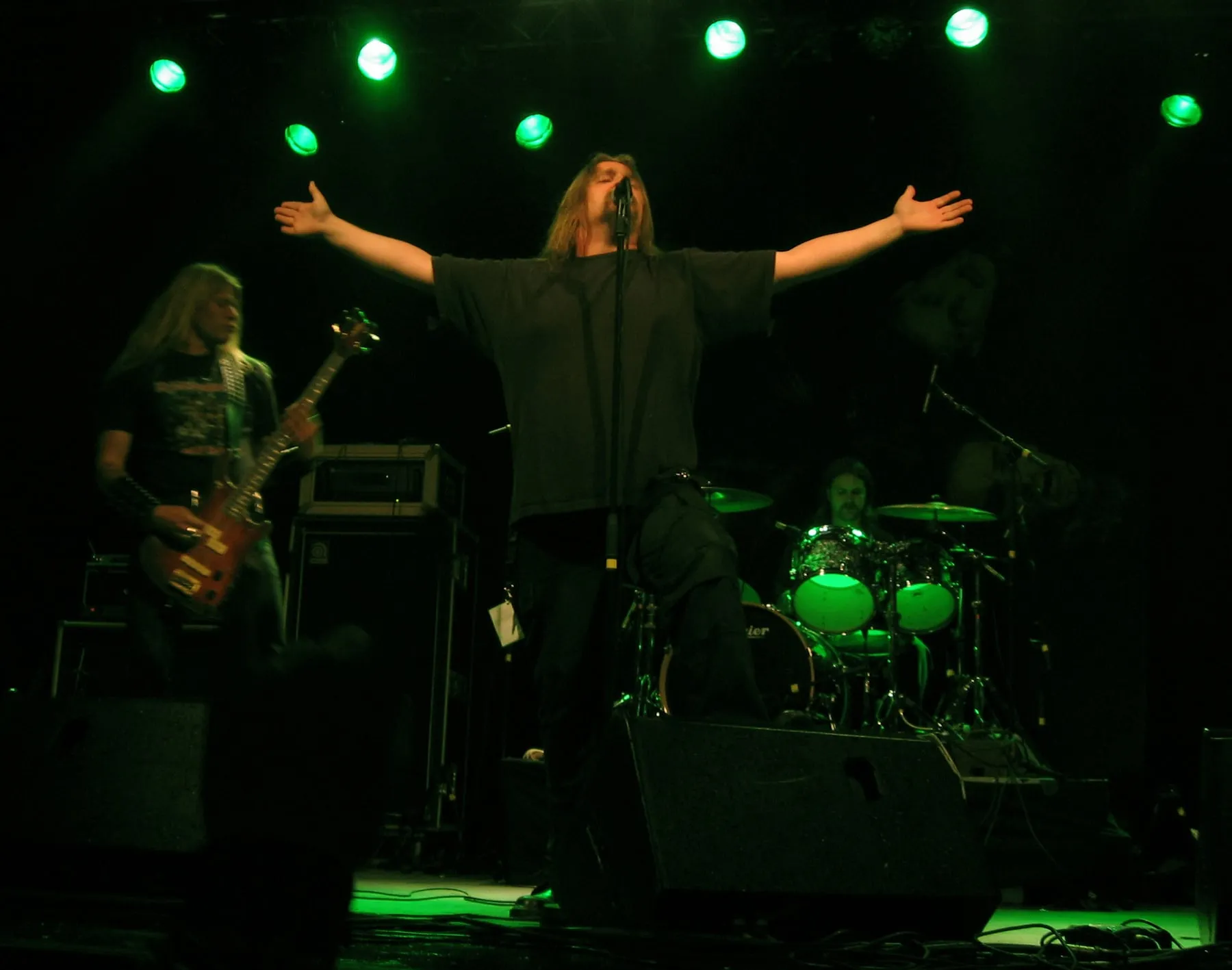
Photo by Mattias Hedström , licensed under CC BY-SA 2.5 · Wikimedia Commons
Rank #259
Dismember
Stockholm death-metal cornerstones alongside Entombed.
From Wikipedia
Dismember is a Swedish death metal band from Stockholm, formed in 1988. They split up in 2011 but reunited in 2019. Pioneers of Swedish death metal, Dismember is considered one of the country's "big four", alongside Entombed, Grave, and Unleashed.
Members
- Matti Kärki
Studio Albums
- 1991 Like an Ever Flowing Stream
- 1993 Indecent & Obscene
- 1995 Massive Killing Capacity
- 1997 Death Metal
- 2000 Hate Campaign
- 2004 Where Ironcrosses Grow
- 2006 The God That Never Was
- 2008 Dismember
Source: MusicBrainz
Deep Dive
Overview
Dismember is a Swedish death metal band from Stockholm, formed in 1988. They stand as one of the country’s most influential purveyors of the genre, counted among Sweden’s “big four” alongside Entombed, Grave, and Unleashed. Dismember helped define the Stockholm sound—a variant of death metal characterized by thick, distorted guitar tones, guttural vocals, and a compositional approach that balanced brutality with a dark, almost melodic undercurrent. Over a thirteen-year initial run ending in 2011, the band released eight studio albums that established them as central figures in the global death metal canon.
Formation Story
Dismember coalesced in Stockholm in 1988, emerging from the same underground metal scene that had begun to crystallize in Scandinavia during the late 1980s. The band arrived during a pivotal moment: thrash metal and early black metal were spreading through the region, but the distinctly Swedish approach to death metal—heavier, more mechanistic, and more produced than its American counterparts—was still taking shape. Formed by musicians immersed in that local ecosystem, Dismember quickly became one of the flagship acts representing Stockholm’s emerging death metal identity.
Breakthrough Moment
Dismember’s debut album, Like an Ever Flowing Stream (1991), announced their arrival as a fully formed force. Released when Swedish death metal was still consolidating its sound and international presence, the record showcased a band capable of writing structured, memorable death metal without sacrificing heaviness. The album’s production—clear enough to articulate the band’s intricate riffing but sufficiently dense to maintain crushing weight—became a template for the Stockholm sound. Like an Ever Flowing Stream established Dismember’s reputation domestically and began building their international profile, positioning them as essential participants in what was becoming a Swedish death metal export phenomenon.
Peak Era
Dismember’s creative and commercial peak extended through the 1990s and into the early 2000s. Albums including Indecent & Obscene (1993), Massive Killing Capacity (1995), Death Metal (1997), and Hate Campaign (2000) cemented their standing as consistent, prolific contributors to death metal. During this period, the band refined its distinctive approach: riffs that moved between grinding monotone passages and brief melodic flourishes, vocal performances from Matti Kärki that ranged from guttural growls to more articulate barks, and production values that never sacrificed clarity for atmosphere. Dismember’s work during these years demonstrated that Swedish death metal could sustain itself across multiple albums without retreading the same ground, proving that the genre was capable of depth and variation beyond shock value.
Musical Style
Dismember’s sound is rooted in death metal but carries distinct Swedish characteristics. The band’s guitar work emphasizes heavily distorted, downtuned riffs that often move in lockstep patterns, creating a grinding, relentless forward momentum. Rather than relying on chaotic blast-beat structures, Dismember favored more measured tempos and deliberate rhythmic progression, allowing riffs to register fully with the listener. Vocally, Matti Kärki delivered guttural, deep vocals—a hallmark of the Swedish scene—that contrasted with the more shrieked approach of some death metal contemporaries. The band’s songwriting showed attention to structure and dynamics; songs rarely disappeared into formless noise, instead building from slower, heavier sections into faster, more aggressive passages, then retreating again. This compositional discipline, combined with tight production that rendered every instrument audible, distinguished Dismember from looser, rawer approaches to death metal emerging elsewhere. Over time, the band’s style remained consistent, refining rather than radically redefining its core identity.
Major Albums
Like an Ever Flowing Stream (1991)
Dismember’s debut established the Swedish death metal template with its clarity of production, intricate riffing, and guttural vocal delivery. The album announced the band as a primary force in defining Stockholm’s emerging sound.
Indecent & Obscene (1993)
The follow-up demonstrated the band’s ability to sustain and develop their approach, moving beyond debut momentum with more confident songwriting and tighter arrangements.
Massive Killing Capacity (1995)
Released at the height of the 1990s death metal boom, this album showcased Dismember’s capacity for sustained heaviness and compositional variety across a full-length release.
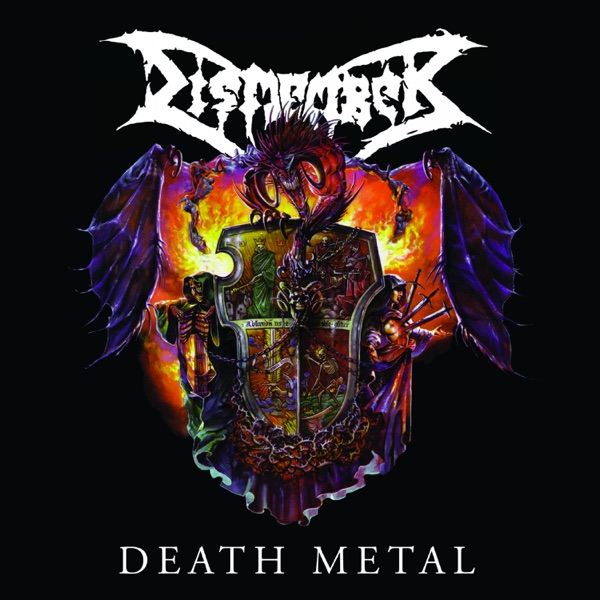
Death Metal (1997)
A self-referential title masked sophisticated songwriting; the album proved that a decade into their existence, Dismember remained vital and capable of producing engaging, substantive death metal.
Hate Campaign (2000)
The band’s fifth studio album marked another shift toward refinement, maintaining their core sound while exploring subtle variations in texture and pacing.
Signature Songs
- “Skinless” — An aggressive showcase for the band’s grinding riff style and Kärki’s guttural delivery.
- “In Darkness” — Demonstrates Dismember’s ability to balance relentless heaviness with compositional structure.
- “Pieces” — A mid-period track capturing the band’s capacity for memorable, memorable hooks within the death metal framework.
- “Misanthropia” — Exemplifies the darker lyrical and sonic palette that characterized the band’s later 1990s work.
Influence on Rock
Dismember’s primary legacy lies in establishing and promoting the Swedish death metal sound as a globally viable subgenre. They worked alongside Entombed, Grave, and Unleashed to create a distinctly Scandinavian approach to death metal—one emphasizing production clarity, compositional sophistication, and thick, downtunedguitar textures—that influenced death metal bands worldwide throughout the 1990s and into the 2000s. The emphasis on riff-driven, heavily produced death metal as opposed to raw or chaotic approaches became a Swedish export, shaping the expectations and capabilities of death metal musicians across Europe and North America. Dismember’s longevity across thirteen years of initial activity proved that death metal was capable of sustaining career-length artistic development rather than burning out after a debut or two.
Legacy
After dissolving in 2011, Dismember reunited in 2019, affirming the enduring appeal of their catalog and the band’s historical importance within death metal. Their eight studio albums from 1991 to 2008 remain widely available and continue to circulate among death metal enthusiasts and historians. The band’s work has become a touchstone for understanding 1990s Scandinavian metal, taught in the context of death metal’s geographic variants and treated as essential documentation of a particular moment in extreme music. Dismember’s influence extends beyond death metal proper into broader heavy metal and extreme music discourse; their records are frequently cited when discussing how subgenres achieve international reach, how bands balance commercial viability with artistic credibility, and how a regional sound—Swedish death metal—can become a globally recognized and emulated aesthetic.
Fun Facts
- Dismember has been signed to Regain Records, a Swedish label that became synonymous with the country’s death metal output.
- The band’s album Death Metal, released in 1997, takes its title directly from the genre itself, reflecting a confident, unironic embrace of their musical identity.
- After an eight-year gap following 2006’s The God That Never Was, Dismember released a self-titled album in 2008, titled simply Dismember, before entering their 2011 dissolution period.
- The band emerged from and remained based in Stockholm, a city that became synonymous with death metal production and export during the 1990s.
Discography & Previews
Click any album to expand its track list. Each track plays a 30-second preview streamed from Apple Music. Tap the link icon next to a track to open it in Apple Music for full playback.


- 1 Of Fire ↗ 3:41
- 2 Trendkiller ↗ 2:11
- 3 Misanthropic ↗ 2:59
- 4 Let the Napalm Rain ↗ 3:27
- 5 Live for the Fear (of Pain) ↗ 2:36
- 6 Stillborn Ways ↗ 4:15
- 7 Killing Compassion ↗ 1:49
- 8 Bred for War ↗ 4:20
- 9 When Hatred Killed the Light ↗ 3:31
- 10 Ceremonial Comedy ↗ 3:25
- 11 Silent are the Watchers ↗ 3:54
- 12 Mistweaver ↗ 4:08


- 1 The God That Never Was ↗ 2:09
- 2 Shadows of the Mutilated ↗ 3:26
- 3 Time Heals Nothing ↗ 3:40
- 4 Autopsy ↗ 3:39
- 5 Never Forget, Never Forgive ↗ 1:44
- 6 Trail of the Dead ↗ 3:14
- 7 Phantoms (of the Oath) ↗ 3:55
- 8 Into the Temple of Humiliation ↗ 4:08
- 9 Blood for Paradise ↗ 2:19
- 10 Feel the Darkness ↗ 3:39
- 11 Where No Ghost is Holy ↗ 3:40
