
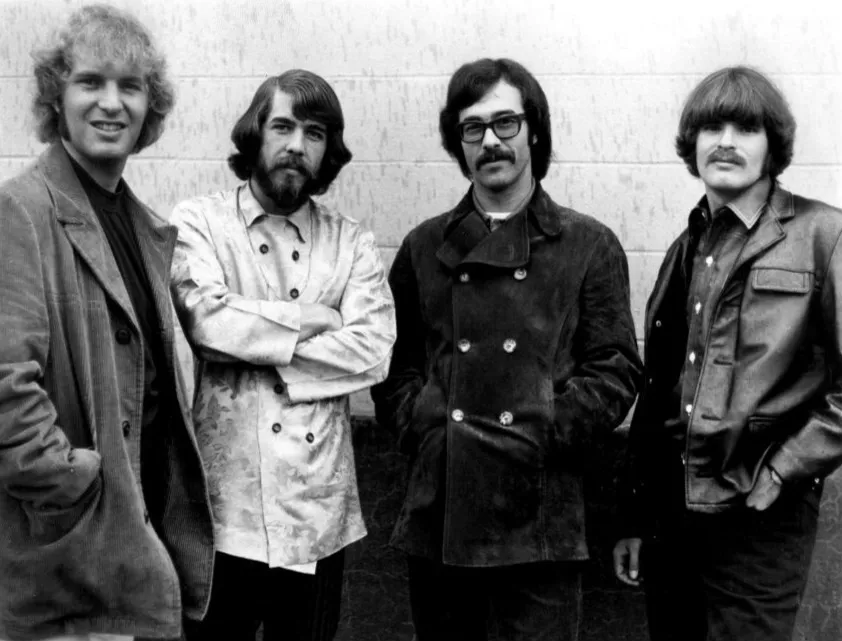
Photo by Fantasy Records , licensed under Public domain · Wikimedia Commons
Rank #70
Creedence Clearwater Revival
Bay Area swamp-rock kings who turned out hit after hit in just a few years.
From Wikipedia
Creedence Clearwater Revival, commonly abbreviated as CCR or simply Creedence, was an American rock band formed in El Cerrito, California, in 1959. The band consisted of the lead vocalist, lead guitarist, and primary songwriter John Fogerty; his brother, the rhythm guitarist Tom Fogerty; the bassist Stu Cook; and the drummer Doug Clifford. These members had played together since 1959, first as the Blue Velvets and later as the Golliwogs, before settling on Creedence Clearwater Revival in 1967. The band's most prolific and successful period, between 1969 and 1971, produced 14 consecutive top-10 singles and five consecutive top-10 albums in the United States, two of which—Green River (1969) and Cosmo's Factory (1970)—topped the Billboard 200 chart. The band performed at the 1969 Woodstock festival in upstate New York and was the first major act signed to appear there.
Members
- Doug Clifford
- John Fogerty
- Stu Cook
- Tom Fogerty
Studio Albums
- 1968 Creedence Clearwater Revival
- 1969 Willy and the Poor Boys
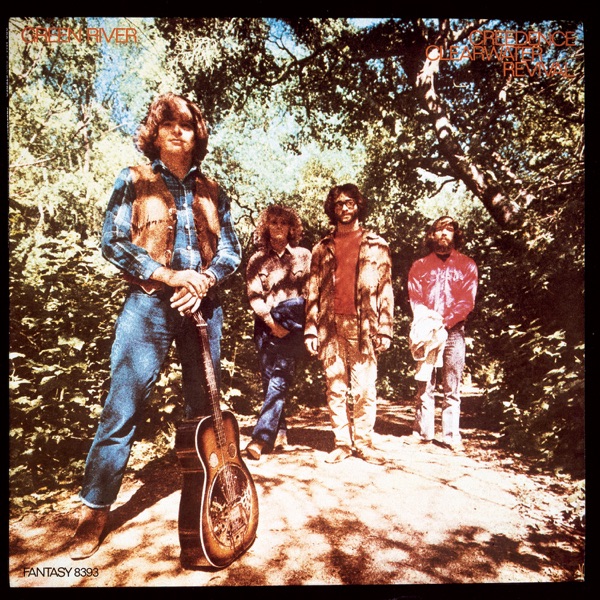
- 1969 Green River
- 1969 Bayou Country
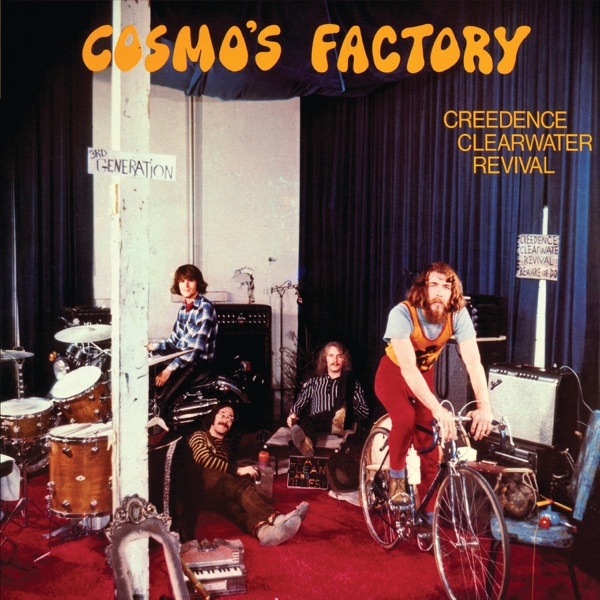
- 1970 Cosmo’s Factory
- 1970 Pendulum
- 1972 Mardi Gras
Source: MusicBrainz
Deep Dive
Overview
Creedence Clearwater Revival stands as one of the most commercially dominant rock bands of the late 1960s and early 1970s, a Bay Area quartet that turned out hits with remarkable consistency across just a few years. Formed in El Cerrito, California, and active from 1968 to 1972, CCR bridged the gap between roots music—blues, country, swamp rock—and the commercial mainstream of the rock radio era. Their appeal lay in direct songwriting, muscular instrumentation, and an earthy authenticity that set them apart from the psychedelic and progressive rock movements dominating the period.
Formation Story
The four members—John Fogerty on lead vocals and lead guitar, his brother Tom on rhythm guitar, Stu Cook on bass, and Doug Clifford on drums—had been playing together since 1959, long before Creedence Clearwater Revival became their name. The band initially performed as the Blue Velvets, then under the name the Golliwogs, establishing themselves in the San Francisco Bay Area music scene. They adopted the name Creedence Clearwater Revival in 1967 and signed to Fantasy Records, the label that would release all their studio output.
Breakthrough Moment
CCR’s initial self-titled album, Creedence Clearwater Revival, arrived in 1968 but was quickly overshadowed by their second release. Bayou Country, released in 1969, marked the true arrival of the band’s signature sound and commercial momentum. That same year, they performed at the 1969 Woodstock festival in upstate New York as the first major act signed to appear there, a performance that cemented their status as a central force in American rock. Green River, also released in 1969, became one of the band’s defining statements, topping the Billboard 200 and establishing them as a genuine chart force.
Peak Era
Between 1969 and 1971, Creedence Clearwater Revival entered a period of unparalleled commercial success. The band produced 14 consecutive top-10 singles on the Billboard Hot 100 and released five consecutive top-10 albums on the Billboard 200 chart. Green River (1969) and Cosmo’s Factory (1970) both reached number one on the album chart, while Pendulum (1970) continued the run of commercial dominance. This three-year stretch established CCR as the dominant rock band on radio and in record sales, a position few bands have matched over such a concentrated period.
Musical Style
Creedence Clearwater Revival’s sound drew from American roots traditions—delta blues, country music, swamp rock—but filtered through a rock and roll sensibility that made it radio-friendly without sacrificing authenticity. John Fogerty’s lead guitar work combined twangy country tones with rock directness, while the rhythm section of Cook and Clifford provided a propulsive, blues-inflected foundation. Lyrically, the band favored narrative songs grounded in everyday American imagery, often with a slightly nostalgic or satirical edge. The production, helmed by Fogerty’s songwriting and arrangement sense, was clean and punchy, designed for maximum impact on AM and FM radio. Tom Fogerty’s rhythm guitar added texture without overwhelming the mix, and the band’s overall approach emphasized groove and feel over technical display or experimental arrangement.
Major Albums
Bayou Country (1969)
The album that fully announced CCR’s arrival, Bayou Country established the swamp-rock template the band would refine over the next two years, combining blues-based guitar work with country and rock idioms into a cohesive statement.
Green River (1969)
One of CCR’s two chart-topping albums, Green River represented the band at their commercial and creative peak, with a string of singles that dominated radio and a cohesive album experience that justified the hits.
Cosmo’s Factory (1970)
The second number-one album, Cosmo’s Factory showcased the band’s expanded range and deepening command of various American musical styles, further solidifying their status as the decade’s most consistent hit-making machine.
Pendulum (1970)
Released the same year as Cosmo’s Factory, Pendulum continued the band’s streak of top-10 albums and demonstrated their ability to maintain quality and commercial appeal across multiple major releases in a single year.
Mardi Gras (1972)
The band’s final studio album before their split, Mardi Gras saw each member contribute lead vocals to several tracks, marking a shift in the songwriting and performance structure that had defined the earlier era.
Signature Songs
- “Proud Mary” — A cover that became one of CCR’s most recognizable hits, transforming a roots standard into a rock staple.
- “Bad Moon Rising” — A rollicking, folk-inflected single that showcased the band’s ability to merge country imagery with rock energy and accessibility.
- “Green River” — The title track and centerpiece of their breakthrough album, a blues-based rocker that exemplified their swamp-rock foundation.
- “Fortunate Son” — A socially conscious track that resonated with audiences navigating the cultural tensions of the Vietnam War era.
- “Traveling Band” — A high-energy rocker that captured the band’s live intensity and blues-rock credibility.
- “Lookin’ Out My Back Door” — A laid-back, groove-oriented single that demonstrated the band’s range beyond hard-charging rockers.
Influence on Rock
Creedence Clearwater Revival’s impact on rock music lay partly in their demonstration that commercially successful rock did not require either the pyrotechnic virtuosity of hard rock or the elaborate production of psychedelia. Their root-based approach—drawing on blues, country, and Americana without sacrificing radio appeal—influenced later generations of roots rockers and singer-songwriters who sought authenticity within a commercial framework. The band’s success on radio and in record sales proved that straightforward, groove-oriented rock with clear songwriting could compete with more experimental approaches. Their influence rippled through Southern rock, heartland rock, and the Americana tradition that would emerge more fully in subsequent decades.
Legacy
Creedence Clearwater Revival disbanded in 1972, ending their remarkable five-year run at the height of their commercial and creative powers. Their catalog remains deeply embedded in classic rock radio, and their combination of commercial dominance and cultural relevance has ensured ongoing interest from collectors, students of rock history, and general audiences. The band’s albums continue to be widely available and frequently reissued, their streaming presence remains strong, and their influence on how rock musicians approach roots material remains evident. Though reunions have been sporadic and complicated by internal tensions, the band’s studio work stands as a complete and compelling document of late-1960s and early-1970s American rock.
Fun Facts
- The band performed at the 1969 Woodstock festival as the first major act signed to appear there, helping establish the festival as a central event in rock history.
- Between 1969 and 1971, CCR achieved 14 consecutive top-10 singles on the Billboard Hot 100, one of the most remarkable chart streaks in rock history.
- All five of their consecutive top-10 albums were released within a three-year period, a concentration of commercial success that few bands have matched.
- The band members had been playing together since 1959 under different names before settling on Creedence Clearwater Revival in 1967.
Discography & Previews
Click any album to expand its track list. Each track plays a 30-second preview streamed from Apple Music. Tap the link icon next to a track to open it in Apple Music for full playback.



- 1 Ramble Tamble ↗ 7:11
- 2 Before You Accuse Me ↗ 3:27
- 3 Travelin Band ↗ 2:08
- 4 Ooby Dooby ↗ 2:07
- 5 Lookin' Out My Back Door ↗ 2:34
- 6 Run Through the Jungle ↗ 3:07
- 7 Up Around the Bend ↗ 2:42
- 8 My Baby Left Me ↗ 2:19
- 9 Who'll Stop the Rain ↗ 2:30
- 10 I Heard It Through the Grapevine ↗ 11:07
- 11 Long As I Can See the Light ↗ 3:33

