
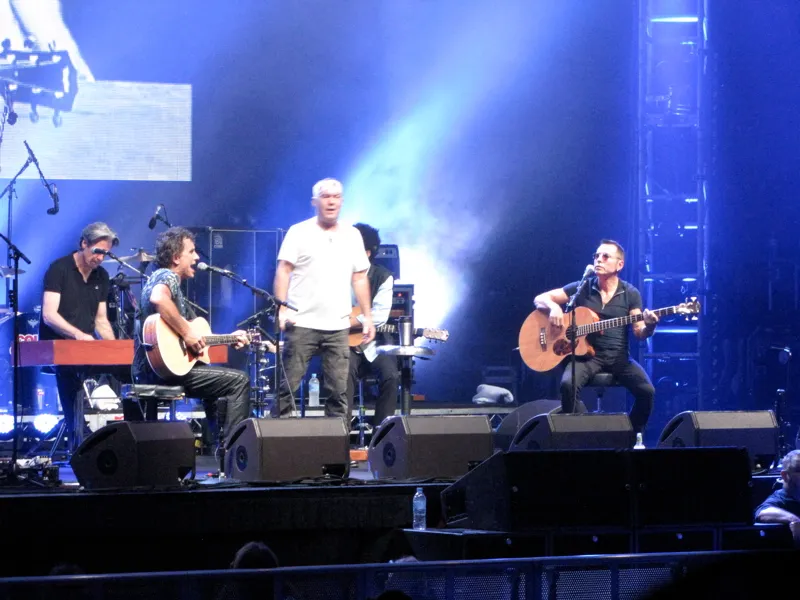
Photo by jeaneeem from Canberra, Australia , licensed under CC BY 2.0 · Wikimedia Commons
Rank #306
Cold Chisel
Adelaide pub-rock institution with deep cultural roots in Australia.
From Wikipedia
Cold Chisel are an Australian pub rock band, which formed in Adelaide in 1973 by mainstay members Ian Moss on guitar and vocals, Steve Prestwich on drums, Les Kaczmarek on bass and Don Walker on piano and keyboards. They were soon joined by Jimmy Barnes on lead vocals and, in 1975, Phil Small became their bass guitarist. The group disbanded in late 1983 but subsequently re-formed several times. Musicologist Ian McFarlane wrote that they became "one of Australia's best-loved groups" as well as "one of the best live bands", fusing "a combination of rockabilly, hard rock and rough-house soul'n'blues that was defiantly Australian in outlook."
Members
- Steve Prestwich
Studio Albums
- 1978 Cold Chisel
- 1979 Breakfast at Sweethearts
- 1980 East
- 1982 Circus Animals
- 1984 Twentieth Century
- 1998 The Last Wave of Summer
- 2012 No Plans
- 2015 The Perfect Crime
- 2019 Blood Moon
Source: MusicBrainz
Deep Dive
Overview
Cold Chisel are an Australian pub rock band that formed in Adelaide in 1973 and established themselves as one of the nation’s defining rock groups. Operating primarily across the 1970s and 1980s before their initial 1983 disbandment, the band fused rockabilly, hard rock, and rough-house soul and blues into a defiantly Australian sound. Their rise coincided with a broader shift in rock music toward rawer, venue-grounded authenticity, and they became emblematic of that movement within Australia’s cultural landscape.
Formation Story
Cold Chisel crystallized in Adelaide in 1973 around the core partnership of guitarist and vocalist Ian Moss and drummer Steve Prestwich. The early lineup also included bassist Les Kaczmarek and pianist Don Walker, whose keyboard work would distinguish the band’s approach from American hard rock templates. Jimmy Barnes joined as lead vocalist, adding a ferocious vocal presence, and in 1975 Phil Small replaced Kaczmarek on bass, solidifying the classic-era lineup. Adelaide’s pub circuit provided both their proving ground and their aesthetic template—the band built their reputation through relentless touring and live performance rather than studio artifice, a foundation that would define their identity for decades.
Breakthrough Moment
Cold Chisel’s debut album, Cold Chisel (1978), announced their arrival with force and directness. The record’s raw energy and Australian vernacular idiom distinguished them in a landscape dominated by imported sounds. Their subsequent albums Breakfast at Sweethearts (1979) and East (1980) deepened their commercial and critical foothold, establishing them as major touring attractions and radio presences. By the early 1980s, Cold Chisel had transcended pub-rock categorization to become one of Australia’s premier rock bands, filling concert halls and achieving sustained chart presence through a combination of studio presence and uncompromising live performance.
Peak Era
The band’s most creatively ambitious and commercially successful period spanned the early 1980s, anchored by the albums Circus Animals (1982) and Twentieth Century (1984). During this window, Cold Chisel refined their songwriting while maintaining the visceral directness that characterized their work. Their live reputation reached its apex during these years; musicologist Ian McFarlane identified them as “one of the best live bands,” a distinction earned through hundreds of performances that tested and sharpened their material. Internal tensions and changing market conditions led to their disbandment in late 1983, though Twentieth Century appeared in 1984, marking an endpoint and legacy statement simultaneously.
Musical Style
Cold Chisel’s sound drew from rockabilly’s twang and energy, American hard rock’s power and structure, and the blues’ emotional rawness. Don Walker’s piano and keyboard arrangements were crucial; rather than functioning as mere accompaniment, his playing added textural depth and harmonic sophistication that prevented the band’s harder moments from lapsing into one-dimensional bombast. Ian Moss’s guitar work ranged from blues-inflected lead playing to chunky rhythm parts, while Steve Prestwich’s drumming provided both precision and swung pocket playing. Jimmy Barnes’s vocals—initially a lead element, later layered with other voices—brought soul and grit; his yelling and intensity signaled emotional authenticity rather than technical display. The ensemble approach meant that no single instrument dominated; rather, they locked together in arrangements that prized interplay. Their defiantly Australian outlook manifested in lyrical content, vocal inflection, and a refusal to smooth regional edges for broader markets.
Major Albums
Cold Chisel (1978)
The band’s self-titled debut established the core sonic template and introduced their blues-rooted hard rock approach to a national audience with unpolished directness.
Breakfast at Sweethearts (1979)
Their second album deepened songwriting craft and consolidated their reputation as serious rock musicians, not novelty pub acts.
East (1980)
With East, Cold Chisel expanded their sonic palette while maintaining raw energy; the album marked their growing sophistication as arrangers and composers.
Circus Animals (1982)
This record represented the band at their creative and commercial peak, balancing ambitious arrangements with immediate, visceral impact and signaling their arrival among Australia’s premier rock bands.
Signature Songs
- “Khe Sanh” — A blues-inflected rock anthem that became one of the band’s most enduring songs and a touchstone of Australian rock identity.
- “Cheap Wine” — A harder-edged rocker showcasing the band’s ability to craft memorable hooks within a rough-textured framework.
- “You’ve Got It” — A showcase for the band’s melodic sophistication and emotional depth beneath their hard-rock exterior.
- “Saturday Night” — A driving pub-rock staple that captured their live energy in recorded form.
Influence on Rock
Cold Chisel demonstrated that substantial rock music could emerge from outside America and Britain’s primary cultural centers. Their success validated a homegrown Australian rock identity at a time when many antipodean bands either emulated Anglo-American models or pursued novelty directions. Their fusion of blues, rockabilly, and hard rock influenced subsequent Australian rock musicians who sought authenticity through local idiom rather than international convention. The band’s emphasis on live performance over studio gloss anticipated broader movements toward punk and post-punk sensibilities, though Cold Chisel remained rooted in blues structures and classic rock vocabulary. Their regional success and later comeback tours established a template for mid-career Australian rock bands navigating legacy, nostalgia, and continued creative ambition.
Legacy
Cold Chisel’s initial 1983 breakup ended their primary creative period, but their influence persisted through continuous touring and periodic reunions. The band’s reformation and subsequent studio albums—The Last Wave of Summer (1998), No Plans (2012), The Perfect Crime (2015), and Blood Moon (2019)—demonstrated sustained connection to live performance and audience. Their cultural standing in Australia remained substantial, grounded in both nostalgic reverence for their 1970s and early 1980s output and respect for their refusal to fade entirely. Cold Chisel remained emblematic of a particular moment in rock music when regional authenticity, live intensity, and blues-based hard rock converged into something genuinely distinctive. Their discography continues to circulate through streaming platforms and reissues, introducing successive generations to their unvarnished approach.
Fun Facts
- Cold Chisel released five studio albums across their initial 1973–1984 active period before reuniting decades later.
- The band’s name derived from a combination of words suggesting both precision and roughness, reflecting their musical balance between craft and raw power.
- Their Adelaide origins placed them at some distance from Australia’s larger rock centers in Sydney and Melbourne, giving them a regional identity that strengthened rather than weakened their appeal.
Discography & Previews
Click any album to expand its track list. Each track plays a 30-second preview streamed from Apple Music. Tap the link icon next to a track to open it in Apple Music for full playback.


- 1 Mr. Crown Prosecutor ↗ 3:20
- 2 The Things I Love In You ↗ 3:18
- 3 Baby's On Fire ↗ 3:05
- 4 This Time Round ↗ 5:06
- 5 Bal-A-Versailles ↗ 4:59
- 6 Yakuza Girls ↗ 2:25
- 7 Once Around the Sun ↗ 3:41
- 8 Somewhere In the Silence ↗ 3:58
- 9 By My Side ↗ 3:06
- 10 Water Into Wine ↗ 4:54
- 11 Never Stop Loving You ↗ 3:59
- 12 Red Sand ↗ 4:55
- 13 Angel In My Room ↗ 3:42
- 14 Pretty Little Thing ↗ 3:14
- 15 Someone Caught My Eye ↗ 4:16
- 16 He Can't Believe It's Over with You ↗ 3:53
- 17 Way Down ↗ 3:57
- 18 This Big Old Car ↗ 2:06
- 19 So Hard ↗ 3:49
- 20 The Last Wave of Summer ↗ 5:23

- 1 No Plans ↗ 2:36
- 2 Everybody ↗ 3:40
- 3 All for You ↗ 4:56
- 4 HQ454 Monroe ↗ 3:11
- 5 Dead and Laid to Rest ↗ 4:29
- 6 Missing a Girl ↗ 3:25
- 7 Too Late ↗ 4:29
- 8 I Gotta Get Back On the Road ↗ 5:51
- 9 Our Old Flame ↗ 3:42
- 10 This Day ↗ 3:13
- 11 Summer Moon ↗ 4:29
- 12 The Horizon ↗ 4:39
- 13 I Got Things to Do (Jimmy Vocal) ↗ 3:07

- 1 Alone for You ↗ 3:10
- 2 The Backroom ↗ 3:36
- 3 All Hell Broke Lucy ↗ 4:06
- 4 The Perfect Crime ↗ 2:41
- 5 Long Dark Road ↗ 4:34
- 6 Four In the Morning ↗ 5:23
- 7 The Mansions ↗ 3:13
- 8 The Toast of Paris ↗ 4:43
- 9 Shoot the Moon ↗ 3:30
- 10 Mexican Wedding ↗ 3:35
- 11 Get Lucky ↗ 3:03
- 12 Bus Station ↗ 5:13
- 13 Lost ↗ 4:06
