
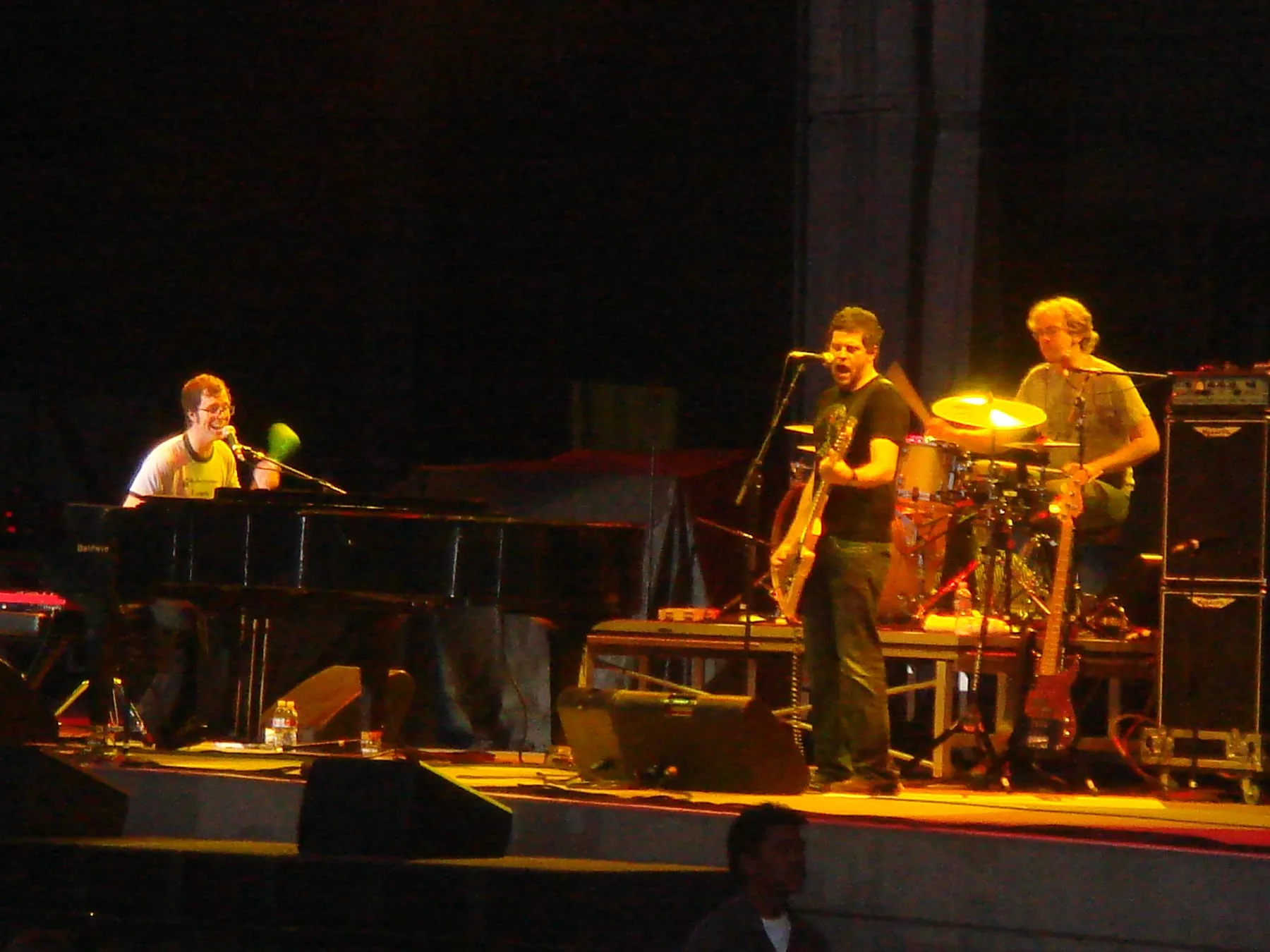
Photo by Kevin Tostado from San Diego, USA , licensed under CC BY 2.0 · Wikimedia Commons
Rank #420
Ben Folds Five
Chapel Hill piano-rock trio whose punkish virtuosity stood out in the 90s.
From Wikipedia
Ben Folds Five was an American alternative rock trio formed in 1993 in Chapel Hill, North Carolina. The group was composed of Ben Folds, Robert Sledge and Darren Jessee. The group achieved success in the alternative, indie and pop music scenes. Their single "Brick" from the second album, Whatever and Ever Amen (1997), gained airplay on many mainstream radio stations.
Members
- Ben Folds
Studio Albums
- 1995 Ben Folds Five
- 1997 Whatever and Ever Amen
- 1999 The Unauthorized Biography of Reinhold Messner
- 2012 The Sound of the Life of the Mind
- — Underground: Pre 1995 Demos
Source: MusicBrainz
Deep Dive
Overview
Ben Folds Five was an American alternative rock trio formed in 1993 in Chapel Hill, North Carolina. Composed of Ben Folds, Robert Sledge, and Darren Jessee, the group achieved significant success across alternative, indie, and pop music scenes throughout the 1990s and beyond. Built around Folds’ piano-driven songwriting and the trio’s disciplined instrumental interplay, they represented a distinctive strain of 1990s rock that rejected the guitar-heavy orthodoxy of grunge and post-grunge in favor of keyboard-centered arrangements and pop-influenced song structures executed with punk-derived energy.
Formation Story
The trio came together in Chapel Hill during 1993, a city with a modest but fertile independent music underground. Ben Folds anchored the group as pianist and primary songwriter, with Robert Sledge on bass and Darren Jessee on drums completing the core lineup. The decision to construct a rock band around piano rather than guitar was itself countercultural for the era; it placed them at a deliberate distance from the Seattle-centered aesthetic that dominated mainstream rock radio in the early-to-mid 1990s. Chapel Hill’s tradition of melodically sophisticated indie pop, exemplified by groups like Superchunk, provided a local context for the band’s blend of accessibility and instrumental ambition.
Breakthrough Moment
The group’s initial self-titled album arrived in 1995 on the Caroline Records label, establishing their core sound but without breaking through to mainstream awareness. The genuine breakthrough came with their second album, Whatever and Ever Amen, released in 1997. That record’s single “Brick,” a meticulously arranged song structured around Folds’ piano work and featuring sophisticated harmonic changes unusual for alternative radio, gained airplay on many mainstream radio stations. This penetration into mainstream formats marked a turning point: the trio had proved that a piano-trio format could succeed in rock radio without diluting its musical intelligence or compositional complexity.
Peak Era
The late 1990s represented the group’s creative and commercial peak. Following the success of Whatever and Ever Amen, the band released The Unauthorized Biography of Reinhold Messner in 1999, solidifying their reputation as major figures in alternative rock. During this three-to-four-year window (1997–1999), Ben Folds Five moved from underground cult status to a position where they could command substantial festival slots, touring opportunities, and radio presence. Their ability to fill venues and maintain critical credibility during an era when alternative rock was rapidly fragmenting into multiple subgenres demonstrated the strength of their core audience and the timelessness of their songwriting approach.
Musical Style
Ben Folds Five’s sound was defined by the interaction between Folds’ classical-training-informed piano technique and the rhythmic discipline of Sledge’s bass and Jessee’s drums. In rock music of the 1990s, this instrumentation was unusual; most rock trios of the era featured guitar, bass, and drums. The piano provided harmonic density and melodic sophistication often associated with pop songwriting, yet Folds deployed it with the intensity and dynamic range of a rock musician. Structurally, many Ben Folds Five songs rejected verse-chorus-verse symmetry in favor of through-composed arrangements that shifted perspective, tempo, or harmonic context mid-song. The vocal delivery was typically direct and emotionally conversational rather than operatic or heavily processed, allowing lyrical specificity to come forward. Over their active period, the group’s arrangements became progressively more layered and studio-craft-intensive, moving from the relatively straightforward piano-bass-drums interplay of their debut toward denser, more orchestrated textures by the late 1990s.
Major Albums
Ben Folds Five (1995)
The trio’s debut introduced their core formula: witty, emotionally astute lyrics married to complicated piano-driven arrangements executed by a three-piece with rhythmic precision. Tracks alternated between introspective ballads and uptempo numbers that moved with pop hooks beneath surfaces of harmonic complexity.
Whatever and Ever Amen (1997)
Their commercial and critical breakthrough, this album refined the group’s approach while expanding its emotional range. The single “Brick” brought their music to mainstream radio, but the album’s strength lay in its consistency across styles, from confessional piano ballads to propulsive pop-rock numbers.
The Unauthorized Biography of Reinhold Messner (1999)
The third album saw the band deepening instrumental and production ambitions, incorporating orchestral elements and exploring more experimental song structures. It consolidated their status as major figures in 1990s alternative rock.
The Sound of the Life of the Mind (2012)
Released after a multi-year hiatus, this album marked the band’s return to recording and documented their continued evolution. It demonstrated that the core songwriting partnership remained creatively viable in a changed musical landscape.
Signature Songs
- “Brick” — The breakthrough single that brought the group’s piano-centric alternative rock to mainstream radio, built around Folds’ intricate keyboard work and emotionally specific lyrics.
- “Underground” — A signature example of the band’s ability to construct complex, multi-section arrangements that reject conventional pop song structure.
- “Not the Same” — Demonstrates the trio’s gift for melodic pop sensibility filtered through their distinctive instrumental approach.
- “Army” — Showcases Folds’ ability to balance pop accessibility with structural complexity and emotional specificity.
Influence on Rock
Ben Folds Five arrived at a moment when 1990s alternative rock was becoming increasingly genre-fragmented, and their success demonstrated that sophisticated pop songwriting and keyboard-forward arrangements could find substantial audiences within rock contexts. They influenced a subsequent generation of indie and alternative rock musicians who rejected guitar-centricity, paving the way for keyboard-driven acts throughout the 2000s. More broadly, they demonstrated that virtuosity and compositional complexity need not alienate rock audiences; their ability to write memorable hooks and emotionally direct lyrics within intricate harmonic and structural frameworks validated a particular approach to rock songwriting that blended classical music literacy with punk-derived energy and pop accessibility.
Legacy
Ben Folds Five’s impact on 1990s alternative rock remains significant. The group has remained sporadically active beyond their initial run, releasing new material in the 2010s and maintaining a presence in rock music culture. “Brick” has become a canonical alternative rock single, its particular combination of emotional specificity, musical sophistication, and accessibility exemplifying the strengths of the band’s approach. The trio’s success helped establish piano-driven rock as a viable alternative to the guitar-dominated formats that had dominated rock radio, influencing artists across multiple genres to incorporate keyboard instruments as primary rather than secondary elements. Their music continues to circulate on streaming platforms and remains a touchstone for understanding 1990s alternative rock’s diversity and range.
Fun Facts
- The band’s name deliberately omits the definite article, styled as “Ben Folds Five” rather than “The Ben Folds Five,” an unusual formatting choice in rock band nomenclature.
- Ben Folds’ classical piano training provided the technical foundation for the band’s unusually complex harmonic arrangements, a rarity in rock music of the 1990s.
- “Brick,” the band’s biggest hit, became a staple of mainstream rock radio rotation despite its unconventional structure and subject matter, demonstrating crossover appeal that surprised many industry observers at the time.
Discography & Previews
Click any album to expand its track list. Each track plays a 30-second preview streamed from Apple Music. Tap the link icon next to a track to open it in Apple Music for full playback.


- 1 One Angry Dwarf and 200 Solemn Faces ↗ 3:52
- 2 Fair ↗ 5:56
- 3 Brick ↗ 4:31
- 4 Song for the Dumped ↗ 3:40
- 5 Selfless, Cold and Composed ↗ 6:10
- 6 Kate ↗ 3:13
- 7 Smoke ↗ 4:52
- 8 Cigarette ↗ 1:38
- 9 Steven's Last Night In Town ↗ 3:27
- 10 Battle of Who Could Care Less ↗ 3:16
- 11 Missing the War ↗ 4:19
- 12 Evaporated ↗ 4:26

